
Air Liquide Healthcare EP Grade (medical air) 100% v/v Gas Cylinder
Brand Information
| Brand name | Air Liquide Healthcare EP Grade (medical air) 100% v/v Gas Cylinder |
| Active ingredient | Air |
| Schedule | Unscheduled |
Consumer Medicine Information (CMI) leaflet
Please read this leaflet carefully before you start using the Air Liquide Healthcare EP Grade (medical air) 100% v/v Gas Cylinder.
What is in this leaflet?
This leaflet answers some common questions about Medicinal Air. It contains only some information, and does not take the place of talking to your doctor or appropriate healthcare professional.
If you have any questions about using Medicinal Air, ask your doctor.
Keep this leaflet with you as you may want to read it again.
What Medicinal Air is used for?
Medicinal Air is indicated for respiratory assistance.
- For normal respiration
- In anaesthetic equipment as a carrier gas during surgery
- For nebulisation of inhaled drugs when oxygen supplementation is not required.
It is usually given by a doctor, dentist, ambulance officer or nurse via a mask or nasal prongs.
Your doctor may prescribe Medicinal Air for another purpose. Ask your doctor if you have any questions about why Medicinal Air has been prescribed for you.
Before you use Medicinal Air
When you must not use it
WARNING:
MEDICINAL AIR WILL BOOST BURNING AND MAY INCREASE THE CHANCE OF FIRE.
DO NOT SMOKE
DO NOT PLACE NEAR FLAMES or HEAT SOURCES
DO NOT USE OIL OR GREASE
Do not use Medicinal Air if the cylinder is damaged
Before you start to use it
Care should be taken when using Medicinal Air because it is stored at high pressure in the gas cylinder.
Secure cylinders by appropriate means (chains, hooks) in order to keep them upright and prevent them from falling over.
Do not use an adaptor or connector to connect devices that do not normally fit.
Never stand facing the valve outlet, always stand opposite the pressure reducing valve some distance behind the cylinder
Check before first use that the tamper evident seal is intact.
How to use Medicinal Air
Medicinal Air should only be used under the supervision of your doctor or healthcare professional for ventilatory or nebulisation purposes.
How much to use and how to use it
The amount of Medicinal Air you need will be decided by your doctor. It is given by breathing it through a mask or nasal prongs.
Follow all directions given to you by your doctor carefully, and do not modify the flow of Medicinal Air.
If you do not understand the instructions, ask your doctor for help.
How long to use it?
Your doctor will decide how long you need to use Medicinal Air.
After you have used Medicinal Air
Things you must not do
You must not smoke, or be near naked flames such as candles, gas stoves etc or sources of fire such as matches or lighters.
Side effects
There are no known side effects for medicinal air
Tell your doctor as soon as possible if you do not feel well while you are using Medicinal Air.
Tell your doctor immediately if:
You notice anything that is making you feel unwell or go to casualty at your nearest hospital.
After using Medicinal Air
Storage
Medicinal Air is stored as a compressed gas in cylinders.
For safety, store cylinders in well ventilated areas and not in small enclosed spaces.
Disposal
Do not discard empty or damaged cylinders.
All cylinders are to be returned to the supplier whose details are on the product label.
Product Description
What it looks like
Medicinal Air is an odourless, colourless gas.
Ingredients
Active Ingredient:
Air
Excipients:
None
Dosage form
Regulated gas inhalation in prescribed litres per minute (L/min).
Cylinder Packages
As a minimum each cylinder package contains 100 % medicinal Air.
Package:
- Steel or aluminium cylinders
- White body
- black and white shoulder quadrants.
Not all cylinder packages and volumes may be marketed
Name and Address of Sponsor
Air Liquide Healthcare Pty Limited
Air Liquide Australia Pty Ltd
Royal Domain Centre
380 St Kilda Road
Melbourne, VIC, 3004
Australian Registration Number
Air - AUST R 97748 (Compressed)
This leaflet was prepared on May 2019.
Version Number: 1
Brand Information
| Brand name | Air Liquide Healthcare EP Grade (medical air) 100% v/v Gas Cylinder |
| Active ingredient | Air |
| Schedule | Unscheduled |
MIMS Revision Date: 01 November 2019
1 Name of Medicine
Medicinal Air 100% v/v.
2 Qualitative and Quantitative Composition
Medicinal Air contains approximately 20.4% v/v - 21.4% v/v oxygen, 78% nitrogen and 1% argon with trace elements of other gases (xenon, neon, krypton).
Excipients. None.
3 Pharmaceutical Form
Compressed medicinal gas for inhalation.
4 Clinical Particulars
4.1 Therapeutic Indications
The current therapeutic applications of Medicinal Air are:
For normal respiration.
In anaesthetic equipment as a carrier gas during surgery.
For nebulisation of inhaled drugs when oxygen supplementation is not required.
4.2 Dose and Method of Administration
Medicinal Air is administered as follows:
For breathing purposes supported by a ventilator.
In anaesthetic equipment as a carrier gas.
4.3 Contraindications
None known.
4.4 Special Warnings and Precautions for Use
Precautions for use in children and infants. Children differ from adults in more than just size: they have for example different breathing patterns, tidal volumes and airways geometry. Careful attention should be brought to the features to be applied to the driving gas, in case of mechanical ventilation or nebulization in children and infants.
Use in the elderly. Not available.
Paediatric use. Not available.
Effects on laboratory tests. Not available.
General handling and instructions for use. Check the state of the material before use.
Do not handle a cylinder with a valve unprotected by a cap.
Handle with clean, grease-free hands.
Secure the cylinders by appropriate means (chains, hooks) in order to keep them upright and prevent them from falling over. Do not use them if the pressure is below 10 bar.
Never force a cylinder into a stand which it fits with difficulty.
Do not pick up a cylinder by its valve.
Do not use an adaptor connector to connect two devices that don't normally fit.
Never stand facing the valve outlet but always on the side opposite the pressure reducing valve some distance behind the cylinder. Never expose the patient face to the valve.
Check first the compatibility of materials in contact with the medicinal air and in particular use valve ports that are designed for this mixture.
Check after delivery by the manufacturer that the tamper-proofing system is intact.
Do not smoke. Do not place near a flame. Do not grease.
In particular, never introduce the gas into an apparatus that may have contained combustible materials and in particular fats and never clean equipment containing this gas, taps, joints, fittings, closing devices and valves with combustible products and in particular fats.
Do not coat the patient's face with grease (Vaseline, ointments).
Do not use sprays (hairspray, deodorant), solvents (alcohol, essential oils), on the material or nearby.
Close the gas cylinder valve after use, allow the pressure regulating valve reading to fall by leaving the flow meter open, then close the flow meter and unscrew the pressure-reducing valve adjustment screw.
Never try to repair a faulty valve.
Do not transfer gas under pressure from one cylinder to another.
Never tighten the pressure-reducing valve with pliers as this may damage the joint.
In the case of a leak, close the leaky valve, well ventilate the room and evacuate it.
Never use a cylinder with a leak.
Never completely empty a cylinder and always leave a minimum pressure of 10 bars.
Keep empty cylinders upright, valves closed (to prevent corrosion in the presence of moisture).
4.5 Interactions with Other Medicines and Other Forms of Interactions
None known.
4.6 Fertility, Pregnancy and Lactation
Effects on fertility. No data available.
Use in pregnancy. No data available.
Use in lactation. No data available.
4.7 Effects on Ability to Drive and Use Machines
Not applicable.
4.8 Adverse Effects (Undesirable Effects)
None known. There are no adverse interactions with other drugs.
Adverse effects due to use of medicinal air are rather related to the technical use of mechanical ventilation or nebulization.
4.9 Overdose
Over dosage is not an issue as Air Medicinal is compressed and purified air.
5 Pharmacological Properties
5.1 Pharmacodynamic Properties
Pharmacotherapeutic group: gas for inhalation.
ATC code: V03AN.
The active substance, air, is one of the basic essentials of maintenance of life. The pharmacodynamic effect of medicinal air is linked to the physiological respiration.
Air normally contains approximately 21% oxygen, equivalent (at normal barometric pressure) to a partial pressure of 159 mmHg. The aim of the respiratory physiology is to maintain enough available oxygen for the metabolic demands of the tissues.
Clinical efficacy. In patients with pathologic conditions requiring mechanical ventilation, or in patients requiring aerosol-therapy, medicinal air is used as gas to supply respirators, to improve gas exchange, to reduce the work of breathing of patients or to administer a drug to the airways, by the mean of nebulization.
Use of medicinal air in clinical practice is strongly linked to the technical use of mechanical ventilation and nebulization devices.
Clinical trials. No data available.
5.2 Pharmacokinetic Properties
The uptake, distribution and metabolism of air are driven by the actual respiratory physiology in the body. During breathing, oxygen is moved with inspired air to the lung, where it diffuses into blood. The blood then transfers oxygen to the tissues: O2 diffuses into mitochondria (structures in cells responsible for energy production) and is available for the metabolic needs. The CO2 produced at this place follows the opposite way.
5.3 Preclinical Safety Data
No known significant data.
6 Pharmaceutical Particulars
6.1 List of Excipients
No excipients.
6.2 Incompatibilities
Where moisturising preparations are required for use with a facemask or in nasal passages etc., avoid using oil based creams. If in doubt, check with the manufacturer to ensure that the product of choice is suitable for use with medicinal air.
Under no circumstances should oils or grease be used to lubricate any part of the medicinal air cylinder or the associated equipment used to deliver the gas to the patient. Always ensure hands are clean and free from any oils or grease.
Electrical equipment capable of sparking or generating extreme heat should not be used in the vicinity of patients receiving oxygen.
6.3 Shelf Life
In Australia, information on the shelf life can be found on the public summary of the Australian Register of Therapeutic Goods (ARTG).
6.4 Special Precautions for Storage
Keep cylinders away from sources of artificial heat.
Do not use oil or grease.
Use with suitable pressure reducing regulator.
All regulations concerning handling of pressure vessels must be followed.
Air is a comburent gas, which can form flammable and explosive mixtures with combustibles gases.
Gas cylinders must be stored in storage area specially provided for the purpose. The storage area must be ventilated.
If they are placed along a personnel passageway, they must be prevented from falling by means or chains.
Full cylinders and empty cylinders have to be storage in separated and identified zones. The storage area cannot reach a temperature up to 50°C.
Whether empty or full, all cylinders in the storage area must be equipped with their valve protection caps and valve closed.
Cylinders must not be subjected to violent impact. If, after an accidental collision, a cylinder exhibits local deformation or a notch, even shallow, it should be considered as hazardous and removed from use. It must be returned to the supplier with notification of the damage.
6.5 Nature and Contents of Container
Medicinal Air is supplied in aluminium or steel cylinders with a white body with a shoulder containing a black and white sector.
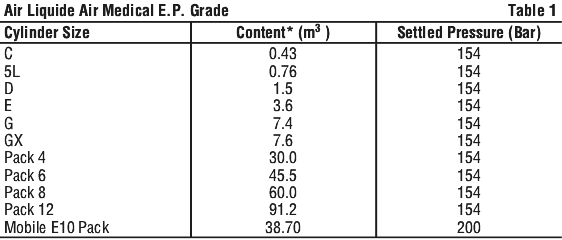
Medicinal Air is presented in gas cylinders and cylinder packs with the following gas content nominal fill pressure. (See Table 1.)
6.6 Special Precautions for Disposal
Not applicable.
6.7 Physicochemical Properties
Medicinal Air is a colourless, odourless gas with a molecular weight of 29.0, a boiling point of 194°C (at 101.325 kPa) and a density of 1.225 kg/m3 (at 15°C and 101.325 kPa).
7 Medicine Schedule (Poisons Standard)
Unscheduled.
Date of First Approval
24 March 2003
Date of Revision
22 August 2019
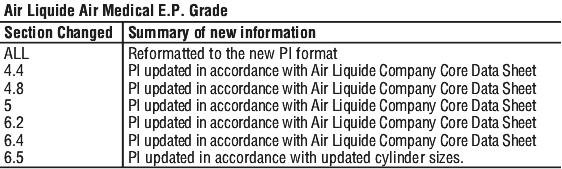
Summary Table of Changes
Reasonable care is taken to provide accurate information at the time of creation. This information is not intended as a substitute for medical advice and should not be exclusively relied on to manage or diagnose a medical condition. The Australian Commission on Safety and Quality in Health Care disclaims all liability (including for negligence) for any loss, damage, injury or any other negative effects resulting from reliance on or use of this information. Read our full disclaimer. This website uses cookies. Read our privacy policy.