
Chlorhexidine and Cetrimide Irrigation Solution
Brand Information
| Brand name | Chlorhexidine and Cetrimide Irrigation Solution |
| Active ingredient | Chlorhexidine gluconate + Cetrimide |
| Schedule | Unscheduled |
Consumer Medicine Information (CMI) leaflet
Please read this leaflet carefully before you start using the Chlorhexidine and Cetrimide Irrigation Solution.
Summary CMI
Chlorhexidine and Cetrimide Irrigation Solution
Consumer Medicine Information (CMI) summary
The full CMI on the next page has more details. If you are worried about using this medicine, speak to your doctor or pharmacist.
1. Why am I using Chlorhexidine and Cetrimide Irrigation Solution?
Chlorhexidine and Cetrimide Irrigation Solution contains the active ingredients chlorhexidine gluconate and cetrimide. Chlorhexidine and Cetrimide Irrigation Solution is used for cleansing and irrigating the skin or dirty wounds.
For more information, see Section 1. Why am I using Chlorhexidine and Cetrimide Irrigation Solution? in the full CMI.
2. What should I know before I use Chlorhexidine and Cetrimide Irrigation Solution?
Do not use if you have ever had an allergic reaction to Chlorhexidine and Cetrimide Irrigation Solution or any of the ingredients listed at the end of the CMI.
Talk to your doctor if you have any other medical conditions, take any other medicines, or are pregnant or plan to become pregnant or are breastfeeding.
For more information, see Section 2. What should I know before I use Chlorhexidine and Cetrimide Irrigation Solution? in the full CMI.
3. What if I am taking other medicines?
Some medicines may interfere with Chlorhexidine and Cetrimide Irrigation Solution and affect how it works.
A list of these medicines is in Section 3. What if I am taking other medicines? in the full CMI.
4. How do I use Chlorhexidine and Cetrimide Irrigation Solution?
- Your doctor or nurse will decide how much of the irrigation to use which will be sufficient for your needs and conditions. It is for external use only and should not be injected or swallowed. It should not be used in the eyes or ears.
More instructions can be found in Section 4. How do I use Chlorhexidine and Cetrimide Irrigation Solution? in the full CMI.
5. What should I know while using Chlorhexidine and Cetrimide Irrigation Solution?
| Things you should do |
|
| Looking after your medicine |
|
For more information, see Section 5. What should I know while using Chlorhexidine and Cetrimide Irrigation Solution? in the full CMI.
6. Are there any side effects?
Common side effects include skin rash, skin reaction, allergic reaction, slower wound healing.
For more information, including what to do if you have any side effects, see Section 6. Are there any side effects? in the full CMI.
Full CMI
Chlorhexidine and Cetrimide Irrigation Solution
Active ingredient(s): chlorhexidine gluconate & cetrimide
Consumer Medicine Information (CMI)
This leaflet provides important information about using Chlorhexidine and Cetrimide Irrigation Solution. You should also speak to your doctor or pharmacist if you would like further information or if you have any concerns or questions about using Chlorhexidine and Cetrimide Irrigation Solution.
Where to find information in this leaflet:
1. Why am I using Chlorhexidine and Cetrimide Irrigation Solution?
2. What should I know before I use Chlorhexidine and Cetrimide Irrigation Solution?
3. What if I am taking other medicines?
4. How do I use Chlorhexidine and Cetrimide Irrigation Solution?
5. What should I know while using Chlorhexidine and Cetrimide Irrigation Solution?
6. Are there any side effects?
7. Product details
1. Why am I using Chlorhexidine and Cetrimide Irrigation Solution?
Chlorhexidine and Cetrimide Irrigation Solution contains the active ingredients chlorhexidine gluconate and cetrimide. Chlorhexidine and Cetrimide Irrigation Solution contains antiseptics which will help prevent infection.
Chlorhexidine and Cetrimide Irrigation Solution is used for cleansing and irrigating the skin or dirty wounds.
2. What should I know before I use Chlorhexidine and Cetrimide Irrigation Solution?
Warnings
Do not use Chlorhexidine and Cetrimide Irrigation Solution if:
- you are allergic to chlorhexidine, cetrimide, or any of the ingredients listed at the end of this leaflet.
- Always check the ingredients to make sure you can use this medicine.
- The expiry date (EXP) printed on the label has passed. It may have no effect at all, or worse, an entirely unexpected effect if you use it after the expiry date.
- The packaging is torn or shows signs of tampering.
- Wounds may take longer to heal if cetrimide is used regularly. Therefore, it is important to use this product as directed by the doctor.
Check with your doctor if you:
- have allergies to chlorhexidine, cetrimide or any of the ingredients listed at the end of this leaflet
- have allergies to any other substances, such as foods, preservatives or dyes
- If you have an allergic reaction, you may get a skin rash.
During treatment, you may be at risk of developing certain side effects. It is important you understand these risks and how to monitor for them. See additional information under Section 6. Are there any side effects?
Pregnancy and breastfeeding
Check with your doctor if you are pregnant or intend to become pregnant.
Talk to your doctor if you are breastfeeding or intend to breastfeed.
3. What if I am taking other medicines?
Tell your doctor or pharmacist if you are taking any other medicines, including any medicines, vitamins or supplements that you buy without a prescription from your pharmacy, supermarket or health food shop.
Check with your doctor or pharmacist if you are not sure about what medicines, vitamins or supplements you are taking and if these affect Chlorhexidine and Cetrimide Irrigation Solution.
4. How do I use Chlorhexidine and Cetrimide Irrigation Solution?
How much to use
- Your doctor or nurse will normally use this irrigation to wash and clean your skin and wounds.
- It is for external use only and should not be injected or swallowed. It should not be used in the eyes or ears.
- Your doctor or nurse will decide how much of the irrigation to use which will be sufficient for your needs. As each irrigation is sterile, your doctor will use a new solution each time.
- If you are given this product to use at home it must be used as directed by your doctor or nurse.
- Rinse the area to be cleaned with water, then use the smallest amount of irrigation to gently wash the area.
- Rinse again with water thoroughly.
- Use a new solution each time.
When to use
- Chlorhexidine and Cetrimide Irrigation Solution should be used as directed by the doctor or nurse.
If you use too much
As your doctor or nurse will administer this irrigation, they will use the correct amount. As it is for external use only, it is unlikely an overdose will occur.
If you think that someone may have swallowed Chlorhexidine Irrigation Solution or if it has been put into the eyes or ears, you should immediately:
- phone the Poisons Information Centre
(by calling 13 11 26), or - contact your doctor, or
- go to the Emergency Department at your nearest hospital.
You should do this even if there are no signs of discomfort or poisoning.
5. What should I know while using Chlorhexidine and Cetrimide Irrigation Solution?
Things you should do
- If you are given this product to use at home, it must be used as directed by your doctor or nurse.
- Discard any unused portion. Chlorhexidine and Cetrimide Irrigation Solution is for single use only.
Call your doctor straight away if you:
- Develop any allergic or hypersensitivity reactions or anaphylaxis to Chlorhexidine and Cetrimide Irrigation Solution.
Things you should not do
- Do not use in the eyes or ears or as enema.
- Do not swallow or inject into your body.
Looking after your medicine
- Store below 25°C and protected from light.
Store it in a cool dry place away from moisture, heat or sunlight; for example, do not store it:
- in the bathroom or near a sink, or
- in the car or on window sills.
Keep it where young children cannot reach it.
Getting rid of any unwanted medicine
If you no longer need to use this medicine or it is out of date, take it to any pharmacy for safe disposal.
Do not use this medicine after the expiry date.
6. Are there any side effects?
All medicines can have side effects. If you do experience any side effects, most of them are minor and temporary. However, some side effects may need medical attention.
See the information below and, if you need to, ask your doctor, nurse, or pharmacist if you have any further questions about side effects.
Less serious side effects
| Less serious side effects | What to do |
| Speak to your doctor if you have any of these less serious side effects and they worry you. |
Serious side effects
| Serious side effects | What to do |
| Call your doctor straight away, or go straight to the Emergency Department at your nearest hospital if you notice any of these serious side effects. |
Tell your doctor, nurse or pharmacist if you notice anything else that may be making you feel unwell during or after Chlorhexidine and Cetrimide Irrigation Solution has been used.
Other side effects not listed here may occur in some people.
Reporting side effects
After you have received medical advice for any side effects you experience, you can report side effects to the Therapeutic Goods Administration online at www.tga.gov.au/reporting-problems. By reporting side effects, you can help provide more information on the safety of this medicine.
Always make sure you speak to your doctor, nurse, or pharmacist before you decide to stop taking any of your medicines.
7. Product details
What Chlorhexidine and Cetrimide Irrigation Solution contains
| Active ingredient (main ingredient) |
|
| Other ingredients (inactive ingredients) |
|
Tell your doctor or nurse if you are allergic to any of these ingredients.
What Chlorhexidine and Cetrimide Irrigation Solution looks like
Chlorhexidine and Cetrimide Irrigation Solution is a sterile, orange solution and comes in a 30 mL plastic ampoule in packs of 30 units.
Chlorhexidine 0.015% and Cetrimide 0.15% Irrigation solution ampoule (AUST R 57021)
Chlorhexidine 0.05% and Cetrimide 0.5% Irrigation solution ampoule (AUST R 57011)
Who distributes Chlorhexidine and Cetrimide Irrigation Solution
Bridgewest Perth Pharma Pty Ltd
15 Brodie Hall Drive
Bentley WA 6102
Telephone: 1800 161 156
safety@lumacina.com
This leaflet was prepared in September 2023.
Brand Information
| Brand name | Chlorhexidine and Cetrimide Irrigation Solution |
| Active ingredient | Chlorhexidine gluconate + Cetrimide |
| Schedule | Unscheduled |
MIMS Revision Date: 01 November 2023
1 Name of Medicine
Chlorhexidine gluconate and cetrimide.
2 Qualitative and Quantitative Composition
Chlorhexidine gluconate 4.5 mg/30 mL (0.015% w/v) and cetrimide 45 mg/30 mL (0.15% w/v).
Chlorhexidine gluconate 15 mg/30 mL (0.05% w/v) and cetrimide 150 mg/30 mL (0.5% w/v).
3 Pharmaceutical Form
Sterile, orange coloured irrigation solution containing chlorhexidine gluconate and cetrimide in purified water. The colouring agent is sunset yellow.
4 Clinical Particulars
4.1 Therapeutic Indications
For cleansing and irrigating the skin and dirty wounds where an added surfactant effect is required.
4.2 Dose and Method of Administration
Rinse the area to be cleaned with water, apply the minimum amount of irrigation necessary to cover the wound area and wash gently. Rinse again thoroughly. Apply to wound as necessary. Discard remaining solution after use.
4.3 Contraindications
Known hypersensitivity to either chlorhexidine or cetrimide.
Do not use to irrigate the brain, meninges, eyes or perforated eardrum.
4.4 Special Warnings and Precautions for Use
For external use only. Not for injection, for irrigation only. Not isotonic and is haemolytic.
Cetrimide may have a prolonging effect on the wound healing process. Use of this antiseptic should be restricted to infection control and cleansing of wounds rather than general wound management.
Use in the elderly. No data available.
Paediatric use. Use with care in neonates, particularly in premature infants. Chlorhexidine may cause irritation or chemical burns.
Effects on laboratory tests. No data available.
4.5 Interactions with Other Medicines and Other Forms of Interactions
No data available.
4.6 Fertility, Pregnancy and Lactation
Effects on fertility. No data available.
Use in pregnancy. No data available.
Use in lactation. No data available.
4.7 Effects on Ability to Drive and Use Machines
The effects of this medicine on a person's ability to drive and use machines were not assessed as part of its registration.
4.8 Adverse Effects (Undesirable Effects)
Irritative skin reactions and hypersensitivity reactions to chlorhexidine have been reported. In the event that these reactions occur, discontinue use.
Chlorhexidine may cause anaphylactic reaction.
Cetrimide may have a prolonging effect on the wound healing process.
Reporting suspected adverse effects. Reporting suspected adverse reactions after registration of the medicinal product is important. It allows continued monitoring of the benefit-risk balance of the medicinal product. Healthcare professionals are asked to report any suspected adverse reactions at www.tga.gov.au/reporting-problems.
4.9 Overdose
For information on the management of overdose, contact the Poison Information Centre on 131126 (Australia).
5 Pharmacological Properties
5.1 Pharmacodynamic Properties
Mechanism of action. Chlorhexidine. Chlorhexidine is an antiseptic and disinfectant which is effective against a wide range of vegetative Gram positive and Gram negative organisms, some viruses and some fungi. It is ineffective against bacterial spores at room temperature, and acid fast bacteria are inhibited but not killed. It is more active against Gram positive than Gram negative bacteria, and some species of Pseudomonas and Proteus are relatively less susceptible. Chlorhexidine is most active at a neutral or slightly acid pH and its activity may be reduced by blood and other organic matter.
Cetrimide. Cetrimide is a quaternary ammonium disinfectant with properties typical of cationic surfactants. Solutions of these surfactants have emulsifying and detergent properties and bactericidal activity against both Gram positive and Gram negative organisms, but higher concentrations are necessary to kill the latter. The combined detergent and antibacterial properties of cetrimide make it useful in cleansing dirty or infected wounds. It is however relatively ineffective against bacterial spores, acid fast bacteria, viruses and fungi.
Clinical trials. No data available.
5.2 Pharmacokinetic Properties
No data available.
5.3 Preclinical Safety Data
Genotoxicity. No data available.
Carcinogenicity. No data available.
6 Pharmaceutical Particulars
6.1 List of Excipients
Gluconic acid, water for injections, sodium hydroxide, sunset yellow FCF.
6.2 Incompatibilities
Incompatibilities were either not assessed or not identified as part of the registration of this medicine.
6.3 Shelf Life
In Australia, information on the shelf life can be found on the public summary of the Australian Register of Therapeutic Goods (ARTG). The expiry date can be found on the packaging.
6.4 Special Precautions for Storage
Store below 25°C. Protect from light. Single use only. Discard unused portion.
6.5 Nature and Contents of Container
Chlorhexidine 0.015% cetrimide 0.15% irrigation solution, 30 mL (sterile) LDPE ampoule.
Chlorhexidine 0.05% cetrimide 0.5% irrigation solution, 30 mL (sterile) LDPE ampoule.
Pack size: 30 units.
6.6 Special Precautions for Disposal
In Australia, any unused medicine or waste material should be disposed of in accordance with local requirements.
6.7 Physicochemical Properties
Chlorhexidine gluconate. The active ingredient chlorhexidine gluconate solution is an almost colourless or pale yellowish liquid. It is miscible with water, soluble in acetone and in ethanol (96%).
Chemical structure. The structural formula is represented below:
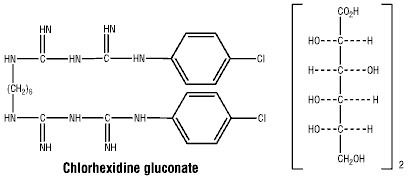
Molecular Weight: 898.
CAS number. 18472-51-0.
Cetrimide. The active ingredient cetrimide is a white or almost white voluminous free-flowing powder, which has a slight and characteristic odour. It is freely soluble in water, chloroform and ethanol (96%) and practically insoluble in ether. The structural formula is represented below:
Chemical structure.
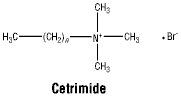
Molecular Weight: 336.4.
CAS number. 505-86-2.
7 Medicine Schedule (Poisons Standard)
Not scheduled.
Date of First Approval
04 September 1996
Date of Revision
12 September 2023
Summary Table of Changes

Reasonable care is taken to provide accurate information at the time of creation. This information is not intended as a substitute for medical advice and should not be exclusively relied on to manage or diagnose a medical condition. The Australian Commission on Safety and Quality in Health Care disclaims all liability (including for negligence) for any loss, damage, injury or any other negative effects resulting from reliance on or use of this information. Read our full disclaimer. This website uses cookies. Read our privacy policy.