
Dimetapp Kids 6 Years & Over Chesty Cough
Brand Information
| Brand name | Dimetapp Kids 6 Years & Over Chesty Cough |
| Active ingredient | Bromhexine hydrochloride + Guaifenesin |
| Schedule | S2 |
No current CMI was found.
Brand Information
| Brand name | Dimetapp Kids 6 Years & Over Chesty Cough |
| Active ingredient | Bromhexine hydrochloride + Guaifenesin |
| Schedule | S2 |
MIMS Revision Date: 01 July 2017
Name of the medicine
Each 10 mL of oral liquid contains guaifenesin 200 mg, bromhexine hydrochloride 8 mg.
Excipients. Also contains: citric acid, sodium benzoate, saccharin sodium, sorbitol solution (70%) (non-crystallising), povidone, maltol, flavour - cherry 58292C, flavour - sweet artificial 13540488, allura red AC and water - purified.

Description
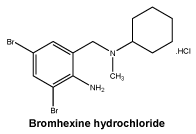
Bromhexine hydrochloride. Chemical name: N-(2-amino-3,5-dibromobenzyl)- N-methylcyclohexanamine hydrochloride. Molecular formula: C14H21Br2ClN2. MW: 412.6. CAS: 611-75-6. Bromhexine hydrochloride is a white or almost white, crystalline powder very slightly soluble in water, slightly soluble in alcohol and in methylene chloride.
Guaifenesin. Chemical name: 3-(2-methoxyphenoxy)propane-1,2-diol. Molecular formula: C10H14O4. MW: 198.22. CAS: 93-14-1. Guaifenesin is a white or almost white, crystalline powder. Sparingly soluble in water, soluble in alcohol.
Dimetapp Kids 6 Years & Over Chesty Cough is a bright red syrup with raspberry odour, free from suspended matter or particles.
Pharmacology
Dimetapp Kids 6 Years & Over Chesty Cough contains guaifenesin and bromhexine. Guaifenesin is an expectorant for productive cough and bromhexine is a mucolytic.
Pharmacodynamics. Guaifenesin is an expectorant, which clears chest congestion by loosening and reducing the viscosity of phlegm, enhancing the output of lower respiratory tract fluid by increasing the volume of phlegm, and making coughs more productive.
Bromhexine hydrochloride is an oral mucolytic agent with a low level of associated toxicity. Bromhexine acts on the mucus at the formative stages in the glands, within the mucus-secreting cells. Bromhexine disrupts the structure of acid mucopolysaccharide fibres in mucoid sputum and produces less viscous mucus, which is easier to expectorate.
This combination promotes the removal of troublesome mucus and as a result clears a congested chest.
Pharmacokinetics. Guaifenesin is well absorbed from the gastrointestinal tract. It is metabolised primarily to beta-2-methoxyphenoxy-lactic acid and then excreted in the urine. In a study where subjects were given 400 mg of guaifenesin orally, no unchanged drug could be detected in the urine. The plasma half-life of guaifenesin is one hour.
Bromhexine hydrochloride is rapidly absorbed from the gastrointestinal tract and undergoes extensive first-pass metabolism in the liver. Its oral bioavailability is stated to be only about 20%. It is widely distributed to body tissues and is highly bound to plasma proteins. About 85 to 90% of a dose is excreted in the urine mainly as metabolites. It has a terminal elimination half-life of up to about 12 hours. Bromhexine crosses the blood brain barrier and small amounts cross the placenta.
Clinical Trials
This information is not available.
Indications
Symptomatic relief from congested chests and coughs due to the common cold. Dimetapp Kids 6 Years & Over Chesty Cough contains the expectorant guaifenesin, which increases the flow of natural secretions along the respiratory tract. It also contains bromhexine hydrochloride to liquefy and break down the secretions. This combination helps break up a cough, helps loosen congestion so you can cough it up and get it off your chest.
Contraindications
Dimetapp Kids 6 Years & Over Chesty Cough is contraindicated for use in patients:
with known hypersensitivity or idiosyncratic reaction to guaifenesin, bromhexine hydrochloride or any of the other ingredients in the product;
under 6 years of age.
Precautions
Dimetapp Kids 6 years & Over Chesty Cough should be used with caution in patients with:
porphyria as guaifenesin is possibly porphyrogenic;
a history of gastric ulceration, as mucolytics like bromhexine may disrupt the gastric mucosal barrier;
severe hepatic or renal impairment, as the clearance of bromhexine or its metabolites may be reduced.
Dimetapp Kids 6 Years & Over Chesty Cough should not be used in patients with chronic or persistent cough associated with chronic lower respiratory tract diseases such as asthma, bronchitis, chronic obstructive pulmonary disease (COPD), emphysema or smoker's cough or cough associated with excessive secretions.
There have been reports of severe skin reactions such as erythema multiforme, Stevens-Johnson syndrome (SJS), toxic epidermal necrolysis (TEN) and acute generalised exanthematous pustulosis (AGEP) associated with the administration of bromhexine. If symptoms or signs of a progressive skin rash (sometimes associated with blisters or mucosal lesions) are present, Dimetapp Chesty Cough treatment should be discontinued immediately and medical advice should be sought.
This product should be kept out of reach of children.
The recommended dosage should not be exceeded.
This product should not be taken with another cough and cold medicines unless directed by a doctor.
Use in pregnancy. (Category A)
The active ingredients in Dimetapp Kids 6 Years & Over Chesty Cough have been taken by large number of pregnant women or women of childbearing age, without any proven increase in the frequency of malformation or other direct or indirect harmful effects on the human fetus having been observed.
Use in lactation. It is not known whether guaifenesin or bromhexine are excreted in breast milk or whether they have a harmful effect on the breastfeeding infant. Dimetapp Kids 6 Years & Over Chesty Cough is not recommended for breastfeeding mothers unless the potential benefits to the patient are weighed against the possible risk to the infant.
Genotoxicity. This information is not available.
Carcinogenicity. This information is not available.
Effect on laboratory test. This information is not available.
Interactions
There are no reported interactions with other medicines and guaifenesin.
There are no significant interactions reported with other medicines and bromhexine.
Adverse effects
The following adverse reactions may be associated with the use of guaifenesin/ bromhexine hydrochloride containing products.
Gastrointestinal disorders. Nausea, vomiting, diarrhoea and stomach pain (particularly in very large doses) and transient rise in serum aminotransferase values.
Nervous system disorders. Vertigo, dizziness, headache, drowsiness.
Immune system disorders. Hypersensitivity reactions, anaphylactic reactions including anaphylactic shock, angioedema and pruritus.
Skin and subcutaneous tissue disorders. Rash, urticaria. Severe cutaneous adverse reactions (including erythema multiforme, Stevens-Johnson syndrome, toxic epidermal necrolysis and acute generalised exanthematous pustulosis).
General and administration site disorders. Sweating.
Dosage and Administration
To be taken orally, every 8 hours when necessary.
Adults and children 12 years and over. 10 mL.
Children 6 years - under 12 years. 5 mL.
Do not exceed 3 doses in 24 hours. Do not use in children under 6 years of age.
Use in children aged 6 to 11 years only on the advice of a doctor, pharmacist or nurse practitioner.
Overdosage
The following signs or symptoms may be associated with an overdose of Dimetapp Kids 6 years & Over Chesty Cough.
Gastrointestinal disorders. Vomiting, nausea and stomach pain (particularly in very large dose).
In case of overdose, immediately contact the Poisons Information Centre (in Australia, call 131 126) for advice.
Presentation
Oral liquid (bright red syrup, raspberry odour), guaifenesin 200 mg/10 mL, bromhexine hydrochloride 8 mg/10 mL: 25 mL*, 45 mL*, 100 mL, 200 mL (bottle).
*Professional sample.
Storage
Store below 25°C.
Poison schedule
S2.
Date of First Approval
21 October 2008
Date of Revision
20 September 2016
Reasonable care is taken to provide accurate information at the time of creation. This information is not intended as a substitute for medical advice and should not be exclusively relied on to manage or diagnose a medical condition. The Australian Commission on Safety and Quality in Health Care disclaims all liability (including for negligence) for any loss, damage, injury or any other negative effects resulting from reliance on or use of this information. Read our full disclaimer. This website uses cookies. Read our privacy policy.