
Lyclear
Brand Information
| Brand name | Lyclear |
| Active ingredient | Permethrin |
| Schedule | Unscheduled |
No current CMI was found.
Brand Information
| Brand name | Lyclear |
| Active ingredient | Permethrin |
| Schedule | Unscheduled |
MIMS Revision Date: 01 October 2024
1 Name of Medicine
Permethrin.
2 Qualitative and Quantitative Composition
Lyclear contains permethrin 5% w/w (50 mg/g).
Excipients. Amerchol L101, butylated hydroxytoluene, carbomer 934P, cetomacrogol 1000, fractionated coconut oil, glycerol, glyceryl monostearate, isopropyl myristate, purified water, sodium hydroxide, ceteth-2 and formaldehyde solution 0.278% w/w as a preservative.
3 Pharmaceutical Form
A smooth, white to off-white cream.
4 Clinical Particulars
4.1 Therapeutic Indications
Lyclear is indicated for the treatment of infestation with Sarcoptes scabiei (scabies).
4.2 Dose and Method of Administration
Adults, children over 6 months. In view of the great individuality of surface area and skin type, precise recommendations on dosage are not possible. The approximate amount of cream to be used as a single application is as follows:
Adults. Up to one 30 g tube.
Children. Over 12 years. Up to one 30 g tube.
5 to 12 years. Up to half of a 30 g tube.
1 to 5 years. Up to one-quarter of a 30 g tube.
6 months to 1 year. Up to one-eighth of a 30 g tube.
A few adults may need to use an additional tube but no more than two tubes should be applied.
Ensure that the skin is clean, dry and cool prior to treatment.
Apply Lyclear Scabies Cream to the skin over the whole body, excluding the head and paying particular attention to the areas between the fingers and toes, wrists, axillae, external genitalia, buttocks and under fingernails and toenails.
In women, the whole body application should include the breasts.
Children, 6 months to 2 years. Patients in this group should be treated under medical supervision. Apply Lyclear Scabies Cream to the skin over the whole body, including the face, neck, scalp and ears. Avoid the immediate vicinity of the mouth, where the cream could be licked off, and close to the eyes.
Older children should be supervised by an adult when applying the cream.
The whole body should be washed thoroughly eight to twelve hours later. If the hands are subsequently washed with soap and water within eight hours of application, Lyclear Scabies Cream should be reapplied to them.
The nature of the cream is such that it disappears when rubbed gently into the skin. It is therefore not necessary to apply the cream until it remains detectable on the surface.
In the majority of individuals, the scabies infection is cleared with a single application of cream. If necessary, however, a second application may be given, not less than seven days after the initial application, if there are no signs of the original lesions healing or if new lesions are present.
4.3 Contraindications
Known hypersensitivity to any component including permethrin, other synthetic pyrethroids or pyrethrins.
4.4 Special Warnings and Precautions for Use
For external use only; not to be swallowed; keep out of reach of children. Avoid contact with the eyes. If contact with the eyes occurs rinse thoroughly with plenty of water or normal saline. If hypersensitivity to Lyclear Scabies Cream occurs, its use should be discontinued.
Nursing staff who routinely apply Lyclear Scabies Cream may wish to wear gloves to avoid any possible irritation to the hands.
Lyclear Scabies Cream should not be applied to elderly patients or to children under two years of age without medical supervision (see Section 4.2 Dose and Method of Administration).
Use in the elderly. In the elderly, Lyclear should be used as directed above but treatment should also include the head, neck, scalp and ears. Care must be taken to avoid applying Lyclear to areas close to the eyes.
Paediatric use. No data available.
Effects on laboratory tests. No data available.
4.5 Interactions with Other Medicines and Other Forms of Interactions
No specific information available.
4.6 Fertility, Pregnancy and Lactation
Effects on fertility. No data available.
Use in pregnancy. (Category B2)
There are limited data on the use of Lyclear in pregnancy which provide no indication of any risk to the fetus. Furthermore, the amount of permethrin absorbed systemically following a whole body application is extremely low, less than 0.5% of the applied dose is absorbed. These data together with the negative mutagenicity tests and the very low mammalian toxicity would suggest that any risk to the fetus following treatment with Lyclear is minimal.
Use in lactation. It is not known whether permethrin is excreted in human breast milk. However, because only extremely small amounts of permethrin are absorbed systemically following treatment with Lyclear, and in theory only a very small percentage of this systemic permethrin may pass into breast milk, it is unlikely that the concentrations of permethrin in the milk will present any risk to the neonate or infant.
4.7 Effects on Ability to Drive and Use Machines
The effects of this medicine on a person's ability to drive and use machines were not assessed as part of its registration.
4.8 Adverse Effects (Undesirable Effects)
Skin discomfort, usually described as burning or stinging, occurs in a few individuals soon after Lyclear Scabies Cream is applied. This symptom occurs more frequently in patients with severe scabies and is usually mild and transient.
Other signs and symptoms of irritation including erythema, oedema, eczema, rash and pruritus are considered to be a part of the natural history of scabies.
In patients treated for scabies, itching may persist for up to four weeks post-treatment. This is generally regarded as due to an allergic reaction to dead mites under the skin and is not necessarily indicative of treatment failure.
Reporting suspected adverse effects. Reporting suspected adverse reactions after registration of the medicinal product is important. It allows continued monitoring of the benefit-risk balance of the medicinal product. Healthcare professionals are asked to report any suspected adverse reactions at: www.tga.gov.au/reporting-problems.
4.9 Overdose
No instance of accidental ingestion of Lyclear Scabies Cream has been reported.
Application of a full tube of cream to a six month old child would result in a dose of approximately 350 mg/kg to the skin. It is unlikely that such a dose would cause overt signs of toxicity even if 100% of the permethrin was absorbed. It is possible that excessive application of Lyclear might result in localised adverse reactions (as described previously) or in more severe skin reactions.
In the event of overdosage, or if accidentally swallowed, contact the Poisons Information Centre on 13 11 26 in Australia or 0800 764 766 in New Zealand.
5 Pharmacological Properties
5.1 Pharmacodynamic Properties
Mechanism of action. The principal physiological action in insects exposed to permethrin is induction of electrochemical abnormalities across the membranes of excitable cells, leading to sensory hyperexcitability, incoordination and prostration. It is assumed that the mode of action against mites is similar.
Clinical trials. See Section 4.8 for clinical trials.
5.2 Pharmacokinetic Properties
Absorption. Permethrin is rapidly metabolised by ester hydrolysis to inactive metabolites which are excreted primarily in the urine. The principal metabolite of permethrin is detectable in the urine within seven hours of whole body application of the cream to healthy volunteers or scabies patients.
Excretion. The highest levels of excretion are detected within the first 48 hours, but very low levels of metabolite are still detectable in the urine of some individuals 21 days after treatment. The overall pattern of excretion indicates that approximately 0.5% of applied permethrin is absorbed during the first 48 hours.
5.3 Preclinical Safety Data
Genotoxicity. No data available.
Carcinogenicity. No data available.
6 Pharmaceutical Particulars
6.1 List of Excipients
See Section 2 Qualitative and Quantitative Composition.
6.2 Incompatibilities
Incompatibilities were either not assessed or not identified as part of the registration of this medicine. See Section 4.5 Interactions with Other Medicines and Other Forms of Interactions.
6.3 Shelf Life
In Australia, information on the shelf life can be found on the public summary of the Australian Register of Therapeutic Goods (ARTG). The expiry date can be found on the packaging.
6.4 Special Precautions for Storage
Store below 25°C. Do not freeze.
6.5 Nature and Contents of Container
Lyclear Cream is supplied in a 30 g tube with 'Instructions for Use' leaflet.
6.6 Special Precautions for Disposal
In Australia, any unused medicine or waste material should be disposed of by taking to your local pharmacy.
6.7 Physicochemical Properties
Chemical structure.
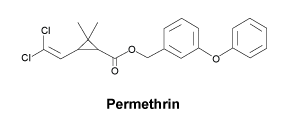
Chemical formula. C21H20Cl2O3.
MW. 391.29.
CAS number. 52645-53-1.
7 Medicine Schedule (Poisons Standard)
Unscheduled.
Date of First Approval
11 February 2010
Date of Revision
11 June 2024
Summary Table of Changes

Reasonable care is taken to provide accurate information at the time of creation. This information is not intended as a substitute for medical advice and should not be exclusively relied on to manage or diagnose a medical condition. The Australian Commission on Safety and Quality in Health Care disclaims all liability (including for negligence) for any loss, damage, injury or any other negative effects resulting from reliance on or use of this information. Read our full disclaimer. This website uses cookies. Read our privacy policy.