
Coregas Pty Ltd Medical Air 100% v/v Gas in Gas Cylinder Medicinal Gas
Brand Information
| Brand name | Coregas Pty Ltd Medical Air 100% v/v Gas in Gas Cylinder Medicinal Gas |
| Active ingredient | Air |
| Schedule | Unscheduled |
Consumer Medicine Information (CMI) leaflet
Please read this leaflet carefully before you start using the Coregas Pty Ltd Medical Air 100% v/v Gas in Gas Cylinder Medicinal Gas.
Summary CMI
COREGAS Pty Ltd MEDICAL AIR 100%v/v gas in gas cylinder Medicinal Gas
Consumer Medicine Information (CMI) summary
The full CMI on the next page has more details. If you are worried about using Medical Air, speak to your healthcare professional or emergency services officer.
1. Why am I having Coregas Pty Ltd Medical Air?
Coregas Pty Ltd Medical Air contains the active ingredient Air. It used to replace the air in the atmosphere when, for example, it has been contaminated by fumes, vapours or gases which may irritate you or are dangerous to your health when breathed in. In ventilators and incubators, it provides clean and controlled air flow.
It is also used for mixing with anaesthetic gases during surgery. For more information, see Section 1. in the full CMI.
2. What should I know before I have Coregas Pty Ltd Medical Air?
- Do not use this if you smoke and plan to keep smoking
- Only use this if your healthcare professional has said it is OK for you to use it
Talk to the person treating you if you have any other medical conditions or are pregnant or planning to become pregnant or are breastfeeding or planning to breastfeed.
For more information, see Section 2. in the full CMI.
3. What if I am taking other medicines?
Tell the person treating you if you are taking any other medicines.
See Section 3. in the full CMI.
4. How do I have Coregas Pty Ltd Medical Air?
You will receive Medical Air via a mask or nasal prongs (tubes). Your healthcare professional or emergency services officer will decide how much you can have.
More information can be found in Section 4. in the full CMI.
5. What should I know while having Coregas Pty Ltd Medical Air?
| Things you should do |
|
| Things you must not do |
|
| Looking after your medicine |
|
For more information, see Section 5. in the full CMI.
6. Are there any side effects?
There are no known side effects of Medical Air, however during treatment, where there may be other gases given to you with Medical Air, you may be at risk of developing certain side effects. For information about what to do if you get any side effects, see Section 6. Are there any side effects? in the full CMI.
Full CMI
COREGAS Pty Ltd MEDICAL AIR 100%v/v gas in gas cylinder Medicinal Gas
Active ingredient: Air
Consumer Medicine Information (CMI)
This leaflet provides important information about using Coregas Pty Ltd Medical Air.
Speak to your healthcare professional or emergency services officer if you want more information, if you are worried or if you have questions about using Medical Air.
Where to find information in this leaflet:
1. Why am I having Coregas Pty Ltd Medical Air?
2. What should I know before I have Coregas Pty Ltd Medical Air?
3. What if I am taking other medicines?
4. How do I have Coregas Pty Ltd Medical Air?
5. What should I know while having Coregas Pty Ltd Medical Air?
6. Are there any side effects?
7. Product details
For the Healthcare Professional/Emergency Services Officer
1. Why am I having Coregas Pty Ltd Medical Air?
Coregas Pty Ltd Medical Air contains the active ingredient air. It is a medical gas. Air contains contains approximately 21% Oxygen, 78% Nitrogen and 1% Argon with trace contents of other inert gases (xenon, neon, krypton). The Nitrogen, Argon and trace gases quoted above are inert, but the Oxygen in air is essential to life for its cellular respiratory function.
Medical Air is used as a replacement for the normal air you breathe in (atmospheric air). It is used when, for example, the atmospheric air has been contaminated by fumes, vapours or gases which may irritate you or are dangerous to your health when breathed in. In ventilators and incubators, it provides clean and controlled air flow.
It is also used for mixing with anaesthetic gases during surgery.
2. What should I know before I have Coregas Pty Ltd Medical Air?
Check with the person treating you if you:
- Have any other medical conditions
- Take any medicines for any other condition
Only use it if your healthcare professional or emergency services officer has said it is OK.
There are no known side effects of Medical Air, however during treatment, where there may be other gases given to you with Medical Air, you may be at risk of developing certain side effects. See additional information under Section 6. Are there any side effects?
Pregnancy and breastfeeding
Air does not normally affect pregnancy or breastfeeding, but if there are other gases being given with Medical Air, you should tell the person treating you if:
- you are pregnant or planning to become pregnant
or - you are breastfeeding or planning to breastfeed.
Elderly people
- Air by itself does not normally affect the elderly, but if there are other gases being given with Medical Air and/or they have a serious medical condition, then they will be monitored accordingly.
Children and Babies
- Air by itself does not normally affect children or babies, but regardless, they will be monitored accordingly.
3. What if I am taking other medicines?
Tell the person treating you if you are taking any other medicines, including any medicines, vitamins or supplements that you buy without a prescription from your pharmacy, supermarket or health food shop.
4. How do I have Coregas Pty Ltd Medical Air?
How much to have
Your healthcare professional or emergency services officer will decide how much to have.
Follow their instructions and use Medical Air until you are told to stop. They will monitor you or your child's treatment and change the amount if needed.
How you will have Coregas Pty Ltd Medical Air
You will receive Medical Air via a mask or nasal prongs (tubes). It is normally given to you by a healthcare professional or emergency services officer.
- The gas cylinder will be set up for you - follow carefully any instructions you are given
If you have had too much Medical Air
It is unlikely that you can have too much Medical Air by itself, however if you were given other medicines or gases with Medical Air and you suddenly feel dizzy, have fits or pass out, then:
You must immediately:
- Tell the person treating you, or
- Go to the Emergency Department at your nearest hospital, or
- Phone the Poisons Information Centre
(by calling 13 11 26).
5. What should I know while having Coregas Pty Ltd Medical Air?
Things you should do
Tell your healthcare professional or emergency services officer straight away if you:
- Feel that you are not receiving enough air
- Hear a hissing sound coming from the cylinder
Things you must not do
- Medical Air in steel cylinders MUST NOT be used in the same area as MRIs under any circumstances.
- Never smoke or stand near open flames, sparks or high heat while having Medical Air (which contains oxygen)
- Do not touch any part of the cylinder or equipment with oils or grease, and make sure your skin is clean and free from oils and grease (this includes not using oil-based moisturisers or creams on your face or nose.
- Do not use this product if the cylinder is damaged or the tamper evident seal has been removed.
Driving or using machines
Be careful before you drive or use any machines or tools until you know how Medical Air affects you.
While Medical Air itself is unlikely to affect you, any medical treatment you had or other medicines/gases you were given, may affect you. Your doctor will assess you and decide whether you can drive or operate machines.
Drinking alcohol
Tell your healthcare professional or emergency services officer if you have recently drunk alcohol, and it is inadvisable to drink alcohol while having treatment with Medical Air.
Looking after your medicine
- Make sure that it is not near any other gas cylinders or anything that may burn (including oils, greases, tars and plastics)
- Make sure that there are no open flames or open lights nearby, no strong heat or anything that gives off sparks
- Check that the cylinder is secured so that it won't fall over.
Keep it where children cannot see or reach it.
Getting rid of any unwanted Medical Air
The cylinder will be returned to Coregas.
Do not keep the cylinder after its expiry date.
6. Are there any side effects?
There are no known side effects of Medical Air, however during treatment, where there may be other gases given to you with Medical Air, you may be at risk of developing certain side effects.
Tell the person treating you if you feel unwell in any way.
Reporting side effects
After you have received medical advice for any side effects you may have had, you can report these side effects to the Therapeutic Goods Administration online at www.tga.gov.au/reporting-problems.
By reporting side effects, you can help provide more information on the safety of this medicine.
Always make sure you speak to your doctor or pharmacist before you decide to stop taking any of your medicines.
7. Product details
This medicine is normally supplied for use in hospitals, dental surgeries or in emergency situations.
What Coregas Pty Ltd Medical Air contains
| Active ingredient (main ingredient) | Air, which comprises approximately 21% Oxygen, 78% Nitrogen and 1% Argon with trace contents of other inert gases (xenon, neon, krypton) |
| Other ingredients (inactive ingredients) | None |
| Potential allergens | None |
What Coregas Pty Ltd Medical Air looks like
Coregas Pty Ltd Medical Air has no smell or colour.
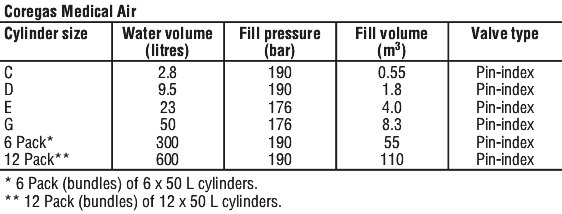
The cylinders have a white body with black and white quadrants on the shoulder. They are made of either steel or aluminium and sealed with a Pin Index valve outlet.
They may be available in the following pack sizes:
| Cylinder Size | Water Volume (litres) | Fill Pressure (bar) | Fill Volume (m3) |
| C | 2.8 | 190 | 0.55 |
| D | 9.5 | 190 | 1.8 |
| E | 23 | 176 | 4.0 |
| G | 50 | 176 | 8.3 |
| 6 Pack* | 300 | 190 | 55 |
| 12 Pack** | 600 | 190 | 110 |
* 6 Pack (bundles) of 6x50 l cylinders
** 12 Pack (bundles) of 12x50 l cylinders
(Not all pack sizes or presentations may be available)
Who distributes Coregas Pty Ltd Medical Air?
Coregas Pty Ltd
66 Loftus Road
Yennora NSW 2161
Australia
Email: Customer.services@coregas.com
Phone:1800807203
Website: www.coregas.com.au/healthcare
Aust R 27160.
This leaflet was revised in April 2023.
For the Healthcare Professional/Emergency Services Officer
Instructions for use/handling
- Care is needed in the handling and use of Medical Air gas cylinders
- When Medical Air is intended for use in a room in which magnetic resonance imaging (MRI) is being performed, all steel medical air cylinders and associated equipment must be considered to potentially contain ferromagnetic materials. Steel cylinders do contain a substantial quantity of ferromagnetic material and MUST NOT be used in proximity to MRIs under any circumstances.
- Electrical equipment capable of sparking or generating extreme heat should not be used in the vicinity of patients receiving oxygen (including that contained in Medical Air).
- Air is a comburent gas, which can form flammable and explosive mixtures with combustible gases.
- Use with suitable pressure reducing regulator.
- Where moisturising preparations are required for use with a facemask or in nasal passages etc., avoid using oil-based creams. If in doubt, check with the manufacturer to ensure that the product of choice is suitable for use with medicinal air.
- Medical gases must only be used for medicinal purposes
- Under no circumstances should oils or grease be used to lubricate any part of the medicinal air cylinder or the associated equipment used to deliver the gas to the patient. Always ensure hands are clean and free from any oils or grease.
- Refer to the respective S.D.S and the “caution” section of the product label.
- Refer to manufacturer for cleaning guidelines.
- All regulations concerning handling of pressure vessels must be followed.
- Cylinders should be handled with care. They must not be allowed to fall or subjected to violent impact. If, after an accidental collision, a cylinder exhibits local deformation or a notch, even shallow, it should be considered as hazardous and removed from use. It must be returned to the supplier with notification of the damage.
- Cylinders should only be moved with the appropriate size and type of cylinder trolley (pallet jack).
- When in use cylinders should be firmly secured to suitable restraining equipment.
- Cylinders containing liquefiable gas must always be used, transported and stored in vertical position.
- Smoking and naked lights must not be allowed within the vicinity of cylinders or pipeline outlets.
- After use cylinder valves should be closed using moderate force only and the pressure in the regulator, manifold, etc released.
- Immediately return used cylinders to the used cylinder store for return to Coregas.
Preparation for use with Pin Index Valves
- Ensure that the connecting face on the yoke, manifold or regulator is clean and the sealing washer or ‘O’ ring where fitted is in good condition.
- Cylinder valves must be opened slowly.
- Only the appropriate regulator should be used for the particular gas concerned.
- Never use excessive force when connecting equipment to cylinders.
Leaks
- Should gas leaks occur, this will usually be evident by a hissing noise.
- Leaks can be found by spraying the suspected area (cylinder inlet and / or valve spindle) with an approved gas leak test solution.
- There are no user serviceable parts associated with the valves fitted, so do not attempt to correct any problems with leakage from any part of the valve itself. Quarantine leaking gas cylinders (in a well-ventilated area), apply a warning sticker and, when empty, return them to Coregas for serving / repair.
- Sealing or jointing compounds must never be used to cure a leak.
Storing of cylinders
Medical Air cylinders should be kept out of the reach of children.
Air supports combustion.
The normal precautions required in the storage of medical gas cylinders as described below are applicable.
- Cylinders should be stored under cover, preferably inside, kept dry and clean and not subjected to extremes of heat or cold.
- Cylinders should not be stored near stocks of combustible materials or exposed to artificial sources of heat.
- Warning notices prohibiting smoking and naked lights must be posted clearly.
- Emergency services should be advised of the location of the cylinder store.
- Medical cylinders should be segregated by medical gas type and identified as such within the store.
- Full and empty cylinders should be stored separately. Full cylinders should be used on a “first in / first out” basis.
- Cylinders must not be re-painted. Cylinder markings must not be obscured. Product labels must not be removed. Foreign objects and attachments must not be affixed when returning cylinders. All gas cylinders should be stored vertically. C size cylinders are traditionally as well stored horizontally.
- Precautions should be taken to protect cylinders from theft and / or interference.
- Gas cylinders must be stored in storage area specially provided for the purpose. The storage area must be ventilated.
- If they are placed along a personnel passageway, they must be prevented from falling by means of chains.
- Whether empty or full, all cylinders in the storage area must be equipped with their valve protection caps and valve closed.
This leaflet was revised in April 2023
Brand Information
| Brand name | Coregas Pty Ltd Medical Air 100% v/v Gas in Gas Cylinder Medicinal Gas |
| Active ingredient | Air |
| Schedule | Unscheduled |
MIMS Revision Date: 01 February 2022
1 Name of Medicine
Air.
2 Qualitative and Quantitative Composition
Medical Air contains approximately 21% oxygen, 78% nitrogen and 1% argon with trace contents of other inert gases (xenon, neon, krypton).
The nitrogen, argon and trace gases quoted above are inert, but the oxygen in air is essential to life for its cellular respiratory function.
3 Pharmaceutical Form
Medicinal gas.
Colourless, odourless gas.
4 Clinical Particulars
4.1 Therapeutic Indications
As replacement for atmospheric air. Carrier gas for volatile anaesthetics.
4.2 Dose and Method of Administration
Use in adults, the elderly and children. For respiratory use.
Instruction for use/handling. Care is needed in the handling and use of Medical Air gas cylinders.
Refer to the respective S.D.S and the "caution" section of the product label.
Refer to manufacturer for cleaning guidelines.
Preparation for use. 1. Ensure that the connecting face on the yoke, manifold or regulator, etc., is clean and the sealing washer or 'O'-ring, where fitted, is in good condition.
2. Cylinder valves must be opened slowly.
3. Only the appropriate regulator should be used for the particular gas concerned.
4. Cylinder valves and any associated equipment must never be lubricated and must be kept free from oil and grease.
Leaks. 1. Should gas leaks occur, this will usually be evident by a hissing noise.
2. Leaks can be found by spraying the suspected area (cylinder inlet and/or valve spindle) with an approved gas leak test solution.
3. There are no user serviceable parts associated with the valves fitted, so do not attempt to correct any problems with leakage from any part of the valve itself. Quarantine leaking gas cylinders (in a well ventilated area), apply a warning sticker and, when empty, return them to Coregas for serving/ repair.
4. Sealing or jointing compounds must never be used to deal with a gas leak.
5. Never use excessive force when connecting equipment to cylinders.
Handling of cylinders. 1. Cylinders should be handled with care and not knocked or allowed to fall.
2. Cylinders should only be moved with the appropriate size and type of cylinder trolley (pallet jack).
3. When in use, cylinders should be firmly secured to suitable restraining equipment.
4. Cylinders containing liquefiable gas must always be used, transported and stored in vertical position.
5. Medical gases must only be used for medicinal purposes.
6. Smoking and naked lights must not be allowed within the vicinity of cylinders or pipeline outlets.
7. After use, cylinder valves should be closed using moderate force only and the pressure in the regulator, manifold, etc. released.
8. Immediately return used cylinders to the used cylinder store for return to Coregas.
4.3 Contraindications
None.
4.4 Special Warnings and Precautions for Use
When Medical Air is intended for use in a room in which magnetic resonance imaging (MRI) is being performed, all medical air cylinders and associated equipment must be considered to potentially contain ferromagnetic materials. Steel cylinders do contain a substantial quantity of ferromagnetic material and must not be used in proximity to MRIs under any circumstances.
Where moisturising preparations are required for use with a facemask or in nasal passages etc., avoid using oil based creams. If in doubt, check with the manufacturer to ensure that the product of choice is suitable for use with medicinal air.
Under no circumstances should oils or grease be used to lubricate any part of the medicinal air cylinder or the associated equipment used to deliver the gas to the patient. Always ensure hands are clean and free from any oils or grease.
Electrical equipment capable of sparking or generating extreme heat should not be used in the vicinity of patients receiving oxygen.
Use with suitable pressure reducing regulator.
All regulations concerning handling of pressure vessels must be followed.
Air is a comburent gas, which can form flammable and explosive mixtures with combustibles gases.
Cylinders must not be subjected to violent impact. If, after an accidental collision, a cylinder exhibits local deformation or a notch, even shallow, it should be considered as hazardous and removed from use. It must be returned to the supplier with notification of the damage.
Use in the elderly. See Section 4.2 Dose and Method of Administration.
Paediatric use. Children differ from adults in more than just size: they have for example different breathing patterns, tidal volumes and airways geometry. Careful attention should be brought to the features to be applied to the driving gas, in case of mechanical ventilation or nebulisation in children and infants.
See Section 4.2 Dose and Method of Administration.
Effects on laboratory tests. No data available.
4.5 Interactions with Other Medicines and Other Forms of Interactions
None.
4.6 Fertility, Pregnancy and Lactation
Effects on fertility. None.
Use in pregnancy. (Category A)
Medical Air does not adversely affect pregnancy.
Use in lactation. Medical Air does not adversely affect lactation.
4.7 Effects on Ability to Drive and Use Machines
None.
4.8 Adverse Effects (Undesirable Effects)
None.
Reporting suspected adverse effects. Reporting suspected adverse reactions after registration of the medicinal product is important. It allows continued monitoring of the benefit-risk balance of the medicinal product.
Healthcare professionals are asked to report any suspected adverse reactions at www.tga.gov.au/reporting-problems.
4.9 Overdose
Not applicable.
For information on the management of overdose, contact the Poisons Information Centre on 131126 (Australia).
5 Pharmacological Properties
5.1 Pharmacodynamic Properties
Under conditions of normal atmospheric pressure, the pharmacodynamic effects of air are essentially those of respiration, oxygen carriage and cellular metabolism.
Clinical trials. No data available.
5.2 Pharmacokinetic Properties
None stated.
5.3 Preclinical Safety Data
Genotoxicity. Not applicable.
Carcinogenicity. Not applicable.
6 Pharmaceutical Particulars
6.1 List of Excipients
None.
6.2 Incompatibilities
Incompatibilities were either not assessed or not identified as part of the registration of this medicine.
6.3 Shelf Life
Shelf life is according to appropriate Australian Standards.
6.4 Special Precautions for Storage
Medical Air cylinders should be kept out of the reach of children.
Air supports combustion.
The normal precautions required in the storage of medical gas cylinders as described below are applicable.
Cylinders should be stored under cover, preferably inside, kept dry and clean and not subjected to extremes of heat or cold.
Cylinders should not be stored near stocks of combustible materials or exposed to artificial sources of heat.
Warning notices prohibiting smoking and naked lights must be posted clearly.
Emergency services should be advised of the location and nature of the cylinder store.
Medical cylinders should be segregated by medical gas type and identified as such within the store.
Full and empty cylinders should be stored separately. Full cylinders should be used on an "first in/ first out" basis.
Cylinders must not be re-painted. Cylinder markings must not be obscured. Product labels must not be removed. Foreign objects and attachments must not be affixed when returning cylinders.
All gas cylinders should be stored vertically. C size cylinders are traditionally as well stored horizontally.
Precautions should be taken to protect cylinders from theft and/or interference.
Gas cylinders must be stored in storage area specially provided for the purpose. The storage area must be ventilated.
If they are placed along a personnel passageway, they must be prevented from falling by means of chains.
Whether empty or full, all cylinders in the storage area must be equipped with their valve protection caps and valve closed.
6.5 Nature and Contents of Container
Medical Air is supplied in aluminium or steel gas cylinders with a pin index valve, suitable for the filling pressure applied for the product.
The types of cylinders normally used are specified in Table 1.
Cylinder valves conform to AS 2473.1 and AS 2473.3.
The cylinders are colour coded conforming to AS 4484.
The colour code for medical air is a white body with black and white quadrants on the shoulder.
6.6 Special Precautions for Disposal
Immediately return used cylinders to the used cylinder store for return to Coregas.
6.7 Physicochemical Properties
Medical Air is a colourless, odourless gas with a molecular weight of 29.0, a boiling point of -194°C (at 101.325 kPa) and a density of 1.225 kg/m3 (at 15°C and 101.325 kPa).
Constituents:
Chemical structure. Molecular formula. Nitrogen. N2.
Oxygen. O2.
Argon. Ar.
Molecular weight. Nitrogen. 28.02.
Oxygen. 32.00.
Argon. 39.95
CAS number. Nitrogen. 7727-37-9.
Oxygen. 7782-44-7.
Argon. 7440-37-1.
7 Medicine Schedule (Poisons Standard)
Not scheduled.
Date of First Approval
21 October 1991
Date of Revision
26 November 2021
Summary Table of Changes

Reasonable care is taken to provide accurate information at the time of creation. This information is not intended as a substitute for medical advice and should not be exclusively relied on to manage or diagnose a medical condition. The Australian Commission on Safety and Quality in Health Care disclaims all liability (including for negligence) for any loss, damage, injury or any other negative effects resulting from reliance on or use of this information. Read our full disclaimer. This website uses cookies. Read our privacy policy.