
Megafol
Brand Information
| Brand name | Megafol |
| Active ingredient | Folic acid |
| Schedule | Unscheduled | S2 |
No current CMI was found.
Brand Information
| Brand name | Megafol |
| Active ingredient | Folic acid |
| Schedule | Unscheduled | S2 |
MIMS Revision Date: 01 January 2025
1 Name of Medicine
Folic acid.
2 Qualitative and Quantitative Composition
Each Megafol 0.5 tablet contains 0.5 mg of folic acid as the active ingredient.
Each Megafol 5 tablet contains 5 mg of folic acid as the active ingredient.
Excipients with known effect. Sulfites and sugars as lactose.
For the full list of excipients, see Section 6.1 List of Excipients.
3 Pharmaceutical Form
Megafol 0.5 mg. 6.5 mm, normal convex, yellow tablet with scoreline on one side and blank on the other.
Megafol 5 mg. 7 mm, flat bevelled edged, yellow tablet with scoreline on one side and blank on the other.
4 Clinical Particulars
4.1 Therapeutic Indications
Treatment of megaloblastic anaemia due to a deficiency of folic acid; prophylaxis during pregnancy and lactation.
4.2 Dose and Method of Administration
Prophylaxis during pregnancy and lactation. 0.5 mg daily, taken orally.
Treatment of megaloblastic anaemia. 1 to 5 mg daily, taken orally, according to the severity of anaemia and the presence/ absence of malabsorption syndromes.
4.3 Contraindications
Avoid treating megaloblastic anaemia due to vitamin B12 deficiency with folic acid. The haematological features of vitamin B12 deficiency may be corrected with folic acid but the neurological effects will not be alleviated and may become irreversible.
4.4 Special Warnings and Precautions for Use
The absorption of folic acid and the success of treatment can be impaired in the case of severe deficiency or in severe cases of intestinal malabsorption. Vitamin B12 deficiency needs to be excluded before folic acid is prescribed (see Section 4.3 Contraindications).
Large doses of folic acid may counteract the anti-epileptic effect of diphenylhydantoin. Patients receiving diphenylhydantoin treatment should be monitored for possible loss of seizure control following large doses of folic acid.
Folic acid does not correct folate deficiency due to dihydrofolate reductase inhibitors (see Section 4.5 Interactions with Other Medicines and Other Forms of Interactions).
Folinic acid should be used for this purpose.
Use in the elderly. Cobalamin deficiency can go undiagnosed for an extended duration, during which the neuropsychiatric manifestations may become irreversible (and may be aggravated by folate supplementation).
Paediatric use. No data available.
Effects on laboratory tests. No data available.
4.5 Interactions with Other Medicines and Other Forms of Interactions
Alcoholism and anticonvulsant therapy can cause folate deficiency. In patients experiencing chronic haemolytic anaemia, daily supplementation of folic acid can lead to a marked increase in serum folate levels.
Folic acid supplementation may decrease serum antiepileptic concentrations in patients receiving anticonvulsant therapy, leading to decreased seizure control. Serum folate and antiepileptic concentrations should be monitored in patients receiving concomitant treatment as dosage adjustment for both treatment regimens may be required.
Methotrexate has a high affinity for mammalian dihydrofolate reductase and therefore inhibits the reduction of folic acid to tetrahydrofolate.
Trimethoprim and pyrimethamine are more selective inhibitors of microbial dihydrofolate reductase: the concentrations required to inhibit the mammalian enzyme are 10,000 to 50,000 times greater than the concentrations required to inhibit the microbial enzyme for trimethoprim and 1,400 times greater for pyrimethamine.
Sulfasalazine has been reported to depress folate absorption.
High intravenous doses of folic acid with concomitant administration of fluorouracil can cause severe diarrhoea.
4.6 Fertility, Pregnancy and Lactation
Effects on fertility. No data available.
Use in pregnancy. (Category A)
Use in lactation. Folic acid, 5-methyltetrahydrofolate and 10-formyltetrahydrofolate are excreted in breast milk. Therapeutic indications include supplementation in lactating or pregnant women when they are folic acid deficient.
4.7 Effects on Ability to Drive and Use Machines
The effects of this medicine on a person's ability to drive and use machines were not assessed as part of its registration.
4.8 Adverse Effects (Undesirable Effects)
Folic acid is usually well tolerated in humans; however, gastrointestinal disturbances and CNS effects have occasionally been reported following high doses (incidence of less than 1% at dose of 15 mg/day), and isolated reports of allergic sensitivity reactions including bronchospasm and rash have been documented.
Reporting suspected adverse effects. Reporting suspected adverse reactions after registration of the medicinal product is important. It allows continued monitoring of the benefit-risk balance of the medicinal product. Healthcare professionals are asked to report any suspected adverse reactions at www.tga.gov.au/reporting-problems.
4.9 Overdose
For information on the management of overdose, contact the Poisons Information Centre on 13 11 26 (Australia).
5 Pharmacological Properties
5.1 Pharmacodynamic Properties
Folic acid is reduced in the body to a number of compounds including tetrahydrofolic acid. In the reduced form, it acts as a coenzyme for various metabolic processes. It is necessary for the synthesis of purine and pyrimidine nucleotides and hence DNA synthesis, and is involved in some amino acid conversions. The maturation of all rapidly proliferating tissues, in particular the bone marrow and the gastrointestinal tract, require folic acid. Folate deficiency leads to megaloblastic anaemia.
Mechanism of action. Treatment of folic acid deficiency. Folic acid deficiency is defined by WHO as serum folate levels below 3 nanogram/mL or red cell folate levels below 100 nanogram/mL. Deficiency may be due to inadequate dietary intake, malabsorption or increased utilisation of folic acid. Dietary intake may be inadequate in infants fed solely on goat's milk or when diet is poor, particularly when it is low in vegetable constituents. Folates in food are largely present in the form of polyglutamates which are hydrolysed enzymatically at the gastrointestinal mucosa to folic acid. Conditions in which folate utilisation is increased include: pregnancy and lactation; haemolytic anaemia; hyperthyroidism; exfoliative dermatitis; and chronic infection.
Clinical trials. No data available.
5.2 Pharmacokinetic Properties
Absorption. Folic acid is absorbed from the upper gastrointestinal tract. It is generally well absorbed; however, absorption is decreased in chronic alcoholics, in malabsorptive diseases such as tropical and coeliac sprue, in patients with systemic bacterial infection, in patients receiving diphenylhydantoin, and following procedures such as gastrectomy and upper intestinal resection.
Distribution. It is stored in tissues, especially the liver, predominantly as methylated polyglutamates. 5-methyltetrahydrofolate is also secreted in bile. Enterohepatic recycling of folate may provide as much as 200 microgram or more folate each day for recirculation to the tissues. Folic acid and 5-methyltetrahydrofolate cross the placenta and accumulate in the foetal liver.
5-Methyltetrahydrofolate is also actively transported into the cerebrospinal fluid.
Metabolism. Folic acid is rapidly metabolised primarily to 5-methyltetrahydrofolate with some 10-formylfolate and some 10-formyltetrahydrofolate formed.
Excretion. Folic acid is excreted in urine unchanged and as a number of metabolites (including 5-methyltetrahydrofolate and pterins). Folic acid is also excreted in faeces.
5.3 Preclinical Safety Data
Genotoxicity. No data available.
Carcinogenicity. No data available.
6 Pharmaceutical Particulars
6.1 List of Excipients
Megafol contains the following excipients: crospovidone, lactose, maize starch, povidone, magnesium stearate.
6.2 Incompatibilities
Incompatibilities were either not assessed or not identified as part of the registration of this medicine.
6.3 Shelf Life
In Australia, information on the shelf life can be found on the public summary of the Australian Register of Therapeutic Goods (ARTG). The expiry date can be found on the packaging.
6.4 Special Precautions for Storage
Store below 30°C.
6.5 Nature and Contents of Container
Container type: HDPE bottles.
Pack sizes: 30, 100, 1000.
Australian register of therapeutic goods (ARTG). AUST R 17706 - Megafol 5 folic acid 5 mg tablet bottle.
AUST R 27951 - Megafol 0.5 folic acid 0.5 mg tablet bottle.
Some strengths, pack sizes and/or pack types may not be marketed.
6.6 Special Precautions for Disposal
In Australia, any unused medicine or waste material should be disposed of by taking it to your local pharmacy.
6.7 Physicochemical Properties
Yellow to orange, crystalline powder; odourless or almost odourless. Practically insoluble in cold water, ethanol, and most organic solvents. Soluble in dilute acids and in alkaline solutions, and boiling water (to 1 g/100 mL). Chemically, it is pteroylglutamic acid, N-[4-[[(2-amino-1,4-dihydro-4-oxo-6-pteridinyl) methyl] amino] benzoyl]-L-glutamic acid. The chemical structure is shown below.
Chemical structure.
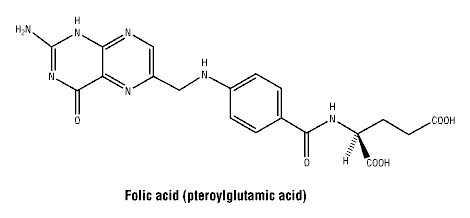
Molecular weight: 441.4.
Molecular formula: C19H19N7O6.
CAS number. 59-30-3.
7 Medicine Schedule (Poisons Standard)
0.5 mg: Unscheduled; 5 mg: S2 (Pharmacy Medicine).
Date of First Approval
20 September 1991
Date of Revision
11 November 2024
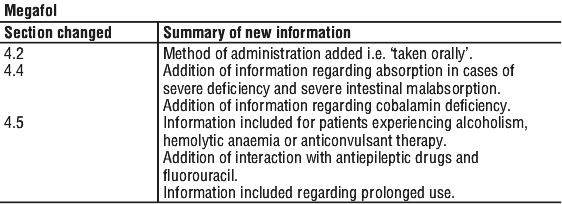
Summary Table of Changes
Reasonable care is taken to provide accurate information at the time of creation. This information is not intended as a substitute for medical advice and should not be exclusively relied on to manage or diagnose a medical condition. The Australian Commission on Safety and Quality in Health Care disclaims all liability (including for negligence) for any loss, damage, injury or any other negative effects resulting from reliance on or use of this information. Read our full disclaimer. This website uses cookies. Read our privacy policy.