
Minims Chloramphenicol
Brand Information
| Brand name | Minims Chloramphenicol |
| Active ingredient | Chloramphenicol |
| Schedule | S3 |
Consumer Medicine Information (CMI) leaflet
Please read this leaflet carefully before you start using the Minims Chloramphenicol.
Summary CMI
Minims® Chloramphenicol
Consumer Medicine Information (CMI) summary
The full CMI on the next page has more details. If you are worried about using this medicine, speak to your doctor or pharmacist.
1. Why am I using Minims Chloramphenicol?
Minims Chloramphenicol contains the active ingredient chloramphenicol. Minims Chloramphenicol is used to treat an eye infection called bacterial conjunctivitis, which is a bacterial infection involving the mucous membrane of the surface of the eye. For more information, see Section 1. Why am I using Minims Chloramphenicol? in the full CMI.
2. What should I know before I use Minims Chloramphenicol?
Do not use if you have ever had an allergic reaction to chloramphenicol or any of the ingredients listed at the end of the CMI. Talk to your doctor if you have any other medical conditions, take any other medicines, or are pregnant or plan to become pregnant or are breastfeeding.
For more information, see Section 2. What should I know before I use Minims Chloramphenicol? in the full CMI.
3. What if I am taking other medicines?
Some medicines may interfere with Minims Chloramphenicol and affect how it works.
A list of these medicines is in Section 3. What if I am taking other medicines? in the full CMI.
4. How do I use Minims Chloramphenicol?
The usual dose in adults and children 2 years and over is one or two drops instilled into each affected eye every two to six hours for two to three days. The interval between applications may then be increased. Continue treatment for at least 48 hours after the eye appears normal. Do not use for more than 5 days in total except on medical advice.
More instructions can be found in Section 4. How do I use Minims Chloramphenicol? in the full CMI.
5. What should I know while using Minims Chloramphenicol?
| Things you should do |
|
| Things you should not do |
|
| Driving or using machines |
|
| Looking after your medicine |
|
For more information, see Section 5. What should I know while using Minims Chloramphenicol? in the full CMI.
6. Are there any side effects?
All medicines can have side effects. If they do occur, they are usually minor and temporary. Do not be alarmed by this list. You may not experience any of them. Less serious side effects include blurred vision and/or problems seeing clearly, local eye irritation, itching or burning. Serious side effects that require urgent medical attention include allergic reaction, symptoms of a blood disorder and effects to the body as a whole. For more information, including what to do if you have any side effects, see Section 6. Are there any side effects? in the full CMI.
Full CMI
Minims® Chloramphenicol
Active ingredient: Chloramphenicol
Consumer Medicine Information (CMI)
This leaflet provides important information about using Minims Chloramphenicol. You should also speak to your doctor or pharmacist if you would like further information or if you have any concerns or questions about using Minims Chloramphenicol.
Where to find information in this leaflet:
1. Why am I using Minims Chloramphenicol?
2. What should I know before I use Minims Chloramphenicol?
3. What if I am taking other medicines?
4. How do I use Minims Chloramphenicol?
5. What should I know while using Minims Chloramphenicol?
6. Are there any side effects?
7. Product details
1. Why am I using Minims Chloramphenicol?
Minims Chloramphenicol contains the active ingredient chloramphenicol. Minims Chloramphenicol is a broad-spectrum antibiotic solution.
Minims Chloramphenicol is used to treat an eye infection called bacterial conjunctivitis, which is a bacterial infection involving the mucous membrane of the surface of the eye. The most common symptom is the presence of a sticky yellow-white discharge with mucus and pus (or glued eyes, especially in the morning on waking). Other symptoms include a gritty sensation in the eye, redness, irritation and watering of the eyes. The infection usually starts in one eye and then spreads to the other.
2. What should I know before I use Minims Chloramphenicol?
Warnings
Do not use Minims Chloramphenicol if:
- You are allergic to chloramphenicol, or any of the ingredients listed at the end of this leaflet. Always check the ingredients to make sure you can use this medicine.
Check with your doctor, pharmacist or optometrist if:
- You have had an allergy to any other medicines, foods, preservatives or dyes.
- You have the following symptoms or any other medical conditions, especially:
- Photophobia (light sensitivity)
- Severe pain in the eye or pain and swelling around the eye
- Loss of, reduced or blurred vision
- Restriction of eye movement
- Cloudy-looking eyes
- Large amount of yellow-green, thick, milky discharge that accumulates after being wiped away
- Abnormal pupil
- Injury to the eye or suspect there is a foreign body in the eye
- Glaucoma (high pressure in the eye)
- Dry eye syndrome
- Any blood disorder such as reduced blood cells, or lack of white blood cells or low blood platelet count. - You wear contact lenses.
- You have been welding without eye protection immediately prior to onset of symptoms.
- You are currently using other eye drops or eye ointments.
- You had eye surgery or laser treatment in the past six months.
- You have individual or family history of bone marrow problems.
- You recently travelled overseas.
- You have had similar symptoms in the past.
- You feel unwell.
- You take any medicines for any other condition.
During treatment, you may be at risk of developing certain side effects. It is important you understand these risks and how to monitor for them. See additional information under Section 6. Are there any side effects?
This medicine has been developed for use in the eye only. It should not be swallowed or injected.
Pregnancy and breastfeeding
Check with your doctor if you are pregnant or intend to become pregnant.
Talk to your doctor if you are breastfeeding or intend to breastfeed.
Children
Minims Chloramphenicol should not be given to children less than 2 years old.
3. What if I am taking other medicines?
Tell your doctor or pharmacist if you are taking any other medicines, including any medicines, vitamins or supplements that you buy without a prescription from your pharmacy, supermarket or health food shop.
Some medicines and Minims Chloramphenicol may interfere with each other. These medicines may be affected by Minims Chloramphenicol or may affect how well it works. These include:
- Chymotrypsin (an eye drop used during cataract surgery).
Check with your doctor or pharmacist if you are not sure about what medicines, vitamins or supplements you are taking and if these affect Minims Chloramphenicol.
4. How do I use Minims Chloramphenicol?
How much to use
- Use Minims Chloramphenicol only when prescribed by your pharmacist, doctor or optometrist. The dose of the eye drops may be different for each person and their medical condition. Your pharmacist, doctor or optometrist will tell you how often to use the eye drops and how many drops to use each time.
- The usual dose of Minims Chloramphenicol in adults and children 2 years and over is one or two drops instilled into each affected eye every two to six hours for two to three days. The interval between applications may then be increased.
- Severe infections may require one or two drops every fifteen to twenty minutes to begin with, then gradually reducing the frequency of application as the infection is controlled.
- Continue treatment for at least 48 hours after the eye appears normal.
- Do not use for more than 5 days in total except on medical advice. If the condition becomes worse or does not get better after 2 days, seek medical advice.
How to use Minims Chloramphenicol
You may find it easier to put drops in your eye while you are sitting or lying down.
If you are instilling your own drops, then follow these steps to use the eye drops:
- Wash your hands well with soap and water.
- Shake the container.
- Break the seal.
- Hold the container upside down in one hand between your thumb and forefinger.
- Using your other hand, gently pull down your lower eyelid to form a pouch or pocket.
- Tilt your head back and look up.
- Put the tip of the container close to your lower eyelid. Do not let it touch your eye.
- Release one or two drops into the pouch or pocket formed between your eye and eyelid by gently squeezing the container.
- Close your eye. Do not blink or rub your eye.
- While your eye is closed, place your index finger against the inside corner of your eye and press against your nose for about two minutes. This is very important when administering to children. This will help to stop the medicine from draining through the tear duct to the nose and throat, from where it can be absorbed into other parts of your body.
- Repeat steps 4-10 for the other eye if needed.
- Throw away any eye drops left in the container.
If you forget to use Minims Chloramphenicol
If it is almost time for your next dose, skip the dose you missed and use your dose when you are meant to.
Otherwise, use it as soon as you remember, and then go back to using your medicine as you would normally.
Do not use a double dose to make up for the dose that you missed. This may increase the chance of you getting an unwanted side effect.
If you are not sure what to do, ask your doctor or pharmacist.
If you have trouble using your medicine, ask your pharmacist for some hints.
If the condition does not get better after 2 days, seek medical advice.
If you use too much Minims Chloramphenicol
If you think that you have used too much Minims Chloramphenicol, you may need urgent medical attention.
Accidental swallowing of the solution is unlikely to cause any bad side effects due to the low content of Chloramphenicol.
If you think that you or anyone else may have swallowed Minims Chloramphenicol or used too much Minims Chloramphenicol, you should immediately:
- phone the Poisons Information Centre
(in Australia phone 13 11 26), or - contact your doctor, or
- go to the Emergency Department at your nearest hospital.
You should do this even if there are no signs of discomfort or poisoning.
5. What should I know while using Minims Chloramphenicol?
Things you should do
- Tell your doctor if you are to have or have had eye surgery. Your doctor may advise you to stop using Minims Chloramphenicol as it may slow corneal wound healing.
- If you have any irritation, pain, swelling, excessive tear production or light-sensitivity while using the eye drops, flush the treated eye(s) with lots of water (room temperature) for at least 15 minutes. Stop using the eye drops and contact your doctor if symptoms persist.
- If you wear contact lenses, stop wearing them while you are using Minims Chloramphenicol.
Things you should not do
- Do not stop using Minims Chloramphenicol without first checking with your pharmacist, doctor or optometrist unless you are experiencing painful sensitivity reactions such as irritation, burning, stinging or itching.
If you do not complete the full course as prescribed by your pharmacist, doctor or optometrist, the infection may not be completely cured. The bacteria may grow again and your symptoms may return.
If you need to stop because of sensitisation, irritation or lack of effect, contact your pharmacist, doctor or optometrist immediately. - Do not use this medicine to treat any other complaints unless your doctor tells you to.
- Do not give this medicine to anyone else, even if you think they have the same condition as you.
- Do not increase the dose without first checking with your doctor, optometrist or pharmacist.
Driving or using machines
Be careful before you drive or use any machines or tools until you know how Minims Chloramphenicol affects you.
Minims Chloramphenicol generally does not cause any problems with your ability to drive a car or use machines. However, it may cause blurred vision for a short time when it is instilled into the eye. Allow enough time to regain clear vision before driving or using machines.
Looking after your medicine
Keep the unopened eye drops in a refrigerator (2-8°C) where children cannot reach them. Do not freeze the eye drops or expose them to strong light.
When to discard your medicine
Discard each single dose unit and any remaining solution in it immediately after use. Do not save unused contents.
Getting rid of any unwanted medicine
If your doctor tells you to stop using the eye drops or it is out of date, take it to any pharmacy for safe disposal.
Do not use this medicine after the expiry date.
6. Are there any side effects?
All medicines can have side effects. If you do experience any side effects, most of them are minor and temporary. However, some side effects may need medical attention.
See the information below and, if you need to, ask your doctor or pharmacist if you have any further questions about side effects.
Less serious side effects
| Less serious side effects | What to do |
Eyes:
| Speak to your doctor if you have any of these less serious side effects and they worry you. |
Serious side effects
| Serious side effects | What to do |
Symptoms of an allergic reaction, such as:
| Call your doctor straight away, or go straight to the Emergency Department at your nearest hospital if you notice any of these serious side effects. |
Tell your doctor or pharmacist if you notice anything else that may be making you feel unwell.
Other side effects not listed here may occur in some people.
Reporting side effects
After you have received medical advice for any side effects you experience, you can report side effects online (in Australia, go to www.tga.gov.au/reporting-problems). By reporting side effects, you can help provide more information on the safety of this medicine.
Always make sure you speak to your doctor or pharmacist before you decide to stop taking any of your medicines.
7. Product details
This medicine is available from a pharmacist without a doctor's prescription.
What Minims Chloramphenicol contains
| Active ingredient (main ingredient) | chloramphenicol (0.5% w/v) |
| Other ingredients (inactive ingredients) |
|
Do not take this medicine if you are allergic to any of these ingredients.
The eye drops do not contain any preservatives.
What Minims Chloramphenicol looks like
Minims Chloramphenicol comes in single dose units (tubes) containing 0.5mL of a clear, colourless solution. Each tube is wrapped in a polyester sachet. The sachets are packed in cartons of 20 units (AUST R 32263).
Who distributes Minims Chloramphenicol
In Australia, Minims Chloramphenicol is supplied by:
Bausch & Lomb (Australia) Pty Ltd
Level 2, 12 Help Street
Chatswood, NSW 2067
Phone: 1800 251 150
This leaflet was prepared in September 2025.
Brand Information
| Brand name | Minims Chloramphenicol |
| Active ingredient | Chloramphenicol |
| Schedule | S3 |
MIMS Revision Date: 01 October 2021
1 Name of Medicine
Chloramphenicol.
2 Qualitative and Quantitative Composition
Minims Chloramphenicol Eye Drops contain chloramphenicol 0.5% (5 mg/mL). No preservatives are included in the formulation.
Excipients with known effect. Minims Chloramphenicol contains borax and boric acid.
For the full list of excipients, see Section 6.1 List of Excipients.
3 Pharmaceutical Form
A single-use eye drops, solution.
Minims Chloramphenicol Eye Drops are single-use, clear, colourless sterile eye drops. No preservatives are included in the formulation.
4 Clinical Particulars
4.1 Therapeutic Indications
For the treatment of bacterial conjunctivitis. For use under medical supervision only in the treatment of other superficial ocular infections caused by chloramphenicol sensitive organisms.
4.2 Dose and Method of Administration
Systemic absorption may be reduced by compressing the lacrimal sac at the medial canthus for a minute during and following the instillation of drops. This blocks the passage of the drops via the nasolacrimal duct to wide absorptive area of the nasal and pharyngeal mucosa. It is especially advisable in children.
Adults and children 2 years of age and over. One to two drops applied to each affected eye every two to six hours for two to three days. The interval between applications may then be increased. Severe infections may require one to two drops every fifteen to twenty minutes initially, reducing the frequency of instillation gradually as the infection is controlled.
Treatment should be continued for at least 48 hours after the eye appears normal. Do not use for more than 5 days in total except on medical advice.
Each Minims unit should be discarded after a single dose.
Minims Chloramphenicol should not be given to children less than 2 years old as it contains boron and may impair fertility in the future.
4.3 Contraindications
Chloramphenicol is contraindicated in individuals with a history of hypersensitivity to any excipients and/or toxic reaction to the drug.
4.4 Special Warnings and Precautions for Use
This product should not be recommended for OTC use under the following circumstances: photophobia; severe pain in the eye or pain and swelling around the eye; loss of, reduced or blurred vision; restriction of eye movement; cloudy cornea; copious yellow-green purulent discharge that accumulates after being wiped away; contact lens wearer; abnormal pupils; injury to the eye or suspicion of a foreign body in the eye; history of welding without eye protection immediately prior to onset of symptoms; glaucoma; dry eye syndrome; patient is using other eye drops or eye ointments at the time of presentation; patient has had eye surgery or laser treatment in the past six months; individual or family history of bone marrow problems; recent overseas travel; patient has had similar symptoms in the past; patient feels unwell.
In these cases, referral to a doctor or optometrist is required.
In severe infections topical use of chloramphenicol should be supplemented with appropriate systemic treatment.
The use of this antibiotic, as with other antibiotics, may result in the overgrowth of non-susceptible organisms, including fungi. If infections caused by non-susceptible organism appear during therapy, its use should be discontinued and appropriate measures taken.
Instructions to patients. If symptoms worsen at any time or if the eye infection does not improve within 48 hours, seek prompt medical advice.
Patients who wear contact lenses should be advised to seek advice from their doctor or optometrist before using this product. Contact lenses should not be worn during the course of treatment with this product. If wearing hard or disposable contact lenses, patients can start using their lenses again after successfully completing the course of treatment. If wearing soft contact lenses, patients should wait 24 hours after successfully completing a course of treatment before starting to use their lenses again.
Local effects. Sensitivity reactions such as transient irritation, burning, stinging, itching and dermatitis may occur.
Discontinue promptly if sensitisation or irritation occurs.
Systemic effects. The mechanism for irreversible aplastic anaemia following ophthalmic use of chloramphenicol has not been established.
Bone marrow hypoplasia, including aplastic anaemia and death, has been rarely reported following local application of chloramphenicol. Chloramphenicol should not be used when less potentially dangerous agents would be expected to provide effective treatment. Ophthalmic chloramphenicol may retard corneal wound healing.
Use in the elderly. No data available.
Paediatric use. Minims Chloramphenicol should not be given to children less than 2 years old as it contains boron and may impair fertility in the future.
Effects on laboratory tests. No data available.
4.5 Interactions with Other Medicines and Other Forms of Interactions
Chymotrypsin (an eye drop used during cataract surgery) may not work properly if it is given at the same time as Minims Chloramphenicol.
4.6 Fertility, Pregnancy and Lactation
Effects on fertility. No data available.
Use in pregnancy. (Category A)
Drugs which have been taken by a large number of pregnant women and women of childbearing age without any proven increase in the frequency of malformations or other direct or indirect harmful effects on the foetus having been observed.
Systemically absorbed/ administered forms of chloramphenicol enter the foetal circulation and are distributed into breast milk. If given systemically to the mother shortly before parturition or whilst breastfeeding, chloramphenicol may cause bone marrow suppression of the neonate or the grey baby syndrome, characterised by cyanosis and hypothermia, owing to the limited glucuronidating capacity of the neonate's liver. However, limited absorption following ophthalmic use at the recommended dosage is generally not expected to pose a risk to the foetus or neonate.
Use in lactation. There are no studies on use in lactation.
4.7 Effects on Ability to Drive and Use Machines
May cause transient blurring of vision on instillation. Warn patients not to drive or operate hazardous machinery unless vision is clear.
4.8 Adverse Effects (Undesirable Effects)
Reporting suspected adverse effects. Reporting suspected adverse reactions after registration of the medicinal product is important. It allows continued monitoring of the benefit-risk balance of the medicinal product. Healthcare professionals are asked to report any suspected adverse reactions at www.tga.gov.au/reporting-problems.
Blood dyscrasias have been reported in association with use of chloramphenicol (see Section 4.4 Special Warnings and Precautions for Use).
Chloramphenicol is absorbed systemically from the eye and toxicity has been reported following chronic exposure. Dose related toxicity following a singular ocular exposure is unlikely.
Signs of local irritation with subjective symptoms of itching or burning. More serious side effects include angioneurotic oedema, anaphylaxis, urticaria, fever, vesicular and maculopapular dermatitis have been reported in patients sensitive to chloramphenicol and are causes for discontinuing the medication. Similar sensitivity reactions to other material in topical preparations may also occur.
4.9 Overdose
Accidental ingestion of the drug is unlikely to cause any toxicity due to the low content of antibiotic. Minims Chloramphenicol contain borax and boric acid as a buffer and if ingestion by infants or young children occurs, the Poisons Information Centre should be contacted. It is advisable to keep medication out of the reach of children.
Treatment. If irritation, pain, lacrimation or photophobia occurs after undesired eye contact, the exposed eye(s) should be irrigated with copious amounts of room temperature water for at least 15 minutes. If symptoms persist after 15 minutes of irrigation, an ophthalmic examination should be considered.
For information on the management of overdose, contact the Poisons Information Centre on 13 11 26 (Australia).
5 Pharmacological Properties
5.1 Pharmacodynamic Properties
Mechanism of action. Chloramphenicol is a broad spectrum antibiotic which is effective against both Gram positive and Gram negative organisms. Chloramphenicol is bacteriostatic and acts by inhibition of protein synthesis. Chloramphenicol is an antimicrobial substance produced by the growth of certain strains of Streptomyces venezuelae.
Clinical trials. This information is not available.
5.2 Pharmacokinetic Properties
Chloramphenicol is rapidly absorbed after oral administration. In the liver, chloramphenicol is inactivated by conjugation with glucuronic acid or by reduction to inactive aryl amines. Excretion is mainly renal, though some bile excretion occurs following oral administration.
5.3 Preclinical Safety Data
Genotoxicity. No data available.
Carcinogenicity. No data available.
6 Pharmaceutical Particulars
6.1 List of Excipients
Borax, boric acid and purified water.
6.2 Incompatibilities
Incompatibilities were either not assessed or not identified as part of the registration of this medicine.
6.3 Shelf Life
In Australia, information on the shelf life can be found on the public summary of the Australian Register of Therapeutic Goods (ARTG). The expiry date can be found on the packaging.
6.4 Special Precautions for Storage
Store at 2°C to 8°C. Refrigerate. Do not freeze. Do not expose to strong light.
6.5 Nature and Contents of Container
Minims Chloramphenicol Eye Drops are supplied as a clear colourless sterile eye drops in a single use polypropylene tube (unit) overwrapped in a polyester sachet. The sachets are packed in cartons of 20 units. Each unit containing approximately 0.5 mL solution.
6.6 Special Precautions for Disposal
In Australia, any unused medicine or waste material should be disposed of in accordance with local requirements.
6.7 Physicochemical Properties
Chemical structure.
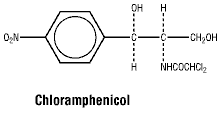
Chemical name: 2,2-dichloro-N-[(α-R, β-R) -β-hydroxy-α-hydroxymethyl-4-nitrophenethylene]-acetamide.
Molecular formula: C11H12Cl2N2O5.
Molecular weight: 323.1.
Chloramphenicol is a white to greyish white or yellowish white, fine crystalline powder or fine crystals, needles or elongated plates.
7 Medicine Schedule (Poisons Standard)
Pharmacist Only Medicine: S3.
Date of First Approval
30 October 1991
Date of Revision
31 August 2021
Summary Table of Changes

Reasonable care is taken to provide accurate information at the time of creation. This information is not intended as a substitute for medical advice and should not be exclusively relied on to manage or diagnose a medical condition. The Australian Commission on Safety and Quality in Health Care disclaims all liability (including for negligence) for any loss, damage, injury or any other negative effects resulting from reliance on or use of this information. Read our full disclaimer. This website uses cookies. Read our privacy policy.