
Miostat
Brand Information
| Brand name | Miostat |
| Active ingredient | Carbachol |
| Schedule | S4 |
Consumer Medicine Information (CMI) leaflet
Please read this leaflet carefully before you start using the Miostat.
Summary CMI
MIOSTAT™
Consumer Medicine Information (CMI) summary
The full CMI on the next page has more details. If you are worried about using this medicine, speak to your doctor or pharmacist.
1. Why am I using MIOSTAT?
MIOSTAT contains the active ingredient carbachol. This medicine works by stimulating the muscles inside the eye and is used to make your pupils constrict during eye surgery.
For more information, see Section 1. Why am I using MIOSTAT? in the full CMI.
2. What should I know before I use MIOSTAT?
Do not use if you have ever had an allergic reaction to MIOSTAT or any of the ingredients listed at the end of the CMI.
Talk to your doctor if you have any other medical conditions, take any other medicines, or are pregnant or plan to become pregnant or are breastfeeding.
For more information, see Section 2. What should I know before I use MIOSTAT? in the full CMI.
3. What if I am taking other medicines?
Some medicines may interfere with MIOSTAT and affect how it works.
A list of these medicines is in Section 3. What if I am taking other medicines? in the full CMI.
4. How do I use MIOSTAT?
- The amount of MIOSTAT Injection will be determined and administered by your doctor.
- MIOSTAT is only to be used by your doctor.
More instructions can be found in Section 4. How do I use MIOSTAT? in the full CMI.
5. What should I know while using MIOSTAT?
| Things you should do |
|
| Things you should not do |
|
| Driving or using machines |
|
| Looking after your medicine |
|
For more information, see Section 5. What should I know while using MIOSTAT? in the full CMI.
6. Are there any side effects?
All medicines can have side effects although not everybody gets them. The most common side effects of MIOSTAT include reactions at or near the site of injection. Less common side effects can include strong taste in the mouth, nausea and/or headache, gastrointestinal discomfort, abdominal pain, dizziness, light-headed or fainting, fatigue, etc.
For more information, including what to do if you have any side effects, see Section 6. Are there any side effects? in the full CMI.
Full CMI
MIOSTAT™
Active ingredient(s): carbachol
Consumer Medicine Information (CMI)
This leaflet provides important information about using MIOSTAT. You should also speak to your doctor or pharmacist if you would like further information or if you have any concerns or questions about using MIOSTAT.
Where to find information in this leaflet:
1. Why am I using MIOSTAT?
2. What should I know before I use MIOSTAT?
3. What if I am taking other medicines?
4. How do I use MIOSTAT?
5. What should I know while using MIOSTAT?
6. Are there any side effects?
7. Product details
1. Why am I using MIOSTAT?
MIOSTAT contains the active ingredient carbachol. This medicine works by stimulating the muscles inside the eye that are responsible for the contraction of the pupils.
Your doctor will inject MIOSTAT into your eyes to constrict your pupils during surgery.
Ask your doctor if you have any questions or concerns about why this medicine has been used on your eye(s).
2. What should I know before I use MIOSTAT?
Warnings
Do not use MIOSTAT if:
- You are allergic to carbachol, any of the ingredients listed at the end of this leaflet or any other similar medicines.
- You are allergic to natural latex
- Always check the ingredients to make sure you can use this medicine.
- Some of the symptoms of an allergic reaction may include:
- shortness of breath,
- wheezing or difficulty breathing
- swelling of the face, lips, tongue, or other parts of the body
- rash, itching or hives on the skin. - Do not use MIOSTAT if the expiry date has passed, the vial/packaging shows signs of tampering. If this medicine is used after the expiry date has passed, it may not work as well.
- If you are not sure whether you should be given MIOSTAT talk to your doctor.
Check with your doctor if you:
- Have any medical conditions, especially the following:
- Heart failure
- Asthma
- Stomach ulcer
- Stomach spasm
- Hyperthyroidism which is caused by an overactive thyroid gland
- Urinary tract obstruction
- Parkinson's disease - Have had an allergy to any other medicines or any other substances, such as foods, preservatives, or dyes.
- take any medicines for any other conditions.
If you have not told your doctor about any of the above, tell them before they administer MIOSTAT injection.
During treatment, you may be at risk of developing certain side effects. It is important you understand these risks and how to monitor for them. See additional information under Section 6. Are there any side effects?
Pregnancy and breastfeeding
Check with your doctor if you are pregnant or intend to become pregnant. Your doctor will discuss the possible risks and benefits of using MIOSTAT during pregnancy.
Talk to your doctor if you are breastfeeding or intend to breastfeed. Your doctor will discuss the possible risks and benefits of using MIOSTAT when breastfeeding.
Use in children
The safety and effectiveness of MIOSTAT Injection has not been established.
3. What if I am taking other medicines?
Tell your doctor or pharmacist if you are taking any other medicines, including any medicines, vitamins, or supplements that you buy without a prescription from your pharmacy, supermarket, or health food shop.
Check with your doctor or pharmacist if you are not sure about what medicines, vitamins or supplements you are taking and if these affect MIOSTAT.
Your doctor will advise you and decide whether or not to give you MIOSTAT.
4. How do I use MIOSTAT?
How much to use
- MIOSTAT is given as an injection into the eye(s) by your doctor.
- Your doctor will decide on the amount of MIOSTAT to be put into your eye(s)
When to use MIOSTAT
MIOSTAT is used during eye surgery.
If you forget to use MIOSTAT
Not applicable as MIOSTAT is only used by your doctor during surgery.
If you are given too much MIOSTAT
If you think that you have been given too much MIOSTAT, you may need urgent medical attention.
You should immediately:
- phone the Poisons Information Centre
(by calling 13 11 26), or - contact your doctor, or
- go to the Emergency Department at your nearest hospital.
You should do this even if there are no signs of discomfort or poisoning.
5. What should I know while using MIOSTAT?
Driving or using machines
You should not drive or operate any machinery after you have been given MIOSTAT.
As with any eye medicines, temporary blurred vision or other visual disturbances may affect the ability to drive or use machinery in some people. If blurred vision occurs, wait until your vision is clear before driving or operating machinery.
Looking after your medicine
MIOSTAT is usually stored in the doctor's surgery or hospital, or at the pharmacy.
However, if you need to store MIOSTAT keep it in a cool, dry place where the temperature stays below 25°C. Do not freeze MIOSTAT.
Follow the instructions in the carton on how to take care of your medicine properly.
Store it in a cool dry place away from moisture, heat or sunlight; for example, do not store it:
- in the bathroom or near a sink, or
- in the car or on window sills.
Keep MIOSTAT and all other medicine in a safe place.
Keep it where children cannot reach it. A locked cupboard at least one and a half metres above the ground is a good place to store medicines.
Getting rid of any unwanted medicine
If you no longer need to use this medicine or it is out of date, take it to any pharmacy for safe disposal.
Do not use this medicine after the expiry date.
6. Are there any side effects?
Tell your doctor as soon as possible if you do not feel well following the use of MIOSTAT.
All medicines can have side effects. If you do experience any side effects, most of them are minor and temporary. However, some side effects may need medical attention.
See the information below and, if you need to, ask your doctor if you have any further questions about side effects.
Less serious side effects
| Less serious side effects | What to do |
| Speak to your doctor if you have any of these less serious side effects and they worry you. |
Serious side effects
| Serious side effects | What to do |
Very serious side effects:
| Call your doctor straight away, or go straight to the Emergency Department at your nearest hospital if you notice any of these serious side effects. |
Tell your doctor or pharmacist if you notice anything else that may be making you feel unwell.
Other side effects not listed here may occur in some people.
Reporting side effects
After you have received medical advice for any side effects you experience, you can report side effects to the Therapeutic Goods Administration online at www.tga.gov.au/reporting-problems. By reporting side effects, you can help provide more information on the safety of this medicine.
Always make sure you speak to your doctor, nurse, or pharmacist before you decide to stop taking any of your medicines.
7. Product details
This medicine is only available with a doctor's prescription.
What MIOSTAT contains
| Active ingredient (main ingredient) | Carbachol 150 µg in 1.5 mL (0.01%) |
| Other ingredients (inactive ingredients) | Sodium chloride, Potassium chloride, Calcium chloride dihydrate, Magnesium chloride hexahydrate, Sodium acetate, Sodium citrate dihydrate, Sodium hydroxide and/or hydrochloric acid (to adjust pH), Water for Injections. |
| Potential allergens | The vial stopper contains natural rubber (latex). |
Do not use this medicine if you are allergic to any of these ingredients.
What MIOSTAT looks like
MIOSTAT is a clear solution that comes in a 1.5 mL vial. (AUST R 40624)
Who distributes MIOSTAT
MIOSTAT is distributed in Australia by:
Alcon Laboratories (Australia) Pty Ltd
ABN 88 000 740 83054
15 Talavera Road
Macquarie Park NSW 2113
Telephone: 1800 224 153
This leaflet was prepared in November 2025. Internal document code Mio191125c.
You should ensure that you speak to your doctor to obtain the most up to date information on the medicine.
You can also obtain a copy of the most up to date leaflet from your pharmacist. The updates may contain important information about the medicine and its use of which you should be aware.
Brand Information
| Brand name | Miostat |
| Active ingredient | Carbachol |
| Schedule | S4 |
MIMS Revision Date: 01 March 2021
1 Name of Medicine
Carbachol.
2 Qualitative and Quantitative Composition
Miostat intraocular injection contains carbachol 150 microgram/1.5 mL (0.01%).
For a full list of excipients, see Section 6.1 List of Excipients.
3 Pharmaceutical Form
Solution for injection.
Sterile, balanced salt solution of carbachol for intraocular injection.
4 Clinical Particulars
4.1 Therapeutic Indications
Intraocular use for miosis during surgery.
4.2 Dose and Method of Administration
This is not a multidose container and should not be used for more than one patient. Contains no antimicrobial agent. Use once only and discard any residue.
Aseptically remove the sterile vial from the blister package by peeling the backing paper and dropping the vial onto a sterile tray.
Withdraw the contents into a dry sterile syringe and replace the needle with an atraumatic cannula prior to intraocular irrigation. No more than one-half mL should be gently instilled into the anterior chamber for the production of satisfactory miosis. It may be instilled before or after securing sutures. Miosis is usually maximal within two to five minutes after application.
4.3 Contraindications
Should not be used in those persons showing hypersensitivity to any of the components of this medicine (see Section 6.1 List of Excipients).
4.4 Special Warnings and Precautions for Use
For single dose intraocular use only.
Discard unused portion.
Intraocular carbachol 0.01% should be used with caution in patients with acute cardiac failure, bronchial asthma, peptic ulcer, hyperthyroidism, G.I. spasm, urinary tract obstruction and Parkinson's disease.
The use of intraocular carbachol may increase surgically induced intraocular inflammation.
The vial stopper contains natural rubber (latex) which may cause severe allergic reactions.
Use in the elderly. No data available.
Paediatric use. Safety and efficacy in paediatric patients have not been established.
Effects on laboratory tests. No data available.
4.5 Interactions with Other Medicines and Other Forms of Interactions
No clinically relevant interactions have been described with intraocular carbachol.
4.6 Fertility, Pregnancy and Lactation
Effects on fertility. Studies have not been performed to evaluate the effect of topical ocular administration of carbachol on human fertility.
Use in pregnancy. (Category B2)
There are no adequate and well controlled studies in pregnant women. Animal studies do not indicate direct or indirect harmful effects with respect to reproductive toxicity. As a precautionary measure, it is preferable to avoid the use of intraocular carbachol during pregnancy. Carbachol should be used during pregnancy only if the potential benefit justifies the potential risk to the foetus.
Use in lactation. It is not known if carbachol is excreted in human milk. Because many drugs are excreted in human milk, caution should be exercised when carbachol is administered to a breastfeeding woman. Therefore, use only when considered essential by the physician.
4.7 Effects on Ability to Drive and Use Machines
Miosis may cause blurred vision and difficulty in dark adaptation. If temporary blurred vision occurs following surgery where intraocular carbachol was used, the patient must wait until vision clears before driving or using machinery.
4.8 Adverse Effects (Undesirable Effects)
Ocular. Corneal clouding, persistent bullous keratopathy and postoperative iritis following cataract extraction with utilisation of intraocular carbachol have been reported with the occasional patient. As with all miotics, retinal detachment has been reported when miotics are used in certain susceptible individuals.
Systemic. Side effects such as flushing, sweating, epigastric distress, abdominal cramps, tightness in urinary bladder and headache have been reported after systemic or topical use of carbachol. These symptoms were not reported following intraocular use of carbachol in premarketing studies.
Postmarketing events. The following adverse reactions are classified according to the following convention: very common (≥ 1/10); common (≥ 1/100 to < 1/10); uncommon (≥ 1/1,000 to < 1/100); rare (≥ 1/10,000 to < 1/1,000); very rare (< 1/10,000); or not known (cannot be estimated from the available data), according to system organ classes. Within each frequency grouping, adverse reactions are presented in order of decreasing seriousness. The adverse reactions have been observed during clinical trials and postmarketing experience with intraocular carbachol:
Nervous system disorders. Uncommon (≥ 0.1% to < 1%): headache.
Eye disorders. Uncommon (≥ 0.1% to < 1%): intraocular pressure increased.
Not known: corneal opacity, anterior chamber inflammation, corneal oedema, eye inflammation, visual impairment, corneal degeneration, drug effect prolonged (miosis), vision blurred, eye pain, ocular hyperaemia.
Gastrointestinal disorders. Not known: vomiting.
Reporting suspected adverse effects. Reporting suspected adverse reactions after registration of the medicinal product is important. It allows continued monitoring of the benefit-risk balance of the medicinal product. Healthcare professionals are asked to report any suspected adverse reactions at www.tga.gov.au/reporting-problems and in New Zealand, at www.medsafe.govt.nz/Safety/report-a-problem.asp.
4.9 Overdose
In case of overdose, symptoms of toxicity may include: headache, salivation, syncope, bradycardia, hypotension, abdominal cramps, vomiting, asthma and diarrhoea.
Treatment of overdose is supportive. In cases of severe systemic toxicity therapy with anticholinergics may be necessary. Atropine should be administered parenterally (for dosage refer to Goodman and Gilman or other pharmacology reference).
For information on the management of overdose in Australia contact the Poisons Information Centre on 13 11 26; in New Zealand call 0800 POISON or 0800 764 766.
5 Pharmacological Properties
5.1 Pharmacodynamic Properties
Mechanism of action. Carbachol is a potent cholinergic (parasympathomimetic) agent.
Clinical trials. No data available.
5.2 Pharmacokinetic Properties
No data available.
5.3 Preclinical Safety Data
Genotoxicity. No data available.
Carcinogenicity. Studies in animals to evaluate the carcinogenic potential have not been conducted.
6 Pharmaceutical Particulars
6.1 List of Excipients
Sodium chloride 9.6 mg; potassium chloride 1.125 mg; calcium chloride dihydrate 720 microgram; magnesium chloride hexahydrate 450 microgram; sodium acetate 5.85 mg; sodium citrate dihydrate 2.55 mg; sodium hydroxide and/or hydrochloric acid (to adjust pH); water for injections.
6.2 Incompatibilities
Incompatibilities were either assessed or not identified as part of the registration of this medicine.
6.3 Shelf Life
2 years.
In Australia, information on the shelf life can be found on the public summary of the Australian Register of Therapeutic Goods (ARTG). The expiry date can be found on the packaging.
6.4 Special Precautions for Storage
Store below 25°C. Do not freeze.
6.5 Nature and Contents of Container
1.5 mL vials; packed twelve to a carton or as single vials when supplied with Custom-Pak. The vial stopper contains natural rubber (latex).
6.6 Special Precautions for Disposal
In Australia, any unused medicine or waste material should be disposed of in accordance with local requirements.
6.7 Physicochemical Properties
Chemical structure.
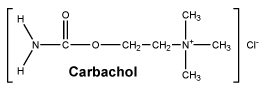
Established name: carbachol.
Chemical name: 2-[(aminocarbonyl) oxy]-N,N,N-trimethylethanaminium chloride.
7 Medicine Schedule (Poisons Standard)
Prescription only medicine (Schedule 4).
Date of First Approval
29 June 1992
Date of Revision
27 January 2021
Summary Table of Changes

Reasonable care is taken to provide accurate information at the time of creation. This information is not intended as a substitute for medical advice and should not be exclusively relied on to manage or diagnose a medical condition. The Australian Commission on Safety and Quality in Health Care disclaims all liability (including for negligence) for any loss, damage, injury or any other negative effects resulting from reliance on or use of this information. Read our full disclaimer. This website uses cookies. Read our privacy policy.