
Movicol Ready To Take
Brand Information
| Brand name | Movicol Ready To Take |
| Active ingredient | Macrogol 3350 + Sodium chloride + Sodium bicarbonate + Potassium chloride |
| Schedule | Unscheduled |
No current CMI was found.
Brand Information
| Brand name | Movicol Ready To Take |
| Active ingredient | Macrogol 3350 + Sodium chloride + Sodium bicarbonate + Potassium chloride |
| Schedule | Unscheduled |
MIMS Revision Date: 01 December 2020
1 Name of Medicine
Macrogol 3350 and electrolytes (sodium chloride, sodium bicarbonate, potassium chloride).
2 Qualitative and Quantitative Composition
Each 25 mL of Movicol Ready To Take oral solution contains: macrogol 3350 13.125 g, sodium chloride 350.8 mg, sodium bicarbonate 178.6 mg, potassium chloride 50.2 mg.
The concentration of electrolyte ions in each 25 mL sachet is: sodium 325 mmol/L, chloride 267 mmol/L, potassium 27 mmol/L, bicarbonate 85 mmol/L.
This corresponds to the following amount of each electrolyte in each 25 mL dose: sodium 8.125 mmol, chloride 6.675 mmol, potassium 0.675 mmol, bicarbonate 2.125 mmol.
Excipient with known effect. Sucralose.
For the full list of excipients, see Section 6.1 List of Excipients.
3 Pharmaceutical Form
Oral solution.
A clear colourless to light yellow, free flowing liquid.
4 Clinical Particulars
4.1 Therapeutic Indications
For use in adults and children over 12 years of age for effective relief from constipation and treatment of chronic constipation.
4.2 Dose and Method of Administration
Movicol Ready To Take should be used directly from the sachet. This product does not need to be diluted with water.
The fluid content of Movicol Ready To Take does not replace regular fluid intake and adequate fluid intake must be maintained. It is recommended that patients drink a glass of water or other fluid after taking Movicol Ready To Take.
Adults and children 12 years and older. Constipation. One sachet of Movicol Ready To Take once daily. This may be increased to 2-3 sachets daily, if required according to individual response.
Children under 12 years of age. Movicol Ready To Take is not recommended for use in children below the age of 12 years (see Section 4.4 Special Warnings and Precautions for Use). Alternative Movicol products are available for children.
Patients with impaired cardiovascular function. No more than two sachets should be taken in any one hour.
Patients with renal insufficiency. No dosage change is necessary for treatment of constipation.
4.3 Contraindications
Intestinal perforation or obstruction due to structural or functional disorder of the gut wall, ileus and severe inflammatory conditions of the intestinal tract, such as Crohn's disease, ulcerative colitis and toxic megacolon.
Known hypersensitivity to macrogol or any of the ingredients.
4.4 Special Warnings and Precautions for Use
Adverse reactions are possible as described, see Section 4.8 Adverse Effects (Undesirable Effects). If patients develop any symptoms indicating shifts of fluid/electrolytes (e.g. oedema, shortness of breath, increasing fatigue, dehydration, cardiac failure) Movicol Ready To Take should be stopped immediately and electrolytes measured, and any abnormality should be treated appropriately.
The absorption of other medicines could transiently be reduced due to a decrease in gastro-intestinal transit time induced by Movicol Ready To Take (see Section 4.5 Interactions with Other Medicines and Other Forms of Interactions).
This medicinal product contains 187 mg of sodium per sachet, equivalent to 9.3% of the WHO recommended maximum daily intake of 2 g sodium for an adult. The maximum daily dose of this product for constipation (i.e. 3 sachets) is equivalent to 28% of the WHO recommended maximum daily intake for sodium. Movicol Ready To Take is considered high in sodium. This should be particularly taken into account for those on a low salt diet.
As with all laxatives, prolonged use is not usually recommended and may lead to dependence. If prolonged use is necessary, it should only be under medical supervision. Extended use may be necessary in the care of patients with severe chronic or resistant constipation, secondary to multiple sclerosis or Parkinson's disease, or induced by regular constipating medication, in particular opioids and antimuscarinics. Patients should be advised to drink plenty of water. They should also increase fibre in the diet, except in the case of medication-induced constipation.
Use in the elderly. No data available.
Paediatric use. Not recommended. Alternative Movicol products are available for children.
Effects on laboratory tests. No data available.
4.5 Interactions with Other Medicines and Other Forms of Interactions
There is a possibility that the absorption of other medicines could be transiently reduced during use with Movicol Ready To Take (see Section 4.4 Special Warnings and Precautions for Use). There have been isolated reports of decreased efficacy with some concomitantly administered medicinal products, e.g. anti-epileptics.
A theoretical potential also exists for decreased absorption (rate and extent) of drugs which are generally poorly absorbed or are contained in sustained or modified release dosage forms. This is more likely to occur if Movicol Ready To Take is overdosed to induce watery diarrhoea.
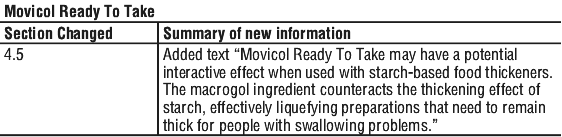
Movicol Ready To Take may have a potential interactive effect when used with starch-based food thickeners. The macrogol ingredient counteracts the thickening effect of starch, effectively liquefying preparations that need to remain thick for people with swallowing problems.
4.6 Fertility, Pregnancy and Lactation
Effects on fertility. No data available.
Use in pregnancy. (Category B1)
Pregnancy Category B1: drugs which have been taken by only a limited number of pregnant women and women of childbearing age, without an increase in the frequency of malformation or other direct or indirect harmful effects on the human foetus having been observed. Studies in animals have not shown evidence of an increased occurrence of foetal damage.
There were no direct embryotoxic or teratogenic effects in rats at maternally toxic doses up to 40 g/kg/day, 51 x the maximum recommended dose in humans for chronic constipation.
Indirect effects, including reduction in fetal and placental weights, reduced fetal viability and abortions, were noted in the rabbit at doses below the maximum recommended human dose. Rabbits are particularly sensitive to the effects of GI acting substances, and the findings are considered most likely a reflection of poor maternal condition as a result of an exaggerated pharmacodynamic response rather than direct embryofetal toxicity. There was no indication of a teratogenic effect.
Use in lactation. No effects on the breastfed newborn/infant are anticipated since the systemic exposure of the breastfeeding woman to macrogol 3350 is negligible.
Movicol Ready To Take can be used during breastfeeding.
4.7 Effects on Ability to Drive and Use Machines
Movicol Ready To Take has no influence on the ability to drive or use machines.
4.8 Adverse Effects (Undesirable Effects)
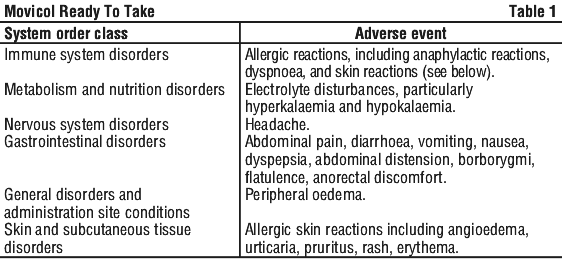
Reactions related to the gastrointestinal tract occur most commonly. These reactions may occur as a consequence of expansion of the contents of the gastrointestinal tract, and an increase in motility due to the pharmacologic effects of Movicol Ready To Take. Diarrhoea usually responds to dose reduction. See Table 1.
4.9 Overdose
Severe pain or distension can be treated by nasogastric aspiration. Extensive fluid loss by diarrhoea or vomiting may require correction of electrolyte disturbances. For information on the management of overdose, contact the Poisons Information Centre on 13 11 26 (Australia).
5 Pharmacological Properties
5.1 Pharmacodynamic Properties
Mechanism of action. Macrogol 3350 exerts an osmotic action in the gut, which induces a laxative effect. Macrogol 3350 increases the stool volume, which triggers colon motility via neuromuscular pathways. The physiological consequence is an improved propulsive colonic transportation of the softened stools and a facilitation of the defaecation. Electrolytes combined with macrogol 3350 are exchanged across the intestinal barrier (mucosa) with serum electrolytes and excreted in faecal water without net gain or loss of sodium, potassium and water.
The laxative action of macrogol has a time course which will vary according to the severity of the constipation being treated.
Clinical trials. No data available.
5.2 Pharmacokinetic Properties
Macrogol 3350 is unchanged along the gut. It is virtually unabsorbed from the gastrointestinal tract. Any macrogol 3350 that is absorbed is excreted via the urine.
5.3 Preclinical Safety Data
Genotoxicity. Preclinical studies provide evidence that macrogol 3350 has no significant systemic toxicity potential, based on conventional studies of pharmacology, repeated dose toxicity, genotoxicity and toxicity to reproduction.
Carcinogenicity. There are long-term animal toxicity and carcinogenicity studies involving macrogol 3350. Results from these and other toxicity studies using high levels of orally administered high molecular weight macrogols provide evidence of safety at the recommended therapeutic dose.
6 Pharmaceutical Particulars
6.1 List of Excipients
Movicol Ready To Take oral solution also contains sucralose (E955), purified water, and strawberry-banana flavour, which contains natural flavouring substances, flavouring preparations (including celery oil) and propylene glycol.
6.2 Incompatibilities
Incompatibilities were either not assessed or not identified as part of the registration of this medicine.
6.3 Shelf Life
In Australia, information on the shelf life can be found on the public summary of the Australian Register of Therapeutic Goods (ARTG). The expiry date can be found on the packaging.
6.4 Special Precautions for Storage
Store below 30°C. Do not refrigerate or freeze.
6.5 Nature and Contents of Container
Movicol Ready To Take is a liquid for oral solution that does not require dilution before use. It is supplied in 25 mL sachets, in boxes of 10, 20, 30 and 50 sachets.
Not all pack sizes may be marketed.
6.6 Special Precautions for Disposal
In Australia, any unused medicine or waste material should be disposed of by taking to your local pharmacy.
6.7 Physicochemical Properties
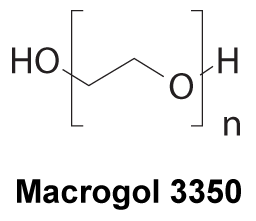
Chemical structure. Macrogol 3350.
Sodium bicarbonate. NaHCO3.
Potassium chloride. KCl.
CAS number. Macrogol 3350. 25322-68-3.
Sodium chloride. 7647-14-5.
Sodium bicarbonate. 144-55-8.
Potassium chloride. 7447-40-7.
7 Medicine Schedule (Poisons Standard)
Unscheduled.
Date of First Approval
03 May 2016
Date of Revision
29 October 2020
Summary Table of Changes
Reasonable care is taken to provide accurate information at the time of creation. This information is not intended as a substitute for medical advice and should not be exclusively relied on to manage or diagnose a medical condition. The Australian Commission on Safety and Quality in Health Care disclaims all liability (including for negligence) for any loss, damage, injury or any other negative effects resulting from reliance on or use of this information. Read our full disclaimer. This website uses cookies. Read our privacy policy.