
Practice Reflections are personalised reports that provide confidential information for individual Australian General Practitioners (GPs) on their Pharmaceutical Benefits Scheme (PBS) prescribing or Medicare Benefits Schedule (MBS tests) in specific clinical areas.
Found 479 result(s)

The Commission recognises the importance of delivering sustainable healthcare and reducing harm from environmental impacts.
Resources for consumers, clinicians, and healthcare services to support implementation of the Colonoscopy Clinical Care Standard, and about assessment to the NSQHS resources.
Information about the safe and responsible use of Artificial Intelligence (AI) in healthcare.
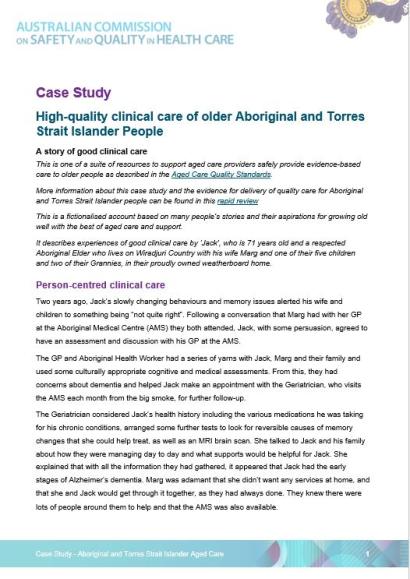
The Integrated Health and Aged Care Services (IHACS) Module and User Guide is the primary resource for providers. The resources for the IHACS Module listed on this page are categorised in terms of the Module item that they support.
The Commission manages several Australian health service accreditation schemes. These are the details of accrediting agencies for each of those schemes.
Clinical variation is a difference in healthcare processes or outcomes, compared to peers or to a gold standard such as an evidence-based guideline recommendation.
The Commission's new Better Care Everywhere initiative will bring together the wide range of guidance, tools and resources developed by the Commission to provide a comprehensive approach to promoting appropriate and sustainable health care.
This page includes information on infection prevention and control (IPC) strategies for Candida auris (C. auris).
C. auris is a fungus (yeast) that is resistant to a range of antifungal medicines and can cause serious infections in patients who are immunocompromised. The severity, communicability, and drug resistance associated with C. auris infections means that correct identification and management of C. auris is crucial for the treatment and control of disease.
People receiving care have a unique perspective on the day-to-day running of a health service and how this affects them. Patient experience captures the events and experiences relevant to patients in health care.