
Aeris Medical E.P. Grade Compressed Air
Brand Information
| Brand name | Aeris Medical E.P. Grade Compressed Air |
| Active ingredient | Air |
| Schedule | Unscheduled |
Consumer Medicine Information (CMI) leaflet
Please read this leaflet carefully before you start using the Aeris Medical E.P. Grade Compressed Air.
Summary CMI
Aeris Medical Medical EP Grade Compressed Air
Consumer Medicine Information (CMI) summary
The full CMI on the next page has more details. If you are worried about using Medical Air, speak to your doctor, nurse or pharmacist.
1. Why am I using Aeris Medical Medical EP Grade Compressed Air?
Aeris Medical Medical EP Grade Compressed Air contains the active ingredient Medical Air. Medical Air is used to help with normal breathing, to carry other gases to your lungs, or to help you inhale certain other medicines.
For more information, see Section 1. in the full CMI.
2. What should I know before I use Aeris Medical Medical EP Grade Compressed Air?
Do not use Medical Air if:
- Your doctor has said that you need to inhale oxygen or other gases that don't need to have air as a carrier
- You smoke or intend to smoke or anyone near you is smoking or there are open lights nearby
- The cylinder is damaged or has the tamper evident plastic seal removed
You can use Medical Air if you are planning to be pregnant, are pregnant or breastfeeding.
Talk to your doctor if you have any other medical conditions or take any other medicines.
For more information, see Section 2. in the full CMI.
3. What if I am taking other medicines?
There are normally no problems if you are taking other medicines when using Medical Air. Tell your doctor anyway about any other medicines you are taking.
See also Section 3. in the full CMI.
4. How do I use Aeris Medical Medical EP Grade Compressed Air?
- You may receive Medical Air in several different ways including via a mask or a tube in your throat (during anaesthetic).
- Your doctor will decide how much you can have.
More instructions can be found in Section 4. in the full CMI.
5. What should I know while using Aeris Medical Medical EP Grade Compressed Air?
| Things you should do |
|
| Things you must not do |
|
| Looking after your medicine |
|
For more information, see Section 5. in the full CMI.
6. Are there any side effects?
There are no known side effects of Medical Air. For information about what to do if you get any side effects, see Section 6. in the full CMI.
Full CMI
Aeris Medical Medical EP Grade Compressed Air
Active ingredient: Medical Air
Consumer Medicine Information (CMI)
This leaflet provides important information about using Aeris Medical Medical EP Grade Compressed Air.
Speak to your doctor, nurse or pharmacist if you want more information, if you are worried or have questions about using Medical Air.
Where to find information in this leaflet:
1. Why am I using Aeris Medical Medical EP Grade Compressed Air?
2. What should I know before I use Aeris Medical Medical EP Grade Compressed Air?
3. What if I am taking other medicines?
4. How do I use Aeris Medical Medical EP Grade Compressed Air?
5. What should I know while using Aeris Medical Medical EP Grade Compressed Air?
6. Are there any side effects?
7. Product details
1. Why am I using Aeris Medical Medical EP Grade Compressed Air?
Aeris Medical Medical EP Grade Compressed Air contains the active ingredient Medical Air. It is a medical gas.
Medical Air is used to help with normal breathing, to carry other gases to your lungs, or to help you inhale certain other medicines.
2. What should I know before I use Aeris Medical Medical EP Grade Compressed Air?
Warnings
Do not use Medical Air if:
- Your doctor has said that you need to inhale oxygen or other gases that don't need to have air as a carrier
- You smoke or intend to smoke or anyone near you is smoking
- There are open lights nearby
- The cylinder is damaged or has the tamper evident plastic seal removed
- The cylinder does not have a pin index valve attached (the person who sets the cylinder up for you will check this).
Check with your doctor if you:
- Have any other medical conditions
- Take any other medicines
Only use it if your doctor has said it is OK.
There are no known side effects of Medical Air. See extra information under Section 6. Are there any side effects?
Pregnancy and breastfeeding
You can use Medical Air if you are planning to become pregnant, are pregnant or breastfeeding.
Special age groups
Medical Air is used in the same way for people of all ages.
3. What if I am taking other medicines?
Tell your doctor or pharmacist if you are taking any other medicines.
There is normally no problem with using medicines with Medical Air.
Check with your doctor or pharmacist if you are not sure about whether any medicines, vitamins or supplements you are taking may affect you when you are using Medical Air.
4. How do I use Aeris Medical Medical EP Grade Compressed Air?
How much to use
- Your doctor will decide how much you can have.
- Follow the instructions provided and use Medical Air until your doctor tells you to stop.
How to use Aeris Medical Medical EP Grade Compressed Air
- You may receive Medical Air in different ways including via a mask or a tube in your throat (during anaesthetic).
- You will have help in setting up and using the cylinder and attachments - follow the instructions you are given, including what to do in an emergency
- The cylinder must be handled carefully with suitable equipment and should not be knocked violently or allowed to fall over
- Only use medical air for the medical purpose that your doctor has stated.
If you have had too much Medical Air
It is unlikely that you could have too much Medical Air, but if you do start to feel unwell then:
You must immediately:
- Contact your doctor or nurse or pharmacist, or
- Go to the Emergency Department at your nearest hospital, or
- Phone the Poisons Information Centre
(by calling 13 11 26)
5. What should I know while using Aeris Medical Medical EP Grade Compressed Air?
Things you should do
- Remind any doctor, dentist, nurse or pharmacist you see that you are using Medical Air
- Make sure the cylinder is secured upright so that it won't fall over, and is in a well-ventilated area
- Make sure your hands are clean and free from oils or grease
- Check how much air is in the cylinder by looking at the pressure gauge.
Things you must not do
- Do not smoke or stand near other smokers or open lights while using medical air
- Do not use any oil-based products on the cylinder, connections or mask
- Do not use the gas for any other purpose.
Driving or using machines
Be careful before you drive or use any machines or tools until you know how Medical Air affects you.
Medical Air alone does not normally affect alertness in people.
Check with your doctor to see if it is OK for you to drive or operate machines.
Looking after your medicine
- Store below 30 degrees Celsius
- Make sure the cylinder does not get too hot or too cold
- Be careful when storing and handling the cylinder and attachments
Follow the instructions carefully.
Keep it where children cannot reach it.
Getting rid of any unwanted medical air
If you no longer need to use this, the cylinder is empty or it is out of date, first close the cylinder valve (using moderate force only), release the pressure and put on the valve regulator cap (if there is one fitted).
Ask your supplier (hospital or pharmacy) to collect it from you.
Do not keep the cylinder after its expiry date.
6. Are there any side effects?
There are no known side effects of Medical Air.
Tell your doctor, nurse or pharmacist if you do start to feel unwell.
Side effects not yet known about may occur in some people.
Reporting side effects
After you have received medical advice for any side effects that you have had, you can report these side effects to the Therapeutic Goods Administration online at www.tga.gov.au/reporting-problems. By reporting side effects, you can help provide more information on the safety of this medicine.
Always make sure you speak to your doctor nurse or pharmacist before you decide to stop taking any of your medicines.
7. Product details
This is normally supplied for use in hospitals or delivered to your home for use there.
What Aeris Medical Medical EP Grade Compressed Air contains
Medical Air is composed of:
Nitrogen 78.1% v/v
Oxygen 20.9% v/v
Argon 0.9% v/v
What Aeris Medical Medical EP Grade Compressed Air looks like
Aeris Medical Medical EP Grade Compressed Air has no smell and it is colourless.
The cylinders have a white body, black and white shoulder and black and white dome.
They are sealed with a Pin Index valve outlet.
They may be available in the following pack sizes:
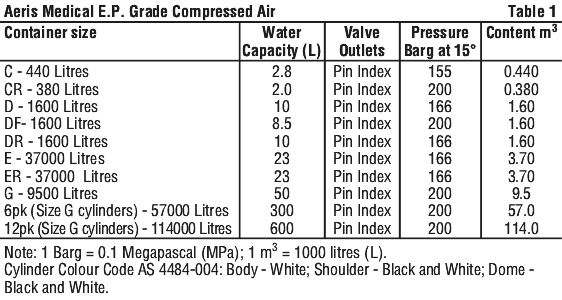
| Container Size | Water capacity (Litres) | Pressure Barg at 15° | Content m³ |
| C (440 Litres) | 1.5 | 155 | 0.440 |
| CR (380 Litres) | 2.0 | 200 | 0.380 |
| D (1600 Litres) | 10 | 166 | 1.60 |
| DF (1600 Litres) | 8.5 | 200 | 1.60 |
| DR (1600 Litres) | 10 | 166 | 1.60 |
| E (37000 Litres) | 23 | 166 | 3.70 |
| ER (37000 Litres) | 23 | 166 | 3.70 |
| G (9500 Litres) | 50 | 200 | 9.5 |
| 6pack (57000 Litres) | 300 | 200 | 57.0 |
| 12 pack (114000 Litres) | 600 | 200 | 114.0 |
Note: 1 Barg = 0.1 Megapascal (MPa); 1 m³ = 1000 litres (L)
(Not all pack sizes may be available)
Aust R 155229.
Who distributes Aeris Medical Medical EP Grade Compressed Air
Supagas Pty Ltd
23 Commercial Drive
Dandenong South
VIC 3175
www.supagas.com.au
This leaflet was prepared in October 2020.
© 2020 Supagas Pty Ltd
Brand Information
| Brand name | Aeris Medical E.P. Grade Compressed Air |
| Active ingredient | Air |
| Schedule | Unscheduled |
MIMS Revision Date: 01 February 2021
1 Name of Medicine
Air.
2 Qualitative and Quantitative Composition
Each cylinder of the medicinal gas contains 100% v/v Air E.P. grade, consisting of:
Nitrogen 78.1% v/v;
Oxygen 20.9% v/v;
Argon 0.9% v/v.
3 Pharmaceutical Form
Medicinal gas.
Odourless, colourless gas.
4 Clinical Particulars
4.1 Therapeutic Indications
Air for medical use.
For normal respiration.
In anaesthetic equipment as a carrier gas during surgery.
For nebulisation of inhaled drugs when oxygen supplementation is not required.
4.2 Dose and Method of Administration
Dosage. There is no distinction in the use of medical air between age groups.
Method of administration. For breathing purposes, medical air is administered by various means, commonly by self-contained or compressed air breathing apparatus.
In anaesthesia medical air is administered from a cylinder and valve assembly or pipeline through a face mask or endotracheal tube.
4.3 Contraindications
Medical air is not indicated when medical oxygen or other medical gases are required (unless as a carrier). See Section 4.4 Special Warnings and Precautions for Use.
4.4 Special Warnings and Precautions for Use
General. Medical air should never be given unless it contains 20.4 - 21.4% oxygen. Will support combustion.
Check the following before use:
Medical air cylinders are fitted with an appropriate pin index valve in accordance with Australian Standards (see Section 4.2 Dose and Method of Administration, Handling and instructions for use (below)). Only medical air devices with compatible connection to the pin index valve can be used.
Cylinder pressure may be used as an indicator of the quantity of gas remaining in the cylinder.
Use of gas cylinders. The normal precautions required for the storage and use of medical air cylinders are applicable. Because the contents are under pressure and are sometimes hazardous, there are special safety regulations for handling bottled gases. These include chaining bottles to prevent falling and breaking, proper ventilation to prevent injury or death in case of leaks and signage to indicate the potential hazards. Installing and replacing gas cylinders should be done by trained personnel.
Under no circumstances should oils or grease be used to lubricate any part of the compressed gas medical air cylinder or the associated equipment used to deliver the gas to the patient.
Cylinders must be kept out of reach of children.
Cylinders must not be exposed to extremes of temperature. Always ensure hands are clean and free from any oils or grease.
See Section 4.2 Dose and Method of Administration, Handling and instructions for use (below); Section 6.4 Special Precautions for Storage.
Additional information is contained in the Safety Data Sheet from the Sponsor.
Handling and instructions for use. Cylinders must be fitted with an appropriate pressure-reducing device; see Section 4.4 Special Warnings and Precautions for Use. Consult the information provided by the Sponsor about operating procedures for the cylinders. Do not use medical air if the cylinder is damaged or has the tamper evident plastic seal removed.
All personnel handling medical air should have adequate knowledge of:
Properties of the gas.
Correct operating procedures for the cylinder.
Precautions and actions to be taken in the event of an emergency.
Under no circumstances should oils or grease be used to lubricate any part of the compressed gas medical air cylinder or the associated equipment used to deliver the gas to the patient. Always ensure hands are clean and free from any oils or grease.
When compressed medical air cylinders are in use, ensure that they are:
Only used for medicinal purposes.
Only moved with the appropriate size and type of trolley or handling device.
Handled with care and not knocked violently or allowed to fall.
Firmly secured to a suitable cylinder support when in use.
Not used in the vicinity of persons smoking or near naked lights.
When the compressed medical air cylinder is empty ensure that:
The cylinder valve is closed using moderate force only and the pressure in the regulator or Tailpipe released, and the valve outlet cap, where fitted, is replaced.
Empty cylinders are immediately returned to the empty cylinder store for return to the supplier.
Use in the elderly. Use of medical air is not differentiated between age groups. Medical air does not adversely affect the elderly.
Paediatric use. Use of medical air is not differentiated between age groups. Medical air does not adversely affect children.
Effects on laboratory tests. Not applicable.
4.5 Interactions with Other Medicines and Other Forms of Interactions
None known.
4.6 Fertility, Pregnancy and Lactation
Effects on fertility. Medical air does not adversely affect fertility.
Use in pregnancy. (Category A)
Medical air does not adversely affect pregnancy.
Use in lactation. Medical air does not adversely affect lactation.
4.7 Effects on Ability to Drive and Use Machines
Medical air does not affect ability to drive or use machinery.
4.8 Adverse Effects (Undesirable Effects)
There are no known adverse effects of medical air.
Reporting suspected adverse effects. Reporting suspected adverse reactions after registration of the medicinal product is important. It allows continued monitoring of the benefit-risk balance of the medicinal product.
Healthcare professionals are asked to report any suspected adverse reactions at www.tga.gov.au/reporting-problems.
4.9 Overdose
Not applicable.
For information on the management of overdose, contact the Poisons Information Centre on 131126 (Australia).
5 Pharmacological Properties
5.1 Pharmacodynamic Properties
The pharmacology of medical air is the same as that for atmospheric air.
Pharmacotherapeutic group: GASMED, Gas, Medical. ATC Code: V03AN.
Clinical trials. None stated.
5.2 Pharmacokinetic Properties
The pharmacokinetics of medical air are the same as those for atmospheric air.
5.3 Preclinical Safety Data
Genotoxicity. Medical air does not increase genotoxic risk.
Carcinogenicity. Medical air does not increase carcinogenic risk.
6 Pharmaceutical Particulars
6.1 List of Excipients
None applicable.
6.2 Incompatibilities
Incompatibilities were either not assessed or not identified as part of the registration of this medicine.
6.3 Shelf Life
In Australia, information on the shelf life can be found on the public summary of the Australian Register of Therapeutic Goods (ARTG). The expiry date can be found on the packaging.
6.4 Special Precautions for Storage
Store below 30 degrees Celsius.
The normal precautions required in the storage and use of medical gas cylinders are applicable. Also see Section 4.4 Special Warnings and Precautions for Use.
6.5 Nature and Contents of Container
Aluminium alloy (Size C) or steel (Sizes D, E and G) gas cylinder with brass valve closure. The CR, DR and ER gas cylinders are supplied with integrated analogue regulator.
Pack sizes. See Table 1.
6.6 Special Precautions for Disposal
Empty cylinders are immediately returned to the empty cylinder store for return to the supplier.
6.7 Physicochemical Properties
Compressed medical gas 100% v/v Air E.P. grade complies with current European Pharmacopoeial specifications:
Oxygen (O2): 20.4% to 21.4% v/v.
Carbon dioxide: Not more than 500 ppm v/v.
Carbon monoxide: Not more than 5 ppm v/v.
Sulfur dioxide: Not more than 1 ppm v/v.
Oil: Not more than 0.1 mg/m3.
Nitrogen monoxide and nitrogen dioxide: Not more than 2 ppm v/v in total.
Water: Not more than 67 ppm v/v.
Appearance: Odourless, colourless gas.
Molecular mass: 29.0 g/mol.
Relative density (Air = 1): 1.0.
Density (101.325 kPa at 15°C): 1.22 kg/m3.
Boiling point: -194°C.
Solubility in water (101.33 kPa at 20°C): 0.018 cm3/cm3.
Combustion characteristics: Non-flammable. Inert.
Constituents:
Chemical structure.
Molecular formula. Nitrogen: N2;
Oxygen: O2;
Argon: Ar.
CAS number. Nitrogen: 7727-37-9;
Oxygen: 7782-44-7;
Argon: 7440-37-1.
7 Medicine Schedule (Poisons Standard)
Not scheduled.
Date of First Approval
29 January 2014
Date of Revision
01 December 2020
Summary Table of Changes

Reasonable care is taken to provide accurate information at the time of creation. This information is not intended as a substitute for medical advice and should not be exclusively relied on to manage or diagnose a medical condition. The Australian Commission on Safety and Quality in Health Care disclaims all liability (including for negligence) for any loss, damage, injury or any other negative effects resulting from reliance on or use of this information. Read our full disclaimer. This website uses cookies. Read our privacy policy.