
Daktarin Cream
Brand Information
| Brand name | Daktarin Cream |
| Active ingredient | Miconazole nitrate |
| Schedule | S2 |
Consumer Medicine Information (CMI) leaflet
Please read this leaflet carefully before you start using the Daktarin Cream.
What is in this leaflet
This leaflet answers some of the common questions about DAKTARIN Cream. It does not contain all of the available information or take the place of talking to your doctor or pharmacist.
If you have any concerns about using DAKTARIN Cream, ask your doctor or pharmacist. Your doctor and pharmacist have more information.
Keep this leaflet with your DAKTARIN Cream. You may need to read it again.
What DAKTARIN Cream is used for
DAKTARIN Cream is a medicine used for treating athlete's foot, tinea, ringworm and thrush infections of the skin caused by fungi, including yeast.
Your doctor or pharmacist may have recommended DAKTARIN Cream for another reason. Ask your doctor or pharmacist if you have any questions about why DAKTARIN Cream has been recommended for you.
Before you use DAKTARIN Cream
When you must not use it
Do not use DAKTARIN Cream if you know you are allergic to:
- miconazole or any of the ingredients (see the last section of this leaflet for a full list of ingredients)
- similar antifungal agents such as ketoconazole.
Do not use DAKTARIN Cream if:
- you are pregnant or breastfeeding, unless your doctor has advised you to
- the packaging is torn or shows signs of being tampered with
- the expiry date (month and year) printed on the pack has passed. If you take it after the expiry date it may not work.
Taking other medicines
Consult your doctor or pharmacist first if you are planning on using DAKTARIN Cream and are taking any of the following medicines because it may affect the way these medicines work:
- oral anticoagulants such as warfarin used to prevent blood clots
- oral hypoglycemics used by diabetics to lower blood sugar levels in blood
- phenytoin used to treat epilepsy and convulsions.
Using DAKTARIN Cream
How to use it
Wash the affected area and dry thoroughly. (Reserve a special towel for this purpose.)
Apply a thin layer of cream to the affected area twice daily. Rub the cream into the skin with your finger until it has fully penetrated. Continue treatment until all signs of the infection have disappeared (usually two to four weeks).
Important Notes:
- Keep a separate face washer and towels for your own use to avoid infecting other people.
- Regularly change clothing, which comes into contact with the infected areas to avoid reinfecting yourself.
- Clean the site of infection twice daily to prevent build up of fungal cells.
- Keep the areas of infection well ventilated. Do not apply moisturisers to the site of infection as this will promote the growth of fungus. If infection involves the feet, footwear that make the feet perspire should be avoided.
If you forget to use it
If you forget to use DAKTARIN Cream, do so as soon as you remember, and then go back to using it as you would normally.
If you have problems remembering when to take your medicine, ask your pharmacist for some hints.
KEEP OUT OF REACH OF CHILDREN.
While you are using DAKTARIN Cream
Things you must do
If your symptoms do not improve after using DAKTARIN Cream, see your healthcare professional.
Things you must not do
Do not use DAKTARIN Cream near the eyes.
Do not use this medicine to treat any other complaints unless your doctor tells you to.
Do not give it to anyone else, even if their condition seems similar to yours.
Side Effects
All medicines have side effects. Sometimes they are serious, most of the time they are not. You may need medical treatment if you get some side effects.
DAKTARIN Cream is usually well tolerated. However, it may sometimes cause a skin reaction such as a rash, redness, swelling, itching or a burning sensation.
Do not be alarmed by this list of side effects. You may not experience any of them.
If severe irritation or other signs of allergic reaction occur, discontinue treatment and consult your doctor or pharmacist.
Do not hesitate to report any other side effects to your doctor or pharmacist.
Overdose
If you have used too much DAKTARIN Cream you may experience skin irritation. Skip one or two applications and start again according to the normal scheme.
Tell your doctor or pharmacist if symptoms persist.
Accidental swallowing of large quantities of DAKTARIN Cream may give rise to gastric trouble. If you think you or anybody else has swallowed large quantities of DAKTARIN Cream, contact your doctor, pharmacist or the Poisons Information Centre who will advise you what to do. You can contact the Poisons Information Centre by dialling 13 11 26 in Australia or 0800 POISON or 0800 764 766 in New Zealand.
Storage
- Keep your DAKTARIN Cream in a cool dry place where the temperature stays below 25°C.
- Do not store it or any other medicine in the bathroom or near a sink. Heat and dampness can destroy some medicines.
- Keep it where young children cannot reach it. A locked cupboard at least one and a half metres above the ground is a good place to store medicines.
- Medicines cannot be stored indefinitely. Do not use DAKTARIN Cream beyond the date (month and year) printed on the pack after the letters "EXP", even if it has been stored properly.
Disposal
If your doctor tells you to stop using this medicine or the expiry date has passed, ask your pharmacist what to do with any medicine that is left over.
Product Description
What it looks like
DAKTARIN Cream is a white homogenous cream. It is packaged in tubes of 15, 30 or 70 g.
Ingredients
DAKTARIN Cream contains 20 milligrams of miconazole nitrate in each gram. It also contains apricot kernel oil PEG-6 esters, ethylene glycol, liquid paraffin, tefose 63, benzoic acid, butylated hydroxyanisole and purified water.
Sponsor
Johnson & Johnson Pacific
45 Jones Street
Ultimo NSW 2007
Australia
DAKTARIN is a registered trademark.
This leaflet was prepared in May 2007. Amended February 2010.
Australian Registration Number:
AUST R 13284
Brand Information
| Brand name | Daktarin Cream |
| Active ingredient | Miconazole nitrate |
| Schedule | S2 |
MIMS Revision Date: 01 April 2021
1 Name of Medicine
Miconazole - cream, powder, spray powder.
Miconazole nitrate - tincture.
2 Qualitative and Quantitative Composition
Daktarin Cream contains miconazole nitrate 2% w/w.
Excipients: butylated hydroxyanisole, liquid paraffin, ethylene glycol, apricot kernel oil PEG-6 esters, tefose 63, purified water and benzoic acid as a preservative.
Daktarin Powder contains miconazole nitrate 2%.
Excipeints: silica-colloidal anhydrous, zinc oxide and talc. It is a white homogenous powder.
Daktarin Spray Powder contains miconazole nitrate 2%.
Excipients: ethanol, propane, butane, sorbitan sesquioleate, stearalkonium hectorite and talc-purified.
Daktarin Tincture contains miconazole base 2%.
Excipients: propylene glycol, ethanol, and acrylates copolymer.
3 Pharmaceutical Form
Daktarin Cream: water miscible white cream with a pH of 2.6-3.6.
Daktarin Powder: white homogenous powder.
Daktarin Powder Spray: smooth, non-gritty, off-white alcoholic paste with a characteristic odour.
Daktarin Tincture: colourless to faintly yellow solution with a pH of 5.5.
4 Clinical Particulars
4.1 Therapeutic Indications
Daktarin Cream, Lotion, Powder and Spray Powder are indicated for the topical treatment of the following fungal infections:
cutaneous candidiasis (moniliasis), caused by Candida albicans;
tinea corporis, tinea cruris and tinea pedis caused by Trichophyton rubrum, T. mentagrophytes and Epidermophyton floccosum;
tinea versicolour caused by Pityrosporum orbicular (Malassezia furfur).
Daktarin Tincture is indicated for the topical treatment of tinea unguium caused by Candida albicans, Trichophyton rubrum, T. mentagrophytes and Epidermophyton floccosum.
4.2 Dose and Method of Administration
A thin layer of Daktarin Cream sufficient to cover the affected area should be applied and rubbed well into the skin. In patients with tinea pedis, tinea cruris, tinea corporis and cutaneous candidiasis, the cream or lotion should be applied twice daily, and in patients with tinea versicolour, once daily.
Daktarin Powder should be applied directly to the lesions and also dusted inside articles of clothing in contact with the affected areas. This should be carried out twice daily.
The Daktarin Spray Powder can must be well shaken before use. It should be held about 15 cm from the area to be treated and a thin layer is applied twice daily.
Treatment must be continued, without interruption until the lesions have completely healed. Candida infections should be treated for 2 weeks and dermatophyte infections for one month.
Nail infections. Before treatment commences, the nail should be cut as short as possible. A thin layer of Daktarin Tincture should be applied to the affected nail, the area around it and if possible under it twice daily. After the infected nail has come off, the treatment should be continued without interruption until a new nail has grown and the lesions are completely cured (usually for at least 2 months). If the nail falls off during the course of treatment, this is due to the infection not to Daktarin Tincture. Before reapplying the product, clean the nail of any product buildup with acetone based nail polish remover.
Note. To improve the therapeutic results of treatment, certain hygienic measures must be taken such as washing the infected regions every day, disinfecting and frequently changing stockings and shoes.
4.3 Contraindications
Daktarin Cream, Powder, Spray Powder and Tincture are contraindicated in the following situations:
Patients with known hypersensitivity to the active ingredient and/or any of the other excipients in these presentations.
Patients with known hypersensitivity to similar antifungal agents such as ketoconazole.
4.4 Special Warnings and Precautions for Use
Not all strains of a particular organism may be susceptible to miconazole.
As with other drugs of this class, prolonged use may result in overgrowth of non-susceptible micro-organisms.
Intractable candidiasis may be the presenting symptom of unrecognised diabetes. Appropriate tests should therefore be performed in patients not responding to treatment.
Discontinue Daktarin if sensitisation or irritation is reported during use.
Daktarin must not come into contact with the eyes.
Tincture is an alcoholic solution and should not be applied to open lesions.
Avoid spraying Daktarin Spray Powder in the eyes.
Daktarin powder contains talc. Avoid inhalation of the powder to prevent irritation of airways, In particular, when treating infants and children, careful application should be used to prevent inhalation by the child.
Use in the elderly. No data available.
Paediatric use. No data available.
Effects on laboratory tests. No data available.
4.5 Interactions with Other Medicines and Other Forms of Interactions
Miconazole administered systemically is known to inhibit CYP3A4/2C9. Due to the limited systemic availability after topical application, clinically relevant interactions occur very rarely. In patients on oral anticoagulants, such as warfarin, caution should be exercised and the anticoagulant effect should be monitored. The effects and side effects of some other drugs (e.g. oral hypoglycemics and phenytoin), when co-administered with miconazole, can be increased and caution should be exercised.
4.6 Fertility, Pregnancy and Lactation
Effects on fertility. No data available.
Use in pregnancy. (Category A)
Although no problems have been documented, despite assumed extensive use of this drug in pregnancy, safety for use during pregnancy has not been established through prospective studies.
Use in lactation. It is not known whether miconazole is excreted in human milk. Because many drugs are excreted in human milk, caution should be exercised when Daktarin is administered to a mother who is breast-feeding.
4.7 Effects on Ability to Drive and Use Machines
The effects of this medicine on a person's ability to drive and use machines were not assessed as part of its registration.
4.8 Adverse Effects (Undesirable Effects)
Adverse drug reactions reported among 834 patients who received miconazole 2% cream and/or placebo cream base in 21 double blind clinical trials are presented in Table 1. Included in the table are all adverse events considered to be related to the study drug.
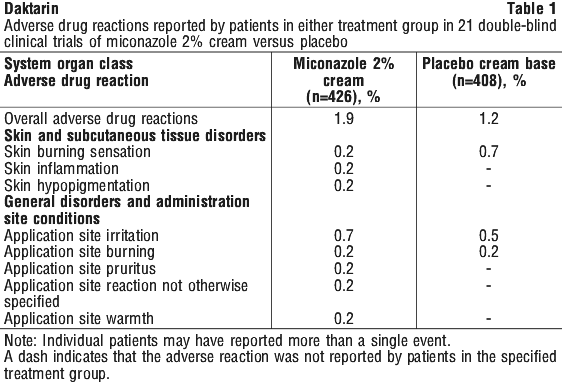
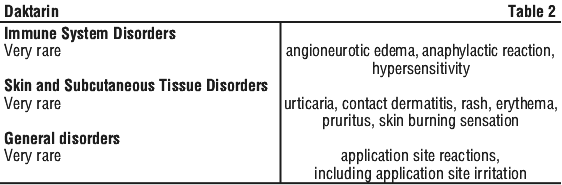
Very common: ≥ 1/10; common: ≥ 1/100 and < 1/10; uncommon: ≥ 1/1,000 and < 1/100; rare: ≥ 1/10,000 and < 1/1,000; very rare: < 1/10,000, including isolated reports.
The frequencies provided in Table 2 reflect reporting rates for adverse drug reactions from spontaneous reports, and do not represent more precise estimates of incidence that might be obtained in clinical or epidemiological studies.
4.9 Overdose
Treatment of overdose is symptomatic and supportive. In the event of overdosage, or if accidentally swallowed, contact the Poisons Information Centre on 13 11 26 in Australia or 0800 764 766 in New Zealand.
5 Pharmacological Properties
5.1 Pharmacodynamic Properties
Mechanism of action. Miconazole exhibits antifungal activity against Candida albicans, the dermatophytes - Trichophyton rubrum, T. mentagrophytes, Epidermophyton floccosum and Pityrosporum orbicular (Malassezia furfur). Miconazole penetrates the fungal cell wall, alters cellular membranes, and interferes with intracellular enzymes and biosynthesis of ergosterol.
Clinical trials. See Section 4.8 for clinical trials.
5.2 Pharmacokinetic Properties
Absorption. Systemic absorption of miconazole is limited, with a bioavailability of less than 1% following application of miconazole. Plasma concentrations of miconazole and/or its metabolites were measurable 24 and 48 hours after application.
Systemic absorption has also been demonstrated after repeated application of miconazole to infants with diaper dermatitis. Plasma levels of miconazole were undetectable or low in all infants.
Distribution. Absorbed miconazole is bound to plasma proteins (88.2%) and red blood cells (10.6%).
Excretion. The small amount of miconazole that is absorbed is eliminated predominantly in feces as both unchanged drug and metabolites over a four-day post-administration period. Smaller amounts of unchanged drug and metabolites also appear in urine.
5.3 Preclinical Safety Data
Genotoxicity. No data available.
Carcinogenicity. No data available.
6 Pharmaceutical Particulars
6.1 List of Excipients
See Section 2 Qualitative and Quantitative Composition.
6.2 Incompatibilities
Incompatibilities were either not assessed or not identified as part of the registration of this medicine. See Section 4.5 Interactions with Other Medicines and Other Forms of Interactions.
6.3 Shelf Life
In Australia, information on the shelf life can be found on the public summary of the Australian Register of Therapeutic Goods (ARTG). The expiry date can be found on the packaging.
6.4 Special Precautions for Storage
Store below 25°C.
6.5 Nature and Contents of Container
Daktarin Cream tubes of 15 g, 30 g and 70 g with 'Instructions for Use' leaflet.
Daktarin Powder in a 30 g "puffer" pack.
Daktarin Tincture in a 30 mL bottle with brush.
Daktarin Spray Powder in a 100 g pressurised can.
6.6 Special Precautions for Disposal
In Australia, any unused medicine or waste material should be disposed of by taking to your local pharmacy.
6.7 Physicochemical Properties
Chemical structure.
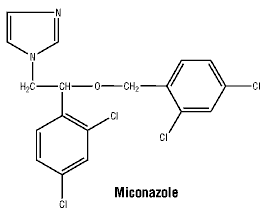
Miconazole nitrate is 1-[2,4-dichloro-beta-(2,4-dichlorobenzyloxy) phenethyl] imidazole nitrate, and is a synthetic 1-phenethylimidazole derivative.
Miconazole. A white, microcrystalline powder, practically insoluble in water but soluble in ethanol (10%).
Miconazole nitrate. A white, microcrystalline powder, very slightly soluble in water and in ether; soluble in 140 parts of ethanol (96%), and slightly soluble in chloroform.
Chemical formula. Miconazole. C18H14Cl4 N2O.
Miconazole nitrate. C18H14Cl4N2O.HNO3.
MW. Miconazole. 416.14.
Miconazole nitrate. 479.16.
CAS number. Miconazole. 22916-47-8.
Miconazole nitrate. 22832-87-7.
7 Medicine Schedule (Poisons Standard)
Pharmacy Medicine (S2).
Date of First Approval
18 March 2010
Date of Revision
01 December 2020
Summary Table of Changes

Reasonable care is taken to provide accurate information at the time of creation. This information is not intended as a substitute for medical advice and should not be exclusively relied on to manage or diagnose a medical condition. The Australian Commission on Safety and Quality in Health Care disclaims all liability (including for negligence) for any loss, damage, injury or any other negative effects resulting from reliance on or use of this information. Read our full disclaimer. This website uses cookies. Read our privacy policy.