
Gelofusine
Brand Information
| Brand name | Gelofusine |
| Active ingredient | Gelatin succinylated |
| Schedule | Unscheduled |
Consumer Medicine Information (CMI) leaflet
Please read this leaflet carefully before you start using the Gelofusine.
Summary CMI
GELOFUSINE
Consumer Medicine Information (CMI) summary
The full CMI on the next page has more details. If you are worried about using this medicine, speak to your doctor or pharmacist.
1. Why am I being given GELOFUSINE?
GELOFUSINE contains the ingredient succinylated gelatin. GELOFUSINE is used to replace blood and body fluid, which may have been lost as a result of an operation, an accident or a burn.
For more information, see Section 1. Why am I being given GELOFUSINE? in the full CMI.
2. What should I know before I am given GELOFUSINE?
Do not use if you have ever had an allergic reaction to gelatin or any of the ingredients listed at the end of the CMI.
Talk to your doctor if you have any other medical conditions, take any other medicines, or are pregnant or plan to become pregnant or are breastfeeding.
For more information, see Section 2. What should I know before I am given GELOFUSINE? in the full CMI.
3. What if I am taking other medicines?
Some medicines may interfere with GELOFUSINE and affect how it works.
A list of these medicines is in Section 3. What if I am taking other medicines? in the full CMI.
4. How will I be given GELOFUSINE?
- GELOFUSINE will be given intravenously i.e. via a drip into a vein.
- The doctor will determine how much is given and for how long depending on how much blood or fluid has been lost and your condition.
More instructions can be found in Section 4. How will I be given GELOFUSINE? in the full CMI.
5. What should I know while being given GELOFUSINE?
| Things you should do |
|
| Things you should not do |
|
| Driving or using machines |
|
| Drinking alcohol |
|
| Looking after your medicine |
|
For more information, see Section 5. What should I know while being given GELOFUSINE? in the full CMI.
6. Are there any side effects?
Common side effects may include mild skin reactions, short lasting queasiness or belly pain, short lasting mild rise of body temperature. Serious side effects may include allergic reactions.
For more information, including what to do if you have any side effects, see Section 6. Are there any side effects? in the full CMI.
Full CMI
GELOFUSINE
Active ingredient(s): succinylated gelatin
Consumer Medicine Information (CMI)
This leaflet provides important information about using GELOFUSINE. You should also speak to your doctor or pharmacist if you would like further information or if you have any concerns or questions about using GELOFUSINE.
Where to find information in this leaflet:
1. Why am I being given GELOFUSINE?
2. What should I know before I am given GELOFUSINE?
3. What if I am taking other medicines?
4. How will I be given GELOFUSINE?
5. What should I know while being given GELOFUSINE?
6. Are there any side effects?
7. Product details
1. Why am I being given GELOFUSINE?
GELOFUSINE contains the ingredient succinylated gelatin. GELOFUSINE is a plasma volume substitute.
GELOFUSINE is used for plasma volume substitution (to replace fluid lost from the circulation following, for example, an operation, an accident or a burn). It can be used instead of a blood transfusion or to fill up the circulating blood volume during the use of the heart-lung machine or artificial kidney.
2. What should I know before I am given GELOFUSINE?
Warnings
Do not use GELOFUSINE if:
- you are allergic to gelatin, or any of the ingredients listed at the end of this leaflet.
- you are allergic to an allergen called “galactose-α-1,3-galactose (alpha-Gal) or to red meat (mammalian meat) and offal.
Always check the ingredients to make sure you can use this medicine. - your circulating blood volume is too large.
- you have excess fluid in your body.
- you have certain types of heart failure.
Check with your doctor if you:
- have problems with your heart or your kidneys because giving large amounts of liquids through an intravenous drip may affect these organs.
- are suffering from allergic diseases such as asthma, because you may be at greater risk of experiencing an allergic reaction.
- Are known to have an allergy to red meat or offal or if you have tested positive to antibodies (IgE) against the allergen alpha-Gal.
- take any medicines for any other condition
Your doctor will exercise caution if you:
- have a large increase of sodium or chloride in your body
- retain water and salt, which may be associated with tissue swelling
- blood clotting is impaired
- are elderly
GELOFUSINE will be given if other products called crystalloids are not sufficient alone. The dose will be adjusted to prevent fluid overload.
During treatment, you may be at risk of developing certain side effects. It is important you understand these risks and how to monitor for them. See additional information under Section 6. Are there any side effects?
Pregnancy and breastfeeding
Check with your doctor if you are pregnant or intend to become pregnant.
Talk to your doctor if you are breastfeeding or intend to breastfeed.
Although you may be given GELOFUSINE during pregnancy or while breastfeeding, the possible risks and benefits should be carefully considered.
Do not use after the expiry date printed on the container.
3. What if I am taking other medicines?
Tell your doctor or pharmacist if you are taking any other medicines, including any medicines, vitamins or supplements that you buy without a prescription from your pharmacy, supermarket or health food shop.
Check with your doctor or pharmacist if you are not sure about what medicines, vitamins or supplements you are taking and if these affect GELOFUSINE.
4. How will I be given GELOFUSINE?
How much to use
- GELOFUSINE will be given intravenously i.e. via a drip into a vein.
- How much you are given and for how long will depend on how much blood or fluid you have lost and on your condition.
- For children, the doctor will determine the dose carefully. A child will receive this medicine only if the doctor considers it essential for recovery.
- The doctor will carry out tests (on your blood and blood pressure, for example) during treatment and the dose of GELOFUSINE will be adjusted as needed.
If you have been given too much GELOFUSINE
If you think that you have been given too much GELOFUSINE, you may need urgent medical attention. An overdose of GELOFUSINE may give rise to circulatory overload that might affect heart and lung function, and to alterations of your blood salt (electrolyte) levels. You may notice headaches and difficulty breathing.
You should immediately:
- phone the Poisons Information Centre
(by calling 13 11 26), or - contact your doctor, or
- go to the Emergency Department at your nearest hospital.
You should do this even if there are no signs of discomfort or poisoning.
5. What should I know while being given GELOFUSINE?
Things you should do
Call your doctor straight away if you:
- Do not feel well while receiving GELOFUSINE.
Remind any doctor, dentist or pharmacist you visit that you have been given GELOFUSINE.
Driving or using machines
GELOFUSINE is normally given to immobile patients in a controlled setting (e.g. emergency treatment, acute treatment in a hospital or a day therapy unit) and this excludes the likelihood of driving and using machines.
Looking after your medicine
- Store below 25°C.
- Do not freeze.
- Do not use GELOFUSINE if you notice: cloudiness or discolouration of the solution, leaking of the container.
Follow the instructions on how to take care of your medicine properly.
Store it in a cool dry place away from moisture, heat or sunlight; for example, do not store it:
- in the bathroom or near a sink, or
- in the car or on window sills.
Keep it where young children cannot reach it.
When to discard your medicine
Previously opened or partly used GELOFUSINE should be thrown away. Partially used bags should not be reconnected.
Getting rid of any unwanted medicine
If you no longer need to use this medicine or it is out of date, take it to any pharmacy for safe disposal.
Medicines should not be disposed of via wastewater or household waste. These measures will help to protect the environment.
Do not use this medicine after the expiry date.
6. Are there any side effects?
All medicines can have side effects. If you do experience any side effects, most of them are minor and temporary. However, some side effects may need medical attention.
See the information below and, if you need to, ask your doctor or pharmacist if you have any further questions about side effects.
Less serious side effects
| Less serious side effects | What to do |
| Speak to your doctor if you have any of these less serious side effects and they worry you. |
Serious side effects
| Serious side effects | What to do |
| Call your doctor straight away, or go straight to the Emergency Department at your nearest hospital if you notice any of these serious side effects. |
Allergic reactions are extremely rare, but should they occur there are established methods of treating them, which would be used immediately by the attending doctor.
Tell your doctor or pharmacist if you notice anything else that may be making you feel unwell.
Other side effects not listed here may occur in some people.
Reporting side effects
After you have received medical advice for any side effects you experience, you can report side effects to the Therapeutic Goods Administration online at www.tga.gov.au/reporting-problems. By reporting side effects, you can help provide more information on the safety of this medicine.
Always make sure you speak to your doctor or pharmacist before you decide to stop taking any of your medicines.
7. Product details
This medicine is only available with a doctor's prescription.
What GELOFUSINE contains
| Active ingredient (main ingredient) | succinylated gelatin |
| Other ingredients (inactive ingredients) | sodium chloride, sodium hydroxide, water for injections |
| Potential allergens | Sulfites (from gelatin) |
Do not take this medicine if you are allergic to any of these ingredients.
What GELOFUSINE looks like
GELOFUSINE is a clear, colourless or slightly yellowish sterile solution. It is a solution for infusion administered through an intravenous drip (a drip into a vein).
It is available in:
- Polyethylene bottle (Ecoflac plus) of 500 mL in packs of 10
- Non-PVC plastic bags (Ecobag) of 500 mL in packs of 10.
- Non-PVC plastic bags (Ecobag) of 1000 mL in packs of 10.
500 mL bottle (Ecoflac plus) (AUST R 60644).
500 mL plastic bag (Ecobag) (AUST R 78102).
1000 mL plastic bag (Ecobag) (AUST R 78103).
Not all presentations may be marketed.
Who distributes GELOFUSINE
B Braun Australia Pty Ltd
Level 2, 4 Burbank Place
Norwest NSW 2153
Toll Free Number: 1 800 251 705
This leaflet was prepared in February 2026.
Brand Information
| Brand name | Gelofusine |
| Active ingredient | Gelatin succinylated |
| Schedule | Unscheduled |
MIMS Revision Date: 01 April 2026
1 Name of Medicine
Succinylated gelatin.
2 Qualitative and Quantitative Composition
See Tables 1 and 2.
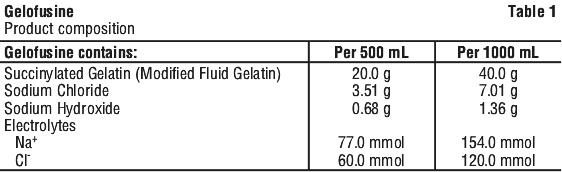
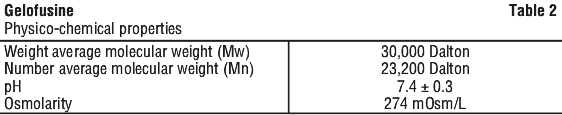
List of excipients with known effect. Contains sulfites.
For the full list of excipients, see Section 6.1 List of Excipients.
3 Pharmaceutical Form
Injection, solution.
4 Clinical Particulars
4.1 Therapeutic Indications
Gelofusine is a colloidal plasma volume substitute for:
Treatment of relative or absolute hypovolaemia and shock.
Prophylaxis of hypotension caused by relative hypovolaemia during induction of epidural or spinal anaesthesia, due to imminent significant blood loss in a surgical setting.
Procedures involving extracorporeal circulation as a component of priming fluid in combination with crystalloid solutions (e.g. heart-lung machine).
4.2 Dose and Method of Administration
Total dosage, duration and rate of infusion will depend upon the amount of blood or plasma lost and condition of the patient, and will need to be adjusted as necessary by monitoring the usual circulatory parameters e.g. blood pressure.
The risk of circulatory overload by too rapid infusion or inappropriately large doses must be borne in mind. In order to detect the occurrence of anaphylactoid/anaphylactic reactions as early as possible the first 20-30 mL should be infused slowly and under careful observation.
Maximum daily dosage. The therapeutic limit is dependent on the dilution effect. If the haematocrit falls to below 25% (in patients at cardiovascular or pulmonary risk 30%), erythrocytes or full blood should be considered (Gelofusine may be used concomitantly with blood, the rate and amount depending on the clinical condition of the patient). For significant bleeds Gelofusine should not be the sole replacement factor used.
Maximum infusion rate. The maximum rate of infusion is dependent on the state of the cardiac circulation. The rate of administration can be increased by the application of pressure to the container or by use of a giving set pump. Before administration, Gelofusine should be warmed to no more than 37°C. See Table 3.
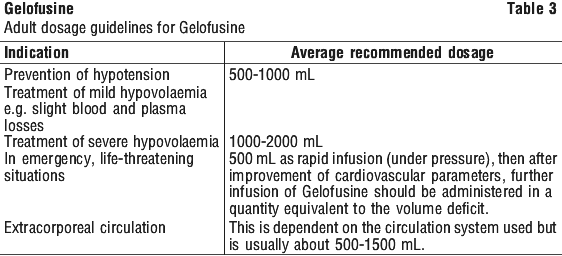
Mixing with other drugs may produce incompatibilities. Therefore, only mixtures of known compatibility should be prepared.
Gelofusine has a low calcium content (max. 0.4 mmol/L) and therefore will not cause clotting of citrated blood or plasma.
Do not use unless the solution is clear and free from particles. Do not use if the container appears damaged or has been previously opened.
4.3 Contraindications
Hypersensitivity to gelatin or to any of the excipients.
Hypersensitivity to galactose-α-1,3-galactose (alpha-Gal) or known allergy to red meat.
Hypervolaemia.
Hyperhydration.
Acute congestive cardiac failure.
4.4 Special Warnings and Precautions for Use
Anaphylactoid/anaphylactic reactions. Gelofusine should be administered with caution to patients with a history of allergic diseases (e.g. asthma).
Modified fluid gelatin solutions rarely cause allergic (anaphylactic/anaphylactoid) reactions of varying degrees of severity. In order to detect the occurrence of an allergic reaction as early as possible, up to the first 20 mL should be infused slowly and the patient should be under careful observation especially at the beginning of the infusion.
Due to possible cross-reactions involving the allergen galactose-alpha-1,3-galactose (alphaGal), the risk of sensitisation and consequent anaphylactic reaction to gelatin-containing solutions could be highly increased in patients with a history of allergy to red meat (mammalian meat) and offal and/or tested positive for anti-alpha-Gal IgE antibodies. Gelatin-containing colloidal solutions should not be used in these patients (see Section 4.3 Contraindications).
Gelofusine has been associated with rare but severe reactions similar to anaphylaxis. Patients should be monitored carefully for relevant symptoms and signs so that the product infusion can be stopped and appropriate urgent treatment can be commenced.
Risks related to fluid and electrolyte administration. Gelofusine should be administered with caution to patients:
at risk of circulatory overload e.g. patients with right or left ventricular insufficiency, hypertension, pulmonary oedema or renal insufficiency with oligo- or anuria.
with severely impaired renal function.
with severe hypernatraemia.
with severe hyperchloraemia.
with oedema with water/salt retention.
with major blood coagulation disorders.
of advanced age as these are more prone to develop disorders such as cardiac or renal insufficiency.
As with all colloids, Gelofusine should only be used if hypovolaemia cannot be sufficiently treated with crystalloids alone. In severe hypovolaemia colloids are usually applied in combination with crystalloids.
Volume overload due to overdose or too rapid infusion must always be avoided. The dosage must be adjusted carefully, particularly in patients with pulmonary or cardiocirculatory problems.
Checks of serum electrolyte concentrations, acid-base balance and water balance are necessary, in particular in patients with hypernatraemia, hyperchloraemia or impairment of renal function.
Electrolytes and fluids should be substituted according to individual requirements if necessary.
As Gelofusine contains no calcium, special attention should be paid to the appearance of symptoms of hypocalcaemia such as tetanie and paraesthesia.
The haemodynamic, haematological and coagulation system should be monitored.
During compensation of severe blood losses by infusions of large amounts of Gelofusine, the haematocrit and electrolytes must be monitored under all circumstances.
Likewise in those situations the dilution effect on coagulation factors should be observed, especially in patients with existing disorders of haemostasis.
Because the product does not substitute lost plasma protein, it is advisable to check the plasma protein concentrations (also see Section 4.2 Dose and Method of Administration, Maximum daily dosage).
In cases of pressure infusion which might be necessary in vital emergencies, all air must be removed from the container and the infusion set before the solution is administered. This is to avoid the risk of air embolism that might otherwise be associated with the infusion.
Use in hepatic impairment. Special care and adaptation of the dosage is recommended for patients with impaired hepatic function.
Use in renal impairment. Special care and adaptation of the dosage is recommended for patients with impaired renal function.
Use in the elderly. Caution should be exercised in patients suffering from further diseases like cardiac insufficiency or renal insufficiency that are frequently associated with advanced age.
Paediatric use. There is insufficient experience with the use of Gelofusine in children. Therefore, Gelofusine should only be administered to these patients if the expected benefits clearly outweigh potential risks.
Effects on laboratory tests. Laboratory blood tests (blood group or irregular antibodies) are possible after Gelofusine infusions. Nevertheless, it is recommended to draw blood samples before the infusion of Gelofusine in order to avoid hampered interpretation of results.
Gelofusine may have an influence on the following clinical-chemical tests, leading to falsely high values:
erythrocyte sedimentation rate,
specific gravity of the urine and
non-specific protein determinations, e.g. the biuret method.
4.5 Interactions with Other Medicines and Other Forms of Interactions
Caution should be exercised in patients concurrently taking or receiving medicinal products that can cause sodium retention (e.g. corticosteroids, non-steroidal anti-inflammatory agents) as concomitant administration may lead to oedema.
4.6 Fertility, Pregnancy and Lactation
Effects on fertility. There are no data on the effect of Gelofusine on human or animal fertility. However, because of the nature of its constituents it is considered unlikely that Gelofusine will affect fertility.
Use in pregnancy. (Category B2)
There are no or limited amount of data on the use of Gelofusine in pregnant women. Animal studies are insufficient with respect to developmental toxicity. Due to the limited data available and the possibility of severe anaphylactic/anaphylactoid reactions, with consequent fetal and neonatal distress, the use of Gelofusine solution should be restricted to emergency situations.
Use in lactation. There are no or limited data regarding the excretion of succinylated gelatin in mother's milk but because of its high molecular weight it is not expected that the milk will contain relevant amounts. Sodium and chloride are normal constituents of the human body and of food. No significant increase in the content of these electrolytes in mother's milk is expected following the use of Gelofusine.
4.7 Effects on Ability to Drive and Use Machines
The effects of this medicine on a person's ability to drive and use machines were not assessed as part of its registration.
4.8 Adverse Effects (Undesirable Effects)
Adverse drug reactions can occur during and after the use of Gelofusine. These will usually involve anaphylactic/anaphylactoid reactions of varying severity (also see Section 4.3 Contraindications; Section 4.4 Special Warnings and Precautions for Use, notably for hypersensitivity to galactose-α-1,3-galactose (alpha-Gal) and allergy to red meat and offal). There are no data relating to a special pattern or incidence of adverse reactions in paediatric patients.
Undesirable effects are listed according to their frequencies as follows: Very common (≥ 1/10); common: (≥ 1/100 to < 1/10); uncommon: (≥ 1/1,000 to < 1/100); rare: (≥ 1/10,000 to < 1/1,000); very rare: (< 1/10,000); not known: (cannot be estimated from the available data).
Tabulated list of adverse reactions. Immune system disorders. Rare. Anaphylactic/anaphylactoid reactions up to shock.
Cardiac disorders. Very rare. Tachycardia.
Vascular disorders. Very rare. Hypotension.
General disorders and administration site conditions. Very rare. Fever, chills.
Gastrointestinal disorders. Not known. Nausea, vomiting, abdominal pain.
Investigations. Not known. Oxygen saturation decreased.
Blood and lymphatic system disorders. Very common. Decreased haematocrit and reduced concentration of plasma proteins.
Common (depending on the administered dose). Relatively large doses of Gelofusine result in dilution of coagulation factors and can therefore affect blood coagulation. Prothrombin time can be increased and activated partial thromboplastin time (aPTT) can be prolonged after administration of large doses of Gelofusine (see Section 4.4 Special Warnings and Precautions for Use).
Reporting suspected adverse effects. Reporting suspected adverse reactions after registration of the medicinal product is important. It allows continued monitoring of the benefit-risk balance of the medicinal product. Healthcare professionals are asked to report any suspected adverse reactions at www.tga.gov.au/reporting-problems.
4.9 Overdose
Symptoms. Overdose of Gelofusine may cause hypervolaemia and circulatory overload, with a significant fall in haematocrit and plasma proteins, accompanied by an electrolyte and acid base imbalance. This may be associated with consecutive impairment of heart and lung function (pulmonary oedema). Symptoms of circulatory overload are, for example, headache, dyspnoea and jugular vein congestion.
Treatment. In case circulatory overload appears, the infusion must be stopped and a rapid-acting diuretic should be given. If an overdose occurs, the patient should be treated symptomatically with monitoring of electrolytes.
For information on the management of overdose, contact the Poisons Information Centre on 13 11 26 (Australia).
5 Pharmacological Properties
5.1 Pharmacodynamic Properties
Mechanism of action. The negative charges introduced into the gelatin molecule by succinylation causes an expansion of the molecule. The molecular volume is therefore higher than that of unsuccinylated gelatin of the same molecular weight.
Gelofusine has a measured initial volume effect of 79% - 100% of the infused volume, with a volume effect half-life of 4 - 5 hours.
The colloid-osmotic pressure of the solution determines the extent of initial volume effect. The duration of the effect depends on the clearance of the colloid mainly by renal excretion. Since the volume effect of Gelofusine is equivalent to the administered amount of solution. Gelofusine is a plasma substitute, not a plasma expander.
The solution also restores the extravascular compartment and does not disturb the electrolyte balance of the extracellular space.
Gelofusine substitutes intra- and extravascular volume deficits caused by losses of blood, plasma and interstitial fluid. Thus, the mean arterial pressure, the left ventricular end-diastolic pressure, the cardiac stroke volume, the cardiac index, the oxygen supply, the microcirculation and the diuresis are increased without dehydrating the extravascular space.
Clinical trials. No data available.
5.2 Pharmacokinetic Properties
Distribution. After infusion Gelofusine is rapidly distributed in the intravascular compartment.
Metabolism. Only about 1% of the infused drug is metabolised.
Excretion. The major route of elimination is urinary excretion, with only a very small amount excreted in the faeces.
5.3 Preclinical Safety Data
Genotoxicity. No genotoxicity studies have been conducted with Gelofusine.
Carcinogenicity. No carcinogenicity studies have been conducted with Gelofusine.
6 Pharmaceutical Particulars
6.1 List of Excipients
Sodium chloride, sodium hydroxide and water for injections.
See Section 2 Qualitative and Quantitative Composition.
6.2 Incompatibilities
Mixing with other drugs may produce incompatibilities. Therefore, only mixtures of known compatibility should be prepared.
6.3 Shelf Life
In Australia, information on the shelf life can be found on the public summary of the Australian Register of Therapeutic Goods (ARTG). The expiry date can be found on the packaging.
6.4 Special Precautions for Storage
Store below 25°C. Do not freeze.
Do not use after the expiry date printed on the container.
6.5 Nature and Contents of Container
Gelofusine is available in the following containers and pack sizes:
1 x 10 Ecoflac of 500 mL - AUST R 60644.
1 x 10 Ecobag of 500 mL - AUST R 78102.
1 x 10 Ecobag of 1000 mL - AUST R 78103.
6.6 Special Precautions for Disposal
In Australia, any unused medicine or waste material should be disposed of in accordance with local requirements.
6.7 Physicochemical Properties
Chemical structure.
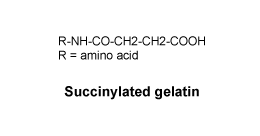
7 Medicine Schedule (Poisons Standard)
Not scheduled.
Date of First Approval
14 August 1998
Date of Revision
09 February 2026
Summary Table of Changes

Reasonable care is taken to provide accurate information at the time of creation. This information is not intended as a substitute for medical advice and should not be exclusively relied on to manage or diagnose a medical condition. The Australian Commission on Safety and Quality in Health Care disclaims all liability (including for negligence) for any loss, damage, injury or any other negative effects resulting from reliance on or use of this information. Read our full disclaimer. This website uses cookies. Read our privacy policy.