
Periactin
Brand Information
| Brand name | Periactin |
| Active ingredient | Cyproheptadine hydrochloride |
| Schedule | S3 |
Consumer Medicine Information (CMI) leaflet
Please read this leaflet carefully before you start using the Periactin.
Full CMI
PERIACTIN®
Active ingredient(s): Cyproheptadine hydrochloride (as sesquihydrate)
Consumer Medicine Information (CMI)
This leaflet provides important information about taking PERIACTIN. Speak to your doctor or pharmacist if you would like further information or if you have any concerns or questions about taking PERIACTIN.
Where to find information in this leaflet:
1. Why am I taking PERIACTIN?
2. What should I know before I take PERIACTIN?
3. What if I am taking other medicines?
4. How do I take PERIACTIN?
5. What should I know while taking PERIACTIN?
6. Are there any side effects?
7. Product details
1. Why am I taking PERIACTIN?
PERIACTIN belongs to a group of medicines called antihistamines. It works by acting in competition with serotonin and histamine at receptor sites.
PERIACTIN is used to:
- Treat allergies and pruritus (itchy skin)
- Relieve migraines and vascular types of headaches.
Ask your doctor if you have any questions about why PERIACTIN has been prescribed for you. Your doctor may have prescribed it for another reason.
2. What should I know before I take PERIACTIN?
Warnings
Do not take PERIACTIN if:
- you are allergic to cyproheptadine, any of the ingredients listed at the end of this leaflet or any other similar medicines.
Some of the symptoms of an allergic reaction may include:
- shortness of breath
- wheezing or difficulty breathing
- swelling of the face, lips, tongue or other parts of the body
- rash, itching or hives on the skin.
Always check the ingredients to make sure you can take PERIACTIN.
Check with your doctor or pharmacist if you:
- have allergies to any other medicines, foods, preservatives or dyes.
- have had any of the following medical conditions:
- lower respiratory tract symptoms including those of acute asthma
- blood dyscrasias (blood cell disorders)
- bronchial asthma (narrow airways causing breathing trouble)
- hyperthyroidism (overactive thyroid making too much hormone)
- cardiovascular disease (conditions affecting the heart and blood vessels)
- hypertension (high blood pressure) - take any medicines for any other condition
During treatment, you may be at risk of developing certain side effects. It is important you understand these risks and how to monitor for them. See additional information under Section 6. Are there any side effects?
Pregnancy and breastfeeding
Tell your doctor or pharmacist if you are pregnant or plan to become pregnant.
Do not breastfeed or plan to breastfeed if you are taking PERIACTIN. The active ingredient in PERIACTIN may pass into breast milk and there is a possibility that your baby may be affected.
Children and infants
Do not give PERIACTIN to a child under the age of 6 years.
PERIACTIN should not be used in children aged 6 to 11 years except on the advice of a doctor, pharmacist or nurse practitioner.
Use in infants has been associated with apnoea (stop in breathing), cyanosis (bluish colour of the skin, lips, or nails caused by low oxygen levels), and respiratory difficulty. PERIACTIN should not be used in newborn or premature infants.
3. What if I am taking other medicines?
Tell your doctor or pharmacist if you are taking any other medicines, including any medicines, vitamins or supplements that you buy without a prescription from your pharmacy, supermarket or health food shop.
Some medicines may interfere with PERIACTIN and affect how it works and/or cause more side effects.
- Monoamine oxidase inhibitors used to treat depression such as phenelzine and tranylcypromine.
- Central nervous system depressants used to treat anxiety, panic and sleep disorders such as hypnotics, sedatives, tranquilisers and anti-depressant drugs.
These medicines may be affected by PERIACTIN or may affect how well it works. You may need different amounts of your medicines, or you may need to take different medicines.
Your doctor and pharmacist have more information on medicines to be careful with or avoid while taking PERIACTIN.
4. How do I take PERIACTIN?
How much to take
- Allergies and pruritus
- Adults: Take 1 tablet, 3 times a day, as required. Do not take more than 8 tablets in 24 hours.
- Children (7 to 14 years of age): Give 1 tablet, 3 times a day as required. Do not give more than 4 tablets in 24 hours.
- Children (6 years of age): Give half a tablet, 2 to 3 times a day. Do not give more than 3 tablets in 24 hours. - Migraine and vascular types of headaches
- Adults: Take 1 tablet initially. If required, take a second tablet after 30 minutes. Do not take more than 2 tablets every 4-6 hours. - Follow the instructions provided with PERIACTIN.
- Do not exceed the recommended dosage.
- Your doctor may adjust the dose according to your response.
How long to take PERIACTIN
Continue taking your medicine for as long as your doctor tells you.
How to take PERIACTIN
- Swallow the tablets whole with a full glass of water.
If you forget to take it
Do not take a double dose to make up for the dose that you missed.
This may increase the chance of you getting an unwanted side effect.
If you are not sure what to do, ask your doctor or pharmacist.
If you take too much PERIACTIN
If you think that you or anyone else have taken too much PERIACTIN, urgent medical attention may be needed.
People may become very sleepy or very excited (central nervous system depression or stimulation), have seizures, stomach problems or a very fast heartbeat (tachycardia). They might stop breathing (respiratory arrest), or their heart might stop (cardiac arrest), which can be life threatening especially in infants and children.
Other atropine-like symptoms can include:
- dry mouth
- large pupils
- red or warm skin (flushing)
Both adults and children may get seizures and possibly fall into a coma. Sometimes they may be very sleepy or very hyper before a seizure.
Children taking too much PERIACTIN may experience:
- unusual excitement (excitation) or acting strangely
- trouble walking or staying balanced (ataxia)
- slow, twisty movements (athetosis)
- seeing or hearing things that are not real (hallucinations)
- thinking or learning problems (usually temporary)
You must immediately:
- phone the Poisons Information Centre
(by calling 13 11 26) for advice, or - contact your doctor, or
- go to the Emergency Department at your nearest hospital.
Do this even if there are no signs of discomfort or poisoning.
5. What should I know while taking PERIACTIN?
Things you must do
- Tell your doctor, dentist or pharmacist you visit that you are taking PERIACTIN.
- If you are going to have surgery, tell the surgeon or anaesthetist that you are taking PERIACTIN as it may affect other medicines used during surgery.
- If you become pregnant while taking PERIACTIN, tell your doctor immediately.
- If you are about to have any blood tests, tell your doctor that you are taking PERIACTIN as it may interfere with the results of some tests.
Things you must not do
- Do not take PERIACTIN to treat any other complaints unless your doctor tells you to.
- Do not give your medicine to anyone else, even if they have the same condition as you.
- Do not give PERIACTIN to children under 6 years old.
Driving or using machines
Be careful before you drive or use any machines or tools until you know how PERIACTIN affects you.
PERIACTIN may cause drowsiness in some people. If you have any of these symptoms, do not drive, operate machinery or do anything else that could be dangerous. Drowsiness may continue the following day. Children should be careful when riding bicycles or climbing a tree.
Drinking alcohol
Tell your doctor or pharmacist if you drink alcohol.
Be careful when drinking alcohol while you are taking PERIACTIN, it may increase the effects of alcohol. Alcohol should be avoided whilst taking PERIACTIN.
Looking after your medicine
- Keep your tablets in the pack until it is time to take them. If you take the tablets out of the pack, they may not keep well.
- Keep your tablets in a cool dry place where the temperature stays below 30°C. Heat and dampness can destroy some medicines.
Follow the instructions on the carton on how to take care of your medicine properly.
Store it in a cool dry place away from moisture, heat or sunlight; for example, do not store it:
- in the bathroom or near a sink, or
- in the car or on window sills.
Keep it where young children cannot see or reach it.
A locked cupboard at least one-and-a-half metres above the ground is a good place to store medicines.
When to discard your medicine
If your doctor tells you to stop taking PERIACTIN or the expiry date has passed, ask your pharmacist what to do with any medicine that is left over.
Getting rid of any unwanted medicine
If you no longer need to take PERIACTIN or it is out of date, take it to any pharmacy for safe disposal. Do not take PERIACTIN after the expiry date.
6. Are there any side effects?
PERIACTIN helps most people with allergies, pruritus, migraines and vascular types of headaches, but it may have unwanted side effects in a few people.
All medicines can have side effects. If you do experience any side effects, most of them are minor and temporary. However, some side effects may need medical attention.
If you are over 65 years of age you may have an increased chance of getting side effects.
Do not be alarmed by the following lists of side effects. You may not experience any of them.
Ask your doctor or pharmacist if you have any further questions.
Common less serious side effects
| Common less serious side effects | What to do |
| Speak to your doctor or pharmacist if you have any of these less serious side effects. |
Serious side effects
| Serious side effects | What to do |
| Tell your doctor as soon as possible if you notice any of these serious side effects. |
Very Serious side effects
| Very serious side effects | What to do |
| Tell your doctor immediately or go to Accident and Emergency at your nearest hospital if you notice any of these very serious side effects. |
Children under 6 years old who have been given PERIACTIN have been reported to get angry or aggressive, see or hear things that are not real and cannot sit still. Do not give PERIACTIN to children under 6 years of age.
Feeling very sleepy or tired symptoms are usually mild and short-lived. Many patients do not experience these symptoms after the first three - four days of continuous administration.
Tell your doctor or pharmacist if you notice anything else that may be making you feel unwell.
Other side effects not listed here may occur in some people.
Reporting side effects
After you have received medical advice for any side effects you experience, you can report side effects to the Therapeutic Goods Administration online at www.tga.gov.au/reporting-problems. By reporting side effects, you can help provide more information on the safety of this medicine.
7. Product details
PERIACTIN is available over-the-counter without a doctor's prescription.
What PERIACTIN contains
| Active ingredient (main ingredient) | 4 mg of cyproheptadine hydrochloride |
| Other ingredients (inactive ingredients) | maize starch pregelatinised maize starch calcium hydrogen phosphate dihydrate lactose monohydrate magnesium stearate |
| Potential allergens | lactose |
Do not take PERIACTIN if you are allergic to any of these ingredients.
What PERIACTIN looks like
PERIACTIN is a white, flat circular bevel edged tablet. Marked 'P4' on one side, scored on the other. (AUST R 62384).
PERIACTIN is available in a blister pack of 100 tablets.
Who distributes PERIACTIN
Viatris Pty Ltd
Level 1, 30 The Bond
30-34 Hickson Road
Millers Point NSW 2000
www.viatris.com.au
Phone: 1800 274 276
This leaflet was prepared in June 2026.
PERIACTIN® is a Viatris company trade mark
PERIACTIN_cmi\Jun26/00
Brand Information
| Brand name | Periactin |
| Active ingredient | Cyproheptadine hydrochloride |
| Schedule | S3 |
MIMS Revision Date: 01 August 2026
1 Name of Medicine
Cyproheptadine hydrochloride.
2 Qualitative and Quantitative Composition
Each tablet contains 4 mg of cyproheptadine hydrochloride as the active ingredient.
Excipients with known effect. Lactose monohydrate.
For the full list of excipients, see Section 6.1 List of Excipients.
3 Pharmaceutical Form
White, flat circular bevel edged tablet containing 4 mg of cyproheptadine hydrochloride. Marked 'P4' on one side, scored on the other.
4 Clinical Particulars
4.1 Therapeutic Indications
Periactin (cyproheptadine hydrochloride) is a serotonin and histamine antagonist with anticholinergic and sedative effects.
As an antiallergic and antipruritic. Periactin has a wide range of antiallergic and antipruritic activity and can be used successfully in the treatment of acute and chronic allergies and pruritus, such as: dermatitis (including neurodermatitis and neurodermatitis circumscripta), eczema, eczematoid dermatitis, dermatographism, mild local allergic reactions to insect bites, hay fever and other seasonal rhinitis, perennial allergic and vasomotor rhinitis, allergic conjunctivitis due to inhalant allergens and foods, urticaria, angioneurotic oedema, drug and serum reactions, anogenital pruritus and pruritus of chickenpox.
Periactin may be used as therapy for anaphylactic reactions, adjunctive to adrenaline (epinephrine) and other standard measures after the acute manifestations have been controlled.
In migraine and vascular types of headache. Periactin has been reported to have beneficial effects in a significant number of patients diagnosed as having vascular types of headache, such as migraine and histamine cephalalgia. Many patients who have not been able to obtain adequate relief from any other agent have reported amelioration of symptoms with Periactin. The characteristic headache and feeling of malaise may disappear within an hour or two after the first dose.
4.2 Dose and Method of Administration
Allergies and pruritus. Dosage must be individualised. Since the antiallergic effect of a single dose usually lasts four to six hours, the daily requirement should be given in divided doses three times a day or as often as necessary to provide continuous relief.
Adults. The therapeutic range is from 4 mg to 20 mg a day, the majority of patients requiring 12 mg to 16 mg a day. An occasional patient may require as much as 32 mg a day for adequate relief. It is suggested that dosage be initiated with 4 mg three times a day and adjusted according to the size and response of the patient. The dosage is not to exceed 32 mg a day.
Children 7 to 14 years of age. The usual dosage is 4 mg three times a day. This dosage may be adjusted as necessary according to the size and response of the patient. If an additional dose is required, it should be taken preferably at bedtime. The dosage is not to exceed 16 mg a day.
Children 6 years of age. It is suggested that the dosage be initiated with 2 mg two or three times a day and adjusted as necessary according to the size and response of the patient. If an additional dose is required, it should be taken at bedtime. The total dosage is not to exceed 12 mg a day.
Children under 6 years of age. There is no recommended dosage schedule for children under 6 years of age.
Periactin must not be used in children under 6 years of age (see Section 4.3 Contraindications). Periactin should not be used in children aged 6 to 11 years except on the advice of a doctor, pharmacist or nurse practitioner (see Section 4.4 Special Warnings and Precautions for Use).
For migraine and vascular types of headache. For prophylaxis or treatment, the recommended dosage is 4 mg initially, repeated in ½ hour if necessary; not to exceed 8 mg in a 4 to 6 hour period. Relief is usually obtained in responsive patients with 2 doses (total 8 mg) and maintained with 4 mg every 4 to 6 hours.
4.3 Contraindications
Cyproheptadine should not be used for therapy of an acute asthmatic attack.
Children under 6 years of age. This medicine is contraindicated for use in children under 6 years of age because of the potential for fatal respiratory depression, psychiatric and CNS (central nervous system) events (see Section 4.4 Special Warnings and Precautions for Use; Section 4.8 Adverse Effects (Undesirable Effects)). Use in infants has been associated with apnoea, cyanosis, and respiratory difficulty.
Nursing mothers. Because of the higher risk of antihistamines for infants generally, and for newborn and prematures, in particular, antihistamine therapy is contraindicated in nursing mothers.
Other conditions. Hypersensitivity to cyproheptadine and other medicine of similar chemical structure.
Monoamine oxidase inhibitor therapy (see Section 4.5 Interactions with Other Medicines and Other Forms of Interactions).
Angle closure glaucoma.
Stenosing peptic ulcer.
Symptomatic prostatic hypertrophy.
Bladder neck obstruction.
Pyloroduodenal obstruction.
Elderly, debilitated patients.
4.4 Special Warnings and Precautions for Use
Antihistamines should not be used to treat lower respiratory tract symptoms, including those of acute asthma.
Use in the elderly. Antihistamines are more likely to cause dizziness, sedation, and hypotension in elderly patients.
Paediatric use. This product must not be used in children under 6 years of age, due to the potential for fatal respiratory depression, psychiatric and CNS events (see Section 4.3 Contraindications; Section 4.8 Adverse Effects (Undesirable Effects)).
This product should not be used in children aged 6 to 11 years except on the advice of a doctor, pharmacist or nurse practitioner.
Overdose of antihistamines, particularly in infants and children, may produce hallucinations, central nervous system depression, convulsions, respiratory and cardiac arrest, and death.
Antihistamines may diminish mental alertness; conversely, particularly in the young child, they may occasionally produce excitation.
Effects on laboratory tests. No data available.
Other. Rarely, prolonged therapy with antihistamines may cause blood dyscrasias.
Cyproheptadine has an atropine-like action and, therefore, should be used with caution in patients with a history of bronchial asthma; increased intraocular pressure; hyperthyroidism; cardiovascular disease; hypertension.
4.5 Interactions with Other Medicines and Other Forms of Interactions
MAO inhibitors prolong and intensify the anticholinergic effects of antihistamines.
Antihistamines may have additive effects with alcohol and other CNS depressants, e.g. hypnotics, sedatives, tranquillisers, antianxiety agents.
Medicine with antiserotonin activity, such as cyproheptadine, may interfere with serotonin enhancing antidepressant medicine.
Cyproheptadine may cause a false positive test result for tricyclic antidepressant medicine when evaluating a drug screen (e.g. urine, serum).
4.6 Fertility, Pregnancy and Lactation
Effects on fertility. Reproduction studies have been performed in rabbits, mice, and rats at doses up to 32 times the human dose and have revealed no evidence of impaired fertility or harm to the fetus due to cyproheptadine. There are, however, no adequate or well controlled studies in pregnant women. Because animal reproduction studies are not always predictive of human response, this medicine should be used during pregnancy only if clearly needed.
Cyproheptadine at about 10 times the human dose had no effect on fertility in a two-litter study in rats or a two-generation study in mice.
Use in pregnancy. (Category A)
Drugs which have been taken by a large number of pregnant women and women of childbearing age without any proven increase in the frequency of malformations or other direct or indirect harmful effects on the fetus having been observed.
The use of any drug in pregnancy or in women of childbearing potential requires that the anticipated benefit be weighed against possible hazards to the embryo or fetus.
Use in lactation. It is not known whether this drug is excreted in human milk. Because many drugs are excreted in human milk and because of the potential for serious adverse reactions in nursing infants from Periactin, a decision should be made whether to discontinue nursing or to discontinue the drug, taking into account the importance of the drug to the mother (see Section 4.3 Contraindications).
4.7 Effects on Ability to Drive and Use Machines
Cyproheptadine may cause drowsiness and may increase the effects of alcohol. Drowsiness may continue the following day. Those affected should not drive or operate machinery; alcohol should be avoided.
4.8 Adverse Effects (Undesirable Effects)
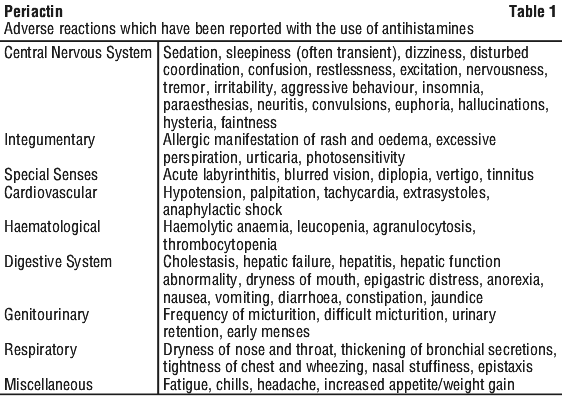
The side effects that appear frequently are drowsiness and somnolence. Many patients who complain initially of drowsiness may no longer do so after the first three or four days of continuous administration. See Table 1.
4.9 Overdose
For information on the management of overdose, contact the Poisons Information Centre on 13 11 26 (Australia).
Signs and symptoms. Antihistamine overdosage reactions may vary from central nervous system depression or stimulation to convulsions, respiratory and cardiac arrest, and death, especially in infants and children. They are characterised in children by various combinations of excitation, ataxia, incoordination, athetosis and hallucinations, reversible intellectual disability and cognition deficit in children less than 6 years of age, while adults may become drowsy and lapse into coma. Convulsions may occur in both adults and children: coma or excitement may precede their occurrence. Tachycardia may develop. Also, atropine-like signs and symptoms (dry mouth; fixed, dilated pupils; flushing, etc) as well as gastrointestinal symptoms may occur.
Treatment. Treatment should be supportive and symptomatic. Activated charcoal may reduce absorption of the medicine if given within one or two hours after ingestion. In patients who are not fully conscious or have impaired gag reflex, consideration should be given to administering activated charcoal via a nasogastric tube, once the airway is protected.
Precautions against aspiration must be taken, especially in infants and children.
When life threatening CNS signs and symptoms are present, intravenous physostigmine salicylate may be considered. Dosage and frequency of administration are dependent on age, clinical response, and recurrence after response. (See package circulars for physostigmine products.)
Saline cathartics, such as milk of magnesia, draw water into the bowel by osmosis and, therefore, are valuable for their action in rapid dilution of bowel content.
Stimulants should not be used. Vasopressors may be used for hypotension.
5 Pharmacological Properties
5.1 Pharmacodynamic Properties
Mechanism of action. Periactin (cyproheptadine HCl) is a serotonin and histamine antagonist with anticholinergic and sedative effects. Antiserotonin and antihistamine drugs appear to compete with serotonin and histamine, respectively, for receptor sites.
Animal studies have shown cyproheptadine hydrochloride to be an effective serotonin and histamine antagonist, comparable, in general, to that of the most active known substances.
Cyproheptadine hydrochloride antagonises the following effects of serotonin in laboratory animals: bronchoconstrictor (guinea pig); vasodepressor (dog); spasmogenic (isolated rat uterus); oedema (rat); lethal (Haemophilus pertussis treated mouse).
In all these effects, cyproheptadine hydrochloride approaches, equals or surpasses the activity of specific serotonin antagonists, such as l-benzyl-2-methyl-5-methoxytryptamine (BAS) and l-benzyl-2-methyl-5-hydroxytryptamine (BMS). In contrast, specific antihistamines, even the most potent, show little or no serotonin antagonism. Thus, cyproheptadine hydrochloride must be considered a serotonin antagonist as well as a histamine antagonist.
Cyproheptadine hydrochloride antagonises or blocks the following effects of histamine in laboratory animals: bronchoconstrictor (guinea pig); vasodepressor (dog); spasmogenic (isolated guinea pig ileum); anaphylactic shock, active and passive (guinea pig, mouse); increased gastric secretion (Heidenhain pouch dog).
It is unusual that cyproheptadine hydrochloride protects both guinea pigs and mice against anaphylactic shock. In guinea pigs, the pulmonary aspects of anaphylactic shock are attributable to the release of endogenous histamine and can be controlled by substances with specific antihistaminic activity. In mice, however, where histamine release seems to be less important and serotonin release may be involved, specific antihistamines are of little value in protecting against anaphylaxis. Thus, the protective effect of cyproheptadine hydrochloride in mice may be an antiserotonin effect.
The inhibitory effect of cyproheptadine hydrochloride in histamine induced gastric secretion is also unusual because specific antihistamines do not influence this effect of histamine.
Because of its marked activity as an antagonist of serotonin and histamine in laboratory animals, cyproheptadine hydrochloride was evaluated in man in situations where standard antihistamines are not effective.
In one evaluation, skin reactions were induced in test subjects by the intradermal injection of histamine, serotonin, and histamine releasing substances, such as Compound 48-80. The wheals and flares resulting from the injections were observed, as well as the degree of blueness of the wheals produced by intravenous injection of a protein dye, coomassie blue. Coomassie blue was used as an indicator of capillary leakage of plasma proteins because of its propensity for plasma binding and its safety for use in man. Cyproheptadine hydrochloride and two standard antihistamines were administered orally in moderate therapeutic doses. Only cyproheptadine hydrochloride led to a suppression of the whealing responses and the capillary damage demonstrated by the bluing reaction.
Acute and chronic toxicity studies in various laboratory animals indicate that cyproheptadine hydrochloride has an adequate margin of safety. In doses far greater than those in the therapeutic range, ataxia, sedation and tachycardia can be produced, but other objective signs of toxicity are not evident.
The oral LD50 of cyproheptadine is 123 mg/kg, and 295 mg/kg in the mouse and rat, respectively.
There was no evidence of histomorphological changes in the various organs when doses approximating subacute lethal doses were administered to dogs, monkeys, rabbits and mice. Twelve months of oral toxicity studies in dogs did not reveal functional or anatomical changes. In chronic toxicity studies in rats, only at dosages of 10 to 12 mg/kg/day, far in excess (approximately 200 times) of those required for pharmacodynamic effects, was reversible vacuolisation of the beta cells of the pancreatic islets noted. This was not observed in the other four species of animals used in the toxicity studies. After six months of continuous drug administration, there was no evidence of derangement of carbohydrate metabolism in man, as measured by serial blood sugar determinations and glucose tolerance tests.
Cyproheptadine hydrochloride has central nervous system effects in laboratory animals, including anticonvulsant and antitremor activity and behavioural effects. It has weak peripheral anticholinergic activity and moderate local anaesthetic action. It exerts highly effective protection against burn shock in mice. Most of these properties are evident only with doses much larger than those used in therapy. In the rat, for instance, behavioural effects are produced only by doses 50-100 times greater than those required to produce antiserotonin activity.
Cyproheptadine is not a hormone, but has effects on certain endocrine systems in humans, possibly as a result of its antiserotonin activity. It acts centrally to reduce ACTH secretion and, thus, tends to cause modest reductions in adrenal corticosteroid output and plasma cortisol levels. This effect has been studied with variable results in the treatment of Cushing's disease and Nelson's syndrome. Cyproheptadine may reduce plasma growth hormone levels during the early phase of sleep and in response to exogenous arginine or insulin, but does not reduce linear growth. Neither has an increase in linear growth in undersized children been demonstrated beyond that which would normally be expected as a result of improved nutrition. These endocrine effects of cyproheptadine have not been shown to have adverse clinical significance.
Clinical trials. No data available.
5.2 Pharmacokinetic Properties
Excretion. After a single 4 mg oral dose of 14C-labelled cyproheptadine HCl in normal subjects, given as tablets or syrup, 2-20% of the radioactivity was excreted in the stools. Only about 34% of the stool radioactivity was unchanged drug, corresponding to less than 5.7% of the dose. At least 40% of the administered radioactivity was excreted in the urine. No significant difference in the mean urinary excretion exists between tablet and syrup formulations. No detectable amounts of unchanged drug were present in the urine of patients on chronic 12-20 mg daily doses of a cyproheptadine HCl syrup formulation. The principal metabolite found in human urine has been identified as a quaternary ammonium glucuronide conjugate of cyproheptadine. Elimination is diminished in renal insufficiency.
5.3 Preclinical Safety Data
Genotoxicity. No data available.
Carcinogenicity. Cyproheptadine has not been evaluated in long-term carcinogenicity studies. Cyproheptadine did not produce chromosome damage in human lymphocytes or fibroblasts in vitro; high dose (10-4M) were cytotoxic.
Mutagenicity. Cyproheptadine did not have any mutagenic effect in the Ames microbial mutagen test; concentrations of above 500 microgram/plate inhibited bacterial growth.
6 Pharmaceutical Particulars
6.1 List of Excipients
Maize starch, pregelatinised maize starch, calcium hydrogen phosphate dihydrate, lactose monohydrate, magnesium stearate.
6.2 Incompatibilities
Incompatibilities were either not assessed or not identified as part of the registration of this medicine.
6.3 Shelf Life
In Australia, information on the shelf life can be found on the public summary of the Australian Register of Therapeutic Goods (ARTG). The expiry date can be found on the packaging.
6.4 Special Precautions for Storage
Store below 30°C.
6.5 Nature and Contents of Container
Tablets are supplied in a blister pack, in pack sizes of 50 or 100 tablets.
Some strengths, pack sizes and/or pack types may not be marketed.
Australian register of therapeutic goods (ARTG). AUST R 62384 - Periactin cyproheptadine hydrochloride (as sesquihydrate) 4 mg tablet blister pack.
6.6 Special Precautions for Disposal
In Australia, any unused medicine or waste material should be disposed of by taking it to your local pharmacy.
6.7 Physicochemical Properties
Cyproheptadine hydrochloride, is a white to slightly yellowish crystalline solid, with a molecular weight of 350.89, which is soluble in water to the extent of about 4 mg/mL, freely soluble in methanol, sparingly soluble in ethanol, soluble in chloroform and practically insoluble in ether.
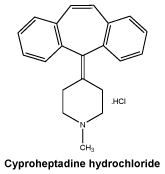
It is the sesquihydrate of 4-(5H-dibenzo[a,d]cyclohepten-5-ylidene)-1-methylpiperidine hydrochloride. The empirical formula of the anhydrous salt is C21H21N.HCl and the structural formula of the anhydrous salt is:
Chemical structure.
7 Medicine Schedule (Poisons Standard)
S3 (Pharmacist Only Medicine).
Date of First Approval
29 January 1998
Date of Revision
25 June 2026
Summary Table of Changes

Reasonable care is taken to provide accurate information at the time of creation. This information is not intended as a substitute for medical advice and should not be exclusively relied on to manage or diagnose a medical condition. The Australian Commission on Safety and Quality in Health Care disclaims all liability (including for negligence) for any loss, damage, injury or any other negative effects resulting from reliance on or use of this information. Read our full disclaimer. This website uses cookies. Read our privacy policy.