
Pharmacy Action Worm Treatment
Brand Information
| Brand name | Pharmacy Action Worm Treatment |
| Active ingredient | Mebendazole |
| Schedule | S2 |
No current CMI was found.
Brand Information
| Brand name | Pharmacy Action Worm Treatment |
| Active ingredient | Mebendazole |
| Schedule | S2 |
MIMS Revision Date: 01 September 2026
1 Name of Medicine
Mebendazole.
2 Qualitative and Quantitative Composition
Pharmacy Action Worm Treatment tablets contain mebendazole 100 mg.
List of excipients with known effects. Saccharin.
For the full list of excipients, see Section 6.1 List of Excipients.
3 Pharmaceutical Form
Slightly orange, circular, flat, bevel-edged, half-scored tablet with orange flavour.
4 Clinical Particulars
4.1 Therapeutic Indications
Pharmacy Action Worm Treatment tablets are indicated for the treatment of single or mixed helminthic infestations. Clinical studies have shown mebendazole to be effective in the treatment of Enterobius vermicularis (threadworm), Ascaris lumbricoides (roundworm), Trichuris trichiura (whipworm) and of Ancylostoma duodenale and Necator americanus (hookworm).
4.2 Dose and Method of Administration
Pharmacy Action Worm Treatment is administered orally.
Pharmacy Action Worm Treatment orange flavoured tablets may be swallowed whole, chewed or crushed into a teaspoon of food.
For control of Enterobiasis. Adults and children 2-12 years. One Pharmacy Action Worm Treatment tablet (100 mg) is given. Since reinfections by Enterobius are known to be very frequent, it is recommended that treatment be repeated after 2 to 4 weeks, especially in eradication programmes.
For control of Trichuriasis, Ascariasis, Ancylostomiasis and mixed infections. Adults and children 2-12 years. One Pharmacy Action Worm Treatment tablet (100 mg) is administered in the morning and evening for three consecutive days.
4.3 Contraindications
Mebendazole is contraindicated in persons who have shown hypersensitivity to the drug or other benzimidazole derivatives.
4.4 Special Warnings and Precautions for Use
Risk-benefit analysis should be considered for the following.
Crohn's ileitis or ulcerative colitis. May increase absorption and toxicity of mebendazole, especially in high-dose therapy.
Use in hepatic impairment. Caution is advised for use in patients with hepatic impairment since this condition may prolong half-life and drug accumulation.
Use in the elderly. No data available.
Paediatric use. Mebendazole has not been studied in children under two years. Therefore, Pharmacy Action Worm Treatment cannot be recommended in this age group pending the results of studies.
Convulsions in children, including in infants below one year of age have been reported very rarely during post-marketing experience with Pharmacy Action Worm Treatment.
Effects on laboratory tests. No data available.
4.5 Interactions with Other Medicines and Other Forms of Interactions
Concurrent administration of cimetidine may inhibit the metabolism of mebendazole in the liver, producing increased plasma concentrations of the drug, especially during prolonged treatment.
In the latter case, determination of plasma concentrations is recommended in order to allow dose adjustments.
Results from a case-control study investigating an outbreak of Stevens-Johnson syndrome/toxic epidermal necrolysis (SJS/TEN) suggested a possible relationship between SJS/TEN and the concomitant use of mebendazole and metronidazole. Further data suggesting such a drug-drug interaction are not available. Therefore, concomitant use of mebendazole and metronidazole should be avoided.
4.6 Fertility, Pregnancy and Lactation
Effects on fertility. The effect of mebendazole on reproduction was determined in various animal species. Included in these studies were determinations on potential embryotoxicity and teratogenicity in rats, rabbits, dogs, sheep and horses and on male and female fertility in rats.
These studies showed that mebendazole is embryotoxic and teratogenic in rats at doses 10 mg/kg and above but not in rabbits up to 40 mg/kg, or dogs and sheep up to 20 mg/kg. There was no significant effect on rat fertility when up to 40 mg/kg was given to males for 60 days before mating and to females at 20 mg/kg for 14 days before exposure to males.
Use in pregnancy. (Category B3)
The safety of use in pregnant women has not been established, although animal trials conducted in a wide range of species revealed an embryotoxic and teratogenic effect in the rat. Therefore, Pharmacy Action Worm Treatment should not be administered during pregnancy, particularly in the first trimester, unless the potential benefit to the patient outweighs the possible risk to the foetus.
Use in lactation. It is not known whether mebendazole passes into maternal milk and thus whether it is harmful to the newborn. The use of Pharmacy Action Worm Treatment in nursing mothers requires that anticipated benefits be weighed against possible risks. If use in the lactating mother is deemed essential by the treating clinician, alternative arrangements to feed the infant should be made.
4.7 Effects on Ability to Drive and Use Machines
The effects of this medicine on a person's ability to drive and use machines were not assessed as part of its registration.
4.8 Adverse Effects (Undesirable Effects)
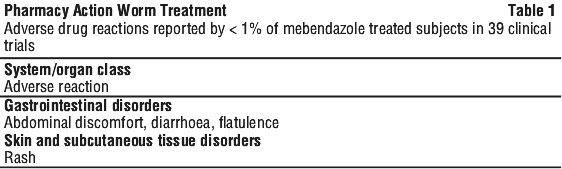
Clinical trial data. The safety of mebendazole was evaluated in 6,276 subjects who participated in 39 clinical trials for the treatment of single or mixed parasitic infestations of the gastrointestinal tract. In these 39 clinical trials, no adverse drug reactions (ADRs) occurred in ≥ 1% of mebendazole-treated subjects. ADRs occurring in < 1% of mebendazole-treated subjects are shown in Table 1.
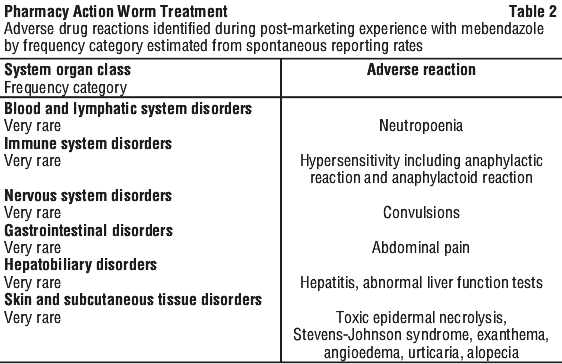
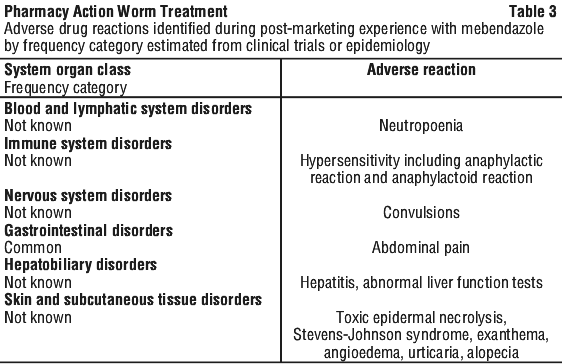
In Table 2, ADRs are presented by frequency category based on spontaneous reporting rates, while in Table 3 the same ADRs are presented by frequency category based on incidence in clinical trials or epidemiology studies, when known.
Note to regulatory. The individual events listed in each of the following 2 tables are identical. The difference between the 2 tables is the source of information used to estimate the frequency category for each event, which is the spontaneous reporting rate in Table 2 and the precise incidence in either an epidemiology study or in clinical trial(s) in Table 3. When deriving a local label from the CCDS only one of these 2 tables should be selected for inclusion in the post-marketing experience section, based on local regulatory requirements.
4.9 Overdose
In patients treated at dosages substantially higher than recommended or for prolonged periods of time, the following adverse reactions have been reported rarely: reversible liver function disturbances, hepatitis, neutropoenia, and glomerulonephritis. With the exception of glomerulonephritis, these also have been reported in patients who were treated with mebendazole at standard dosages.
Respiratory arrest and tachyarrhythmia associated with continuous convulsions have been reported in an 8-week old infant following accidental poisoning with mebendazole. Treatment by exchange transfusion and anticonvulsants was successful.
Symptoms. In the event of accidental overdosage, abdominal cramps, nausea, vomiting and diarrhoea may occur.
Treatment. There is no specific antidote. Supportive and symptomatic therapy should be initiated in cases of overdosage. Activated charcoal may be given if considered appropriate.
For information on the management of overdose, contact the Poisons Information Centre on 13 11 26 (Australia).
5 Pharmacological Properties
5.1 Pharmacodynamic Properties
Therapeutic classification: Anthelmintic.
Mechanism of action. Mebendazole acts locally in the lumen of the gut by interfering with cellular tubulin formation in the intestines of worms. Mebendazole binds specifically to tubulin and causes ultrastructural degenerative changes in the intestine. As a result, the glucose uptake and the digestive functions of the worm are disrupted to such an extent that an autolytic process occurs.
There is no evidence that Pharmacy Action Worm Treatment is effective in the treatment of cysticercosis.
Parasitology. In vitro and in vivo studies indicate that mebendazole inhibits Trichuris trichiura and hookworms (Ancylostoma duodenale and Necator americanus). In vivo efficacy has been demonstrated against Trichuris, Ascaris, hookworm, and Enterobius. The mechanism of action is probably a result of an inhibitory effect on the ability of the organism to utilise exogenous glucose. This interferes with the generation of phosphate bonds (ATP), ultimately leading to the death of the parasite.
Clinical trials. No data available.
5.2 Pharmacokinetic Properties
Absorption. Following oral administration, approximately 20% of the dose reaches the systemic circulation, due to incomplete absorption and to extensive pre-systemic metabolism (first-pass effect). Maximum plasma concentrations are generally seen 2 to 4 hours after administration. Dosing with a high fat meal leads to a modest increase in the bioavailability of mebendazole.
Distribution. The plasma protein binding of mebendazole is 90% to 95%. The volume of distribution is 1 to 2 L/kg, indicating that mebendazole penetrates areas outside the vascular space. This is supported by data in patients on chronic mebendazole therapy (e.g. 40 mg/kg/day for 3-21 months) that show drug levels in tissue.
Metabolism. Orally administered mebendazole is extensively metabolized primarily by the liver. Plasma concentrations of its major metabolites (amino and hydroxylated amino forms of mebendazole) are substantially higher than those of mebendazole. Impaired hepatic function, impaired metabolism, or impaired biliary elimination may lead to higher plasma levels of mebendazole.
Excretion. Mebendazole, the conjugated forms of mebendazole, and its metabolites likely undergo some degree of enterohepatic recirculation and are excreted in the urine and bile. The apparent elimination half-life after an oral dose ranges from 3 to 6 hours in most patients. Approximately 95% of mebendazole is excreted in the faeces unchanged or as the primary metabolite (2-amino derivatives).
Steady-state pharmacokinetics. During chronic dosing (e.g. 40 mg/kg/day for 3-21 months), plasma concentrations of mebendazole and its major metabolites increase, resulting in approximately 3-fold higher exposure at steady-state compared to single dosing.
5.3 Preclinical Safety Data
Genotoxicity. No data available.
Carcinogenicity. No data available.
Miscellaneous studies. Mebendazole was tested for possible cardiovascular effects in dogs. It is concluded that single oral doses up to 160 mg/kg are devoid of electrocardiographic effects in dogs.
6 Pharmaceutical Particulars
6.1 List of Excipients
The inactive ingredients in the tablets are microcrystalline cellulose, sodium starch glycollate, purified talc, maize starch, saccharin sodium, hydrogenated cottonseed oil, magnesium stearate, Trusil Nature Identical orange flavour 17-3126, colloidal anhydrous silica, sodium lauryl sulfate and sunset yellow SCF (orange yellow S (E110)).
6.2 Incompatibilities
Incompatibilities were either not assessed or not identified as part of the registration of this medicine.
6.3 Shelf Life
In Australia, information on the shelf life can be found on the public summary of the Australian Register of Therapeutic Goods (ARTG). The expiry date can be found on the packaging.
6.4 Special Precautions for Storage
Store below 30°C. Keep out of reach of children.
6.5 Nature and Contents of Container
Pharmacy Action Worm Treatment tablets is available in blister packs of 2, 4, and 6 tablets (with patient instructions).
Australian registration number. AUST R 202686.
6.6 Special Precautions for Disposal
In Australia, any unused medicine or waste material should be disposed of by taking to your local pharmacy.
6.7 Physicochemical Properties
Mebendazole is methyl 5-benzoyl-2-benzimidazole carbamate a synthetic benzimidazole derivative and is an off white to yellowish powder, insoluble in water and common organic solvents but freely soluble in formic acid.
Chemical structure.
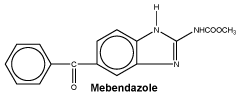
Molecular weight: 295.30.
CAS number. 31431-39-7.
7 Medicine Schedule (Poisons Standard)
(S2) Pharmacy Medicine.
Date of First Approval
05 November 2012
Date of Revision
23 November 2020
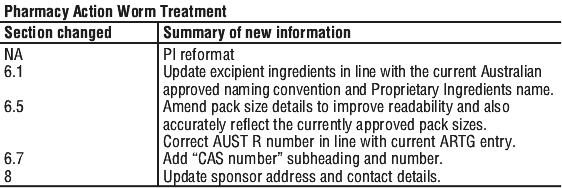
Summary Table of Changes
Reasonable care is taken to provide accurate information at the time of creation. This information is not intended as a substitute for medical advice and should not be exclusively relied on to manage or diagnose a medical condition. The Australian Commission on Safety and Quality in Health Care disclaims all liability (including for negligence) for any loss, damage, injury or any other negative effects resulting from reliance on or use of this information. Read our full disclaimer. This website uses cookies. Read our privacy policy.