
Zyrtec Eye Drops
Brand Information
| Brand name | Zyrtec Eye Drops |
| Active ingredient | Levocabastine |
| Schedule | S2 |
No current CMI was found.
Brand Information
| Brand name | Zyrtec Eye Drops |
| Active ingredient | Levocabastine |
| Schedule | S2 |
MIMS Revision Date: 01 August 2020
1 Name of Medicine
Levocabastine hydrochloride.
2 Qualitative and Quantitative Composition
Zyrtec eye drops. Active ingredients: levocabastine hydrochloride equivalent to levocabastine 0.5 mg/mL.
Excipients with known effect: benzalkonium chloride and disodium edetate (both 0.15 mg/mL) as preservatives.
Excipients: propylene glycol, polysorbate 80, sodium phosphate dibasic, sodium phosphate monobasic, hypromellose and water as inactive excipients.
Zyrtec nasal spray. Active ingredients: levocabastine hydrochloride equivalent to levocabastine 0.5 mg/mL.
Excipients with known effect: benzalkonium chloride and disodium edetate (both 0.15 mg/mL) as preservatives.
Excipients: propylene glycol, polysorbate 80, sodium phosphate dibasic, sodium phosphate monobasic, hypromellose and water as inactive excipients.
3 Pharmaceutical Form
Eye drops: a sterile white ophthalmic microsuspension (pH 6-8).
Nasal spray: a white microsuspension (pH 6-8).
4 Clinical Particulars
4.1 Therapeutic Indications
Eye drops. Symptomatic treatment of seasonal allergic conjunctivitis.
Nasal spray. Symptomatic treatment of seasonal or perennial allergic rhinitis.
4.2 Dose and Method of Administration
As Zyrtec eye drops and nasal spray are available as a microsuspension, the bottle should be shaken before each application.
Eye drops. As with all ophthalmic preparations containing benzalkonium chloride, patients are advised not to wear soft (hydrophilic) contact lenses while under treatment with Zyrtec eye drops.
Adults and children 6 years of age and over. The usual dose is one drop of Zyrtec eye drops per eye, twice daily. If necessary, the dose may be increased to one drop 3 to 4 times daily. The bottle should be well shaken before use. The duration of treatment should be limited to 8 weeks.
Systemic absorption of levocabastine is very low. However, the systemic absorption of drugs from ophthalmic solutions can be minimised by pressure on the tear duct immediately after application.
Zyrtec eye drops should be used within one month of first opening of the bottle. Patients should be instructed to take appropriate measures to avoid contamination of the container.
Nasal spray. Adults and children 6 years of age and over. The usual dose is two sprays of Zyrtec nasal spray per nostril, twice daily. If necessary, the dose may be increased to two sprays 3 to 4 times daily. The duration of treatment should be limited to 8 weeks.
Patients should be instructed to clear the nasal passages prior to administering the spray and to inhale through the nose during spraying. Before using the pump delivery system for the first time, the pump reservoir should be filled by priming until a fine spray is delivered.
4.3 Contraindications
Hypersensitivity to any of the ingredients.
4.4 Special Warnings and Precautions for Use
Mental alertness. In clinical trials there was no significant difference in the incidence of slowed patient reactions with Zyrtec compared to placebo and active comparator drugs. Zyrtec, therefore, would not be expected to interfere with the ability to drive a motor vehicle or operate machinery. Should drowsiness occur, caution is advised.
Renal impairment. After a single oral dose of 0.5 mg levocabastine in solution, the terminal half-life of levocabastine in moderate to severe renal impairment (Creatinine Clearance 10 - 50 mL/min) increased from 36 hours to 95 hours. Overall exposure to levocabastine based on AUC was increased by 56%.
Nasal spray. Limited data are available on the use of oral levocabastine. Caution should be exercised when administering Zyrtec nasal spray to patients with renal impairment (see Section 5.2 Pharmacokinetic Properties).
Eye drop. Given the extremely low plasma concentrations after ocular application, a dose adjustment is unlikely to be required in patients with renal impairment receiving levocabastine eye drops. However, dose reduction should be considered in patients with renal disease during prolonged treatment with levocabastine nasal spray. As hepatic metabolism of levocabastine is negligible, dose adjustments in patients with impaired hepatic function should not be necessary.
Use in the elderly. In the elderly, after multiple nasal administrations of 0.4mg levocabastine for 14 days, the terminal half-life of levocabastine was increased by 15% and the peak plasma level was increased by 26%.
Paediatric use. No data available on use in children less than six years of age.
Effects on laboratory tests. No data available.
4.5 Interactions with Other Medicines and Other Forms of Interactions
No interactions have been seen with Zyrtec eye drops. With Zyrtec nasal spray there were no reports of interaction with alcohol in clinical trials. In psychomotor performance studies there was no significant potentiation of the effects of alcohol on performance and subjective test measures with Zyrtec nasal spray used at normal doses.
Pharmacokinetic interactions. The decongestant oxymetazoline may transiently reduce the absorption of nasal levocabastine.
Coadministration of the CYP3A4 inhibitors ketoconazole (200 mg) and erythromycin (333 mg) as a single dose had no impact on the pharmacokinetics of intranasal levocabastine.
Intranasal levocabastine did not change the pharmacokinetics of loratadine.
4.6 Fertility, Pregnancy and Lactation
Use in pregnancy. (Category B3)
In pregnant rats, levocabastine readily crossed the placental barrier and was distributed extensively in foetal tissues. Reproductive studies in mice and rats showed that levocabastine was embryolethal at oral doses greater than 40 mg/kg/day in both species, and teratogenic at oral doses greater than 40 mg/kg/day in mice and 20 mg/kg/day in rats. The main foetal malformations observed were open eyes in mice, and polydactyly, hydrocephalus, anophthalmia/microphthalmia, hydronephrosis and arthrogryposis in rats. There are limited postmarketing data on the use of Zyrtec eye drops or nasal spray in pregnant women. The risk for humans is unknown. Therefore, Zyrtec eye drops and nasal spray should not be used during pregnancy.
Use in lactation. Based on determinations of levocabastine concentrations in saliva and breast milk in a nursing woman, who received a single oral dose of 0.5 mg levocabastine, it is expected that approximately 0.6% of the total intranasally and approximately 0.3% of the total ophthalmically administered dose of levocabastine may be transferred to a nursing infant. However, due to the limited nature of the clinical and experimental data, it is recommended that Zyrtec nasal spray or eye drops be avoided in breastfeeding mothers.
Effects on fertility. No data available.
4.7 Effects on Ability to Drive and Use Machines
The effects of this medicine on a person's ability to drive and use machines were not assessed as part of its registration.
4.8 Adverse Effects (Undesirable Effects)
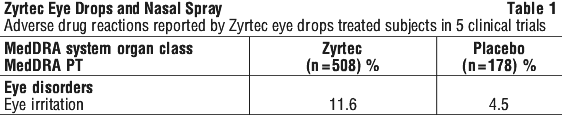
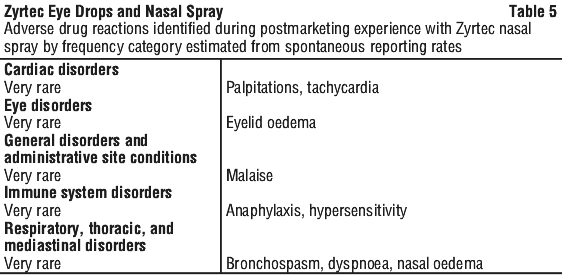
Clinical trial data. Eye drops. The safety of Zyrtec eye drops was evaluated in 508 subjects who participated in 4 placebo controlled clinical trials and one open-label clinical trial. All adverse drug reactions (ADRs) reported by subjects in Zyrtec eye drops clinical trials are presented in Table 1.
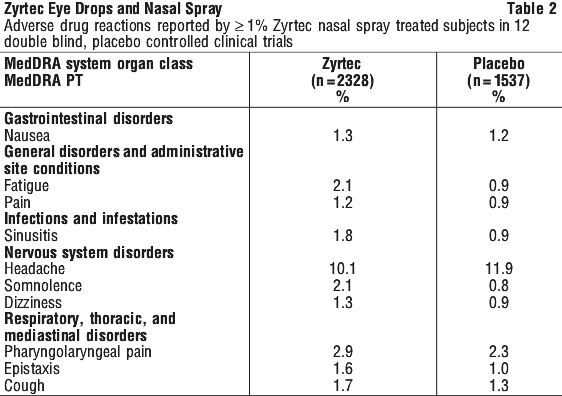
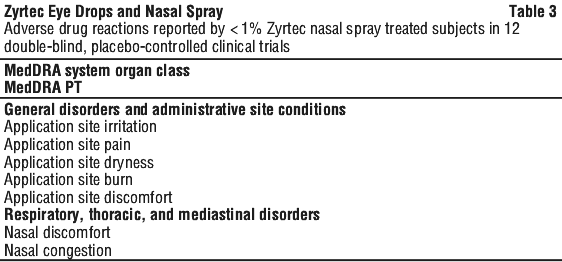
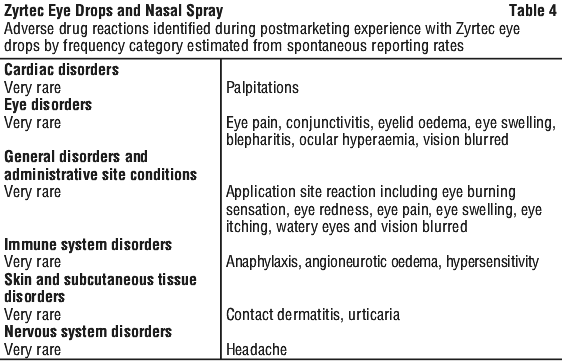
In Tables 4 and 5, ADR's are presented by frequency category based on incidence in clinical trials or epidemiology studies when known.
4.9 Overdose
There has been no experience with overdose of Zyrtec eye drops or nasal spray to date. After accidental intake of the contents of the bottle, sedation may occur. In case of overdose, the patient should be advised to drink plenty of water in order to accelerate the renal elimination of levocabastine. For information on the management of overdose, contact the Poisons Information Centre on 13 11 26 (Australia).
5 Pharmacological Properties
5.1 Pharmacodynamic Properties
Mechanism of action. Zyrtec eye drops contain levocabastine, a potent, fast-acting and highly selective histamine H1-antagonist with a sustained duration of action. After topical application to the eyes, it almost immediately and for several hours relieves the typical symptoms of allergic conjunctivitis (itching, redness, chemosis, eyelid swelling, tearing).
Zyrtec nasal spray contains levocabastine, a potent, fast-acting and highly selective histamine H1-antagonist with a sustained duration of action. After topical application to the nose, it almost immediately and for several hours relieves the typical symptoms of allergic rhinitis (sneezing, itchy nose, rhinorrhoea).
Clinical trials. Clinical studies have shown that Zyrtec eye drops and nasal spray are effective for the indications listed above. The duration of treatment with the eye drops alone was generally 2 - 4 weeks but lasted up to 3 months in two studies and 4 months in one study. Duration of treatment with the nasal spray alone was also generally 2 - 4 weeks, but lasted up to 10 weeks in some instances. The duration of treatment in studies using a combination of the eye drops and nasal spray was 8 weeks.
5.2 Pharmacokinetic Properties
Absorption. After intranasal and ocular application, the absorption of levocabastine is incomplete with a systemic bioavailability ranging from 60 to 80% for the nasal spray and from 30 to 60% for the eye drops. However, as the amount of levocabastine applied intranasally and ocularly is small, the levocabastine plasma concentrations achieved are very low. Steady-state concentrations of levocabastine are attained within 7 to 10 days following multiple dosage and are predictable from single-dose pharmacokinetics.
Distribution. After single intravenous dosing, levocabastine is rapidly distributed over the tissues, and the terminal half-life is 33 h. The total steady-state volume of distribution is 82 L (1.14 L/kg) with a total plasma clearance of 30 mL/min.
The plasma protein binding of levocabastine is 55% with albumin being the main binding protein.
Excretion. Levocabastine undergoes minimal hepatic metabolism, i.e. ester glucuronidation, and is predominantly cleared by the kidneys. 70% of the parent drug is recovered unchanged in the urine, and 10% of the dose is excreted in the urine as the acylglucuronide of levocabastine. The remaining 20% is excreted unchanged in the faeces.
5.3 Preclinical Safety Data
Genotoxicity. No data available.
Carcinogenicity. In female mice, dietary administration of levocabastine for 20 months stimulated the development of pituitary adenomas and mammary adenocarcinomas. The no-effect dose level for the pituitary tumours was 3 mg/kg/day, but a no-effect dose level has not been established for the mammary tumours. In female rats, there was an equivocal increase in the incidence of mammary tumours at the highest dose level of 34 mg/kg/day administered in the diet for 24 months. There was no evidence of carcinogenic activity in male rats or mice. The mechanism of the carcinogenic effects of levocabastine in female mice (and possibly rats) may involve antagonism of dopamine D2-receptors in the pituitary gland and subsequent elevation of serum prolactin levels.
6 Pharmaceutical Particulars
6.1 List of Excipients
See Section 2 Qualitative and Quantitative Composition.
6.2 Incompatibilities
Incompatibilities were either not assessed or not identified as part of the registration of this medicine. See Section 4.5 Interactions with Other Medicines and Other Forms of Interactions.
6.3 Shelf Life
In Australia, information on the shelf life can be found on the public summary of the Australian Register of Therapeutic Goods (ARTG). The expiry date can be found on the packaging.
6.4 Special Precautions for Storage
Store below 25°C.
6.5 Nature and Contents of Container
Zyrtec eye drops: 4 mL in 5 mL bottle.
Zyrtec nasal spray: 10 mL in 15 mL bottle.
6.6 Special Precautions for Disposal
In Australia, any unused medicine or waste material should be disposed of by taking to your local pharmacy.
6.7 Physicochemical Properties
Levocabastine hydrochloride is a white powder, insoluble in water except at higher pH and only fairly soluble in other solvents such as acetone.
Chemical structure.
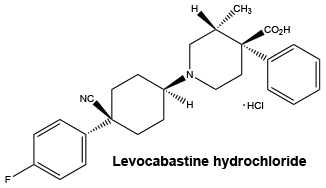
MW: 456.99.
Chemical Name: Levocabastine, (-)-[3S-[1(cis), 3 alpha, 4 beta]]-1-[4-cyano-4-(4-fluorophenyl) cyclohexyl]-3-methyl-4-phenyl-4-piperidine-carboxylic acid monohydrochloride is a highly selective histamine H1-antagonist for topical use.
CAS number. CAS-79547-78-7.
7 Medicine Schedule (Poisons Standard)
Pharmacy Medicine (S2).
Date of First Approval
27 August 2014
Date of Revision
01 June 2020
Summary Table of Changes

Reasonable care is taken to provide accurate information at the time of creation. This information is not intended as a substitute for medical advice and should not be exclusively relied on to manage or diagnose a medical condition. The Australian Commission on Safety and Quality in Health Care disclaims all liability (including for negligence) for any loss, damage, injury or any other negative effects resulting from reliance on or use of this information. Read our full disclaimer. This website uses cookies. Read our privacy policy.