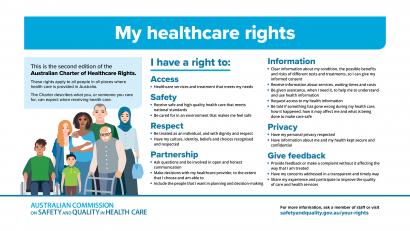
2020
Poster or infographic
Display the Australian Charter of Healthcare Rights on your health service’s TV monitors and digital signs.

Display the Australian Charter of Healthcare Rights on your health service’s TV monitors and digital signs.
This survey tool provides Australian health service organisations with a set of 14 principles supported by a variety of risk reduction strategies. The tool should be used in conjunction with the Principles for the safe selection and storage of medicines – Guidance and survey tool.
This guidance outlines strategies and principles developed to address safe selection and storage of all medicines, including look-alike, sound-alike (LASA) medicines.
In 2018, the Commission identified a need to develop guidance for the safe selection and storage of medicines, with a focus on look-alike, sound-alike (LASA) medicines. Medication incidents related to LASA medicine names are one of the most common type of medication error.
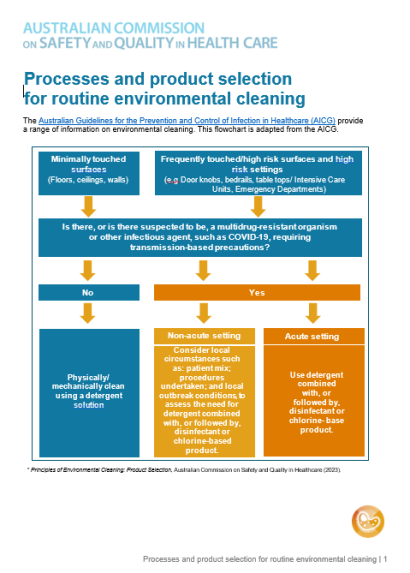
This flowchart provides guidance for selecting suitable cleaning product for environmental cleaning in health service organisations.
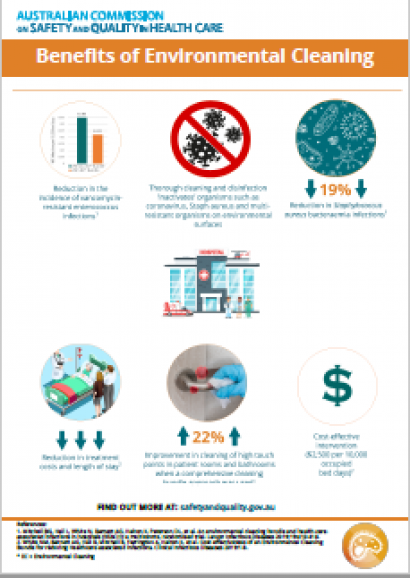
Environmental cleaning is a key component of standard precautions; the first-line in infection prevention and control in the healthcare environment.
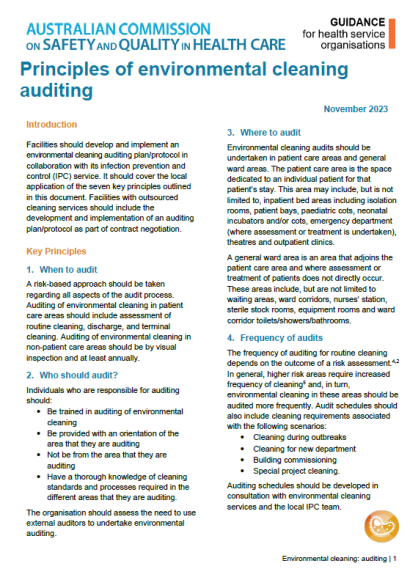
Environmental cleaning is a key component of standard precautions, the first-line in infection prevention and control in health care. Auditing of cleaning practice is an important part of this process.
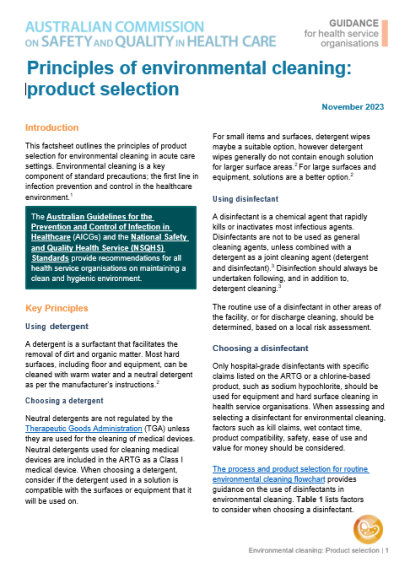
This factsheet provides guidance on selecting suitable cleaning products for environmental cleaning in health service organisations.
The National Safety and Quality Health Service Standards require health service organisations to have processes in place to maintain a clean and hygienic environment, in line with the current edition of the
Both long-standing, and recent, literature support the value of sustained infection prevention and control practices in reducing the incidence of preventable SABSI.
Measures to prevent SABSI in health care include: