
The Australian Charter of Healthcare Rights is for everyone. We are endeavouring to provide translations of the Charter in many community languages. Currently the Charter is available in 32 languages in a printable A4 poster format.
Found 303 result(s)
The Commission is undertaking research into safety and quality in virtual care (telehealth), in acute health and primary healthcare settings.
The Commission has developed a series of resources on infection prevention and control (IPC) for aged care service providers and staff.
The Patient-Reported Indicator Survey or PaRIS Health Survey is an OECD-led initiative to strengthen the measurement of outcomes and experiences of healthcare services in primary care for people living with chronic conditions.
The Commission, on behalf of the Department of Health, Disability and Ageing, led the implementation of the inaugural PaRIS Health Survey in Australia in 2023. The PaRIS Australian National Report was released in July 2025.
This page outlines the Commission's social media channels — how we use them, what we expect, and how we manage and moderate them. A contact point is provided for enquiries.
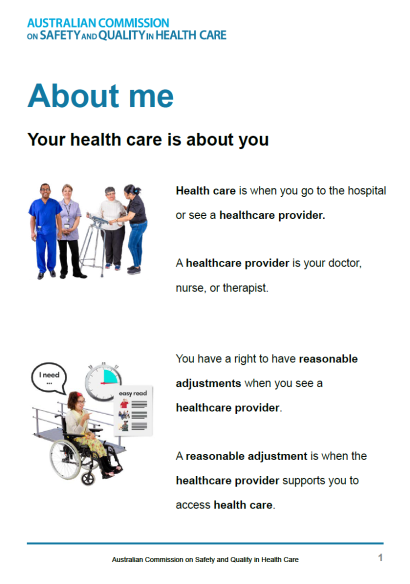
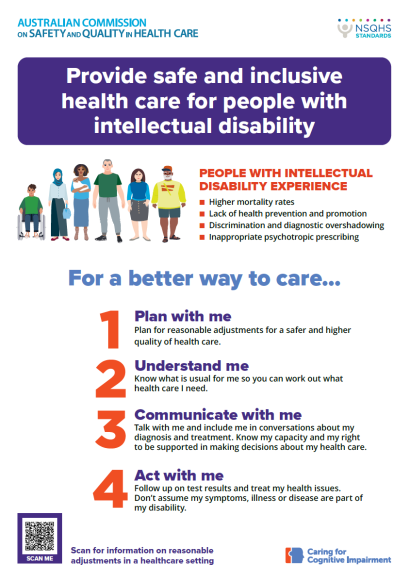
The National Safety and Quality Health Service (NSQHS) Standards support the right of people with intellectual disability to equitable health care. This page provides further resources to assist those with intellectual disability and their family and supporters to understand and advocate for equitable health care, as part of the Commission’s support for improved health care for people with intellectual disability.
Antimicrobial resistance (AMR) is a serious threat to human health and patient safety. Hundreds of people in Australia die each year as a result of AMR.
From 1 January 2023, the Australian Commission on Safety and Quality in Health Care (the Commission) became the custodian of a range of Quality Use of Medicines (QUM) functions, expanding our role in QUM stewardship. This follows the redesign of the Quality Use of Diagnostics, Therapeutics and Pathology (QUDTP) Program outlined in the 2022–23 Federal Budget.
Status updates for each function can be found below.
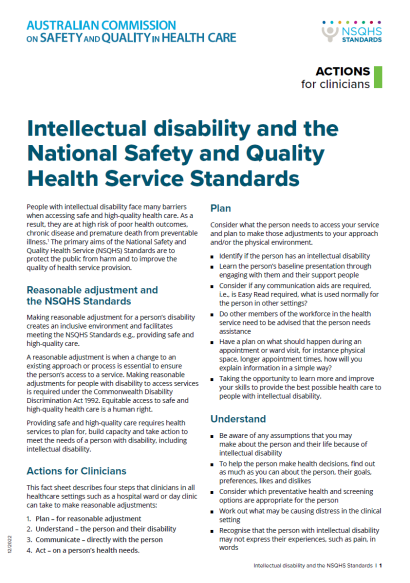
The National Safety and Quality Health Service (NSQHS) Standards support the rights of people with intellectual disability to equitable health care. People with intellectual disability experience significant barriers in accessing safe and quality care evident through a higher mortality rate, increased incidence of preventable illness and more frequent hospital admissions.
In this section, you will find guidance and resources for implementation of the NSQHS Standards, to support healthcare rights and provision of inclusive health care.
Being actively involved in your health care and working in partnership with your healthcare providers can help ensure that you get the care that is right for you.
Effective clinical communication with both consumers and colleagues is essential for a collaborative, shared decision making approach to health care.
Person-centred care must recognise and respect individual needs, beliefs and culture. Understanding the diversity of consumers seen in your organisation can help you design systems that support staff to better meet their needs.
Summary of accreditation outcomes and lessons learnt from the assessment of general practices against the RACGP Standards for general practices (5th edition) and the RACGP Standards for point-of-care testing (5th edition).
To support implementation of the NGPA Scheme, the Australian Commission on Safety and Quality in Health Care (the Commission) provides guidance for the following:
- Notification of significant risk
- Extensions and appeals
- Out-of-cycle assessments
- Hybrid assessments
- Early assessments.
Accreditation provides assurances to the community that a general practice meets expected standards for safety and quality. It is a formal program in which trained independent reviewers assess a general practice’s evidence of implementation of the RACGP Standards for general practices and the RACGP Standards for point-of-care testing.
Embedding a person-centred approach throughout a healthcare organisation requires the involvement of all staff across various aspects of the patient journey.