Sepsis hub
Sepsis is a time-critical emergency. Early detection and treatment are essential to preventing deaths and improving outcomes for people with sepsis and their families and carers. It is vital that sepsis continues to be addressed as a health system safety and quality priority through ongoing action.
Developed as part of our Better Care Everywhere initiative, this hub supports clinicians and health service organisations to improve early detection, data quality and clinical care across the healthcare system.

Sepsis is a life-threatening and time critical condition that arises when the body’s response to an infection damages its own tissues and organs. It is a major cause of morbidity and mortality.
In Australia, recent analyses show the prevalence and impact of sepsis is significantly greater than previously estimated, with over 84,000 reported sepsis separations in Australian public hospitals in 2022-23.
Better Care Everywhere hubs outline what appropriate care looks like across variation focus areas.
In each hub you will find a mix of:
- best practice information on the condition, treatment or procedure
- insights on where and why care may vary from evidence-based practice.
Each hub also includes a practical toolkit to support clinicians and health service organisations address the drivers of low-value care to deliver sustainable, high-quality care. [Link]
Other hubs include:
Learn more about the Better Care Everywhere initiative and the six evidence-based actions that underpin the toolkits.
1 in 7
in-hospital deaths
2x
population rate of sepsis
for First Nations People
21,000+
readmissions within 30 days
Best practice quick links
Clinical Care Standard
Model of Care Framework
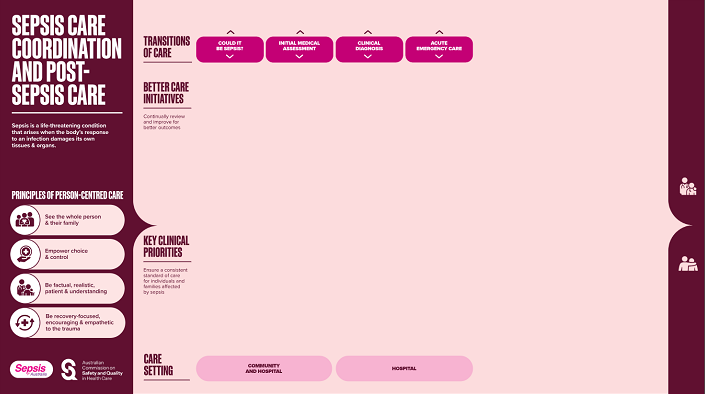
Coordination of care and post-sepsis support
This interactive PDF illustrates the Coordination of care and post-sepsis support - Model of Care Framework to support local conversations about the sepsis patient journey and the quality and safety improvement opportunities across transitions of care.
Success story
Grassroots strategies improve regional sepsis response
The team at Flinders and Upper North Local Health Network led the way in designing a sepsis pathway tailored to local needs, across a large regional and remote area of South Australia. Initiatives to train new staff and a 'Sepsis Pharmacy Box' have helped to cement these changes. Dashboards convey the ongoing improvement from these changes in staff lounges and clinical spaces.

Variation focus area: post-sepsis support
Sepsis has lasting social, emotional and financial impacts beyond discharge or death. Around half of survivors have ongoing physical, cognitive or mental health problems up to two years after discharge, including acquired disability and post-sepsis syndrome.
Rehospitalisation is common. In 2022-23, 54.6% of readmissions within a year occurred in the first 30 days, and sepsis (unspecified) was the most common diagnosis across readmission intervals.
Early readmissions were associated with slightly younger age, greater socioeconomic disadvantage and living outside major cities.
46%
higher proportions of readmissions for people who lived outside of major cities
Why care varies?
- patients outside of major cities were more likely to require hospital transfers for complex conditions like sepsis.
- confidence bias from health services that younger patients will continue to recover after hospital discharge. However, when coupled with higher socio-economic disadvantage, these patients may be less able to recover outside of hospital, increasing risk of readmission.
- financial burden associated with longer hospital stays disproportionately affect those in greater socioeconomic disadvantage, leading to patient preference for earlier discharge, and consequently increased risk of readmission.
What more can be done?
- Listen, Look and Act to recognise sepsis or rule it out. Several tools have been used to enable early identification of sepsis, ranging from tools for sepsis screening and detection, to those predictive of adverse outcomes such as mortality tools to focus on identifying clinical deterioration.
- The evidence regarding the diagnostic accuracy and effectiveness of tools for sepsis detection and risk stratification continues to evolve.
- Increased adherence to sepsis clinical pathways, which include resuscitation and management bundles of care, have been associated with reduced mortality.
- It is important to recognise that both sepsis-specific tools and standardised observation charts used to monitor for acute deterioration can help with assessment and escalation. However, the possibility of sepsis and of the presence of infection must be considered for appropriate intervention to occur.
- If sepsis is suspected, the involvement of a clinician who has experience in recognising and managing sepsis is crucial.
- Implement the Sepsis Clinical Care Standard and use its indicators to support local quality improvement.
- Use sepsis awareness resources to increase clinician and patient knowledge of the signs and symptoms of sepsis and important time critical actions.
- Review the sepsis care coordination and post sepsis support model of care framework to identify ways to improve the sepsis patient journey and provide essential supports for sepsis survivors and bereaved families.
- Act to improve cultural safety and provide culturally appropriate models of care to suit local needs.
- Refer to Emergency Triage Education Kit to ensure Triage teams consider the risk of sepsis and sepsis related deterioration
- Know the signs and symptoms of sepsis
- Talk to your healthcare provider if you are concerned for yourself or a loved one, and use the words ‘could it be sepsis’
- Ask your doctor or other healthcare provider about signs to look out for if you are not getting better or starting to get worse
- If you have had sepsis and are recovering, talk to your healthcare provider about screening for Post Sepsis Syndrome
- If you have lost someone to sepsis, talk to your healthcare provider about bereavement and peer support.
- Connect with sepsis survivors and families at Sepsis Australia.
Better Care Everywhere Toolkit: Sepsis
This toolkit includes resources to help improve the recognition and treatment of sepsis and is designed for health professionals and health service organisations. Resources are organised into six evidence-based actions that address unwarranted clinical variation.
Focus on one strategy to start, or use all six to deliver safer, more consistent and sustainable health care.
Learn more about the six evidenced-based actions in the Better Care Everywhere Toolkit and their role in addressing unwarranted clinical variation.
Better Systems
Better Systems
Better systems refer to the combination of culture, systems and processes that health service organisations need to have to deliver care that is consistently high-quality and improving.
Best practice systems provide the right environment for a clear, system-wide approach to minimise unwarranted clinical variation and the potential for low-value care.
Appropriate clinical governance systems ensure that everyone knows what best-practice looks like, that systems are set up to measure when care varies from best practice and staff are supported to act when care varies more than it should or for the wrong reasons.
Guidance, tools and resources
National Model for Clinical Governance
A national model which identified six foundations of clinical governance that when combined underpin an organisational approach to delivering consistently high-quality and improving care.
- Use to: Establish the systems needed to consistently identify and act to address unwarranted clinical variation.
- Useful for: Boards and Chief Executive Officers of health service organisations.
National Safety and Quality Health Service (NSQHS) Standards
The Standards provide a nationally consistent statement of the level of care consumers can expect from health service organisations.
Action 1.27 and 1.28
- Use to: Set the standard of care that patients should expect from your acute care health service. Action 1.27 and 1.28 states that health service organisations are required to use evidence-based guidance and measure when care varies from the standard.
- Useful for: All professionals (health and non-health) involved in the delivery of acute care services.
Healthcare Sustainability and Resilience Module
The Module provides a framework of actions for health service organisations to integrate environmental sustainability and climate resilience strategies to deliver high-quality care.
- Use to: Support the development of adaptation and mitigation strategies for climate and environmental risk. Action 2b includes reviewing clinical practice to identify and address healthcare variation and unnecessary use of resources.
- Useful for: Sustainability Managers, Safety and Quality Managers.
User Guide for Reviewing Clinical Variation
This User Guide presents a six-step approach to the review of clinical variation data, and case studies that put those steps into action.
- Use to: Support implementation of Action 1.28 of the NSQHS Standards.
- Useful for: health service organisations, Safety and Quality Managers.
Better Insights
Better Insights
Better insights refer to the meaningful use of data to improve the appropriate use and timing of colonoscopy for the diagnosis, monitoring and treatment of bowel cancer and other diseases.
Using data to understand where the use of colonoscopy differs from best practice is critical to improving the diagnosis and management of bowel cancer and other diseases in Australia.
You can use the data in our report to:
- Prompt reflection and review your individual or your practice’s results in comparison to national, state and local area trends.
- Identify key areas for improvement to benefit patients.
- Develop colonoscopy-focussed quality improvement activities that are meaningful to you and your patients.
Guidance, tools and resources
National Sepsis Program Epidemiology Report 2025
This report examines pre and post sepsis separations for patients with a sepsis diagnosis within a 30-day window, to better understand the sepsis patient journey in public admitted care.
- Use to: understand the prevalence and impact of sepsis in Australian public hospitals
- Useful for: policy makers, Safety and Quality Managers, Quality Improvement Managers, epidemiologists, clinicians.
Data infographic - Sepsis Epidemiology Report
- Use to: View a summary of key findings from the sepsis epidemiology report.
- Useful for: policy makers, Safety and Quality Managers, Quality Improvement Managers, epidemiologists, clinicians.
Coordination of care and post-sepsis support - Business Case
- Use to: Consider the impact and burden of sepsis.
- Useful for: Health service executives, policy makers, Safety and Quality Managers, Quality Improvement Managers, clinicians, care teams and discharge planners.
Better Practice
Better Practice
Better practice involves the appropriate use of colonoscopy in the diagnosis and treatment of bowel cancer.
Better clinical practice can address unwarranted clinical variation by ensuring care is delivered in line with evidence-based guidance.
Guidance, tools and resources
Sepsis Clinical Care Standard
Describes the level of care expected to ensure patients presenting with the signs and symptoms of sepsis receive optimal care from symptom onset to discharge from hospital and survivorship care.
- Use to: Improve the quality of care for people with sepsis.
- Useful for: clinicians, health service organisations.
Quality statements - Sepsis Clinical Care Standard
Guidance for clinicians on the seven quality statements from the Sepsis Clinical Care Standard.
- Use to: Improve the quality of sepsis care from symptom onset through to discharge and survivorship.
- Useful for: clinicians, health service organisations.
Coordination of care and post-sepsis support - Model of Care Framework
- Use to: Understand and improve the sepsis patient journey across the health system.
- Useful for: policy makers, Safety and Quality Managers, Quality Improvement Managers, clinicians, care teams and discharge planners.
Coordination of care and post-sepsis support - Supporting evidence and implementation ideas
- Use to: Expanded understanding of the importance of care coordination and post sepsis support and learn about how health semvice organisations are responding and emerging results.
- Useful for: policy makers, Safety and Quality Managers, Quality Improvement Managers, clinicians, care teams and discharge planners.
Coordination of care and post-sepsis support - Interactive PDF
- Use to: Consider different elements in the sepsis patient journey and identify opportunities for quality improvement.
- Useful for: Policy makers, Safety and Quality Managers, Quality Improvement Managers, clinicians, care teams and discharge planners.
Lactate in the deteriorating patient
Information for clinicians about the significance of elevated serum lactate levels in both adults and children.
- Use to: Recognition of elevated lactate and rapid escalation of care can avoid patient harm and potential death.
- Useful for: clinicians, health service organisations.
Antimicrobial guidance for sepsis programs
Guidance for hospitals and acute facilities about systems to ensure rapid access to appropriate antimicrobials for patients with sepsis, including use and governance of sepsis boxes
- Use to: guide antimicrobial preparedness for treating sepsis.
- Useful for: clinicians, health service organisations.
Better Decisions
Better Decisions
Better decisions involve making choices that are patient-centred and considers individual values, preferences and circumstances. It involves engaging in shared decision-making, where clinicians and patients work together to provide care that best meets the patient’s needs and goals.
Better shared decision-making can address unwarranted clinical variation by making information available to patients about the range of treatment options and ensuring that patients consider the risks and benefits of each treatment, enabling them to make an informed choice about their care.
Guidance, tools and resources
Discharge planning guide for patients with sepsis
- Use to: support multidisciplinary discharge planning to ensure follow up and support for patients and their families after hospitalisation with sepsis – including a discharge checklist.
- Useful for: clinicians, discharge coordinator, patients and families
GP letter template for discharge - Sepsis
- Use to: communicate with a patient’s GP or primary healthcare providers on discharge following hospitalisation for sepsis. It contains information about post-sepsis syndrome and sepsis recovery.
- Useful for: clinicians, discharge coordinator, patients and families, primary health care providers.
Information for people with sepsis and their families (for adults)
- Use to: provide information about sepsis and what it means for care and recovery of adults who have had sepsis.
- Useful for: clinicians, discharge coordinator, patients and families.
Information for parents, carers and families of children with sepsis
- Use to: provide information about sepsis and what it means for care and recovery of children who have had sepsis.
- Useful for: clinicians, discharge coordinator, patients and families.
Bereavement support after sepsis
- Use to: provide information on sepsis and bereavement support for people who have lost someone because of sepsis.
- Useful for: clinicians, discharge coordinator, patients and families who have experienced a death due to sepsis.
Guidance, tools and resources for Aboriginal and Torres Strait Islander people
‘Could it be Sepsis?’ - Patient information brochure for Aboriginal and Torres Strait Islander peoples
- Use to: provides information for Aboriginal and Torres Strait Islander patients and carers about sepsis, its causes, prevention, treatment and groups at higher risk of developing sepsis.
- Useful for: clinicians, primary health care providers, community-controlled health service organisations, discharge coordinators, Aboriginal and Torres Strait Islander patients and families.
‘Could it be Sepsis?’
Healthcare professionals and health service organisations are encouraged to download and display the sepsis information posters. These posters aim to raise awareness around sepsis and its early symptoms.
- Use to: provides information for Aboriginal and Torres Strait Isalnder patients and carers about sepsis.
- Useful for: clinicians, primary health care providers, community controlled health service organisations, discharge coordinators, Aboriginal and Torres Strait Islander patients and families.
Sepsis video series
Short, animated videos describe the signs and symptoms of sepsis and what Aboriginal and Torres Strait Islander people need to look out for. The videos also explain when to get medical help.
- Use to: provides information for Aboriginal and Torres Strait Islander patients and carers about sepsis.
- Useful for: clinicians, primary health care providers, community-controlled health service organisations, Aboriginal and Torres Strait Islander patients and families.
Told from the perspective of Uncle Matt Priestley, a proud Kamileroi/Gomeroi man, and then joined by Mr Ronald Prince, a proud Kamileroi/Gomeroi man and former NRL player, across these two videos they complete the sepsis challenge and empower First Nations peoples to ask: could it be sepsis?
Reports
- Experiences of Sepsis among First Nations Peoples in Australia: helping identify and synthesise what is already understood about recognising, responding to and improving sepsis outcomes in First Nations peoples.
- Keeping Community Strong - Protecting Aboriginal and Torres Strait Islander communities from Sepsis: the second component of project five that aimed to understand the impact of sepsis on First Nations peoples.
Better Monitoring
Better Monitoring
Better monitoring means continually measuring and refining quality improvement activities to improve the quality of care and reduce unwarranted clinical variation.
Measurement is fundamental to providing better care, as meaningful indicators are required to assess the effectiveness of quality improvement initiatives and guide decision-making. By routinely measuring how care is delivered and where it differs, we can see where clinical variation is occurring, but identification of variation is only the first step, further investigation and action at a local level is essential to make sure data on clinical variation leads to better care.
Guidance, tools and resources
Self-Assessment Tool - Sepsis Clinical Care Standard
- Use to: support the development and monitoring and quality improvement plans for sepsis care.
- Useful for: clinicians, health service organisations.
Indicator Monitoring Tool - Sepsis Clinical Care Standard
- Use to: collect, analyse and report on Sepsis Clinical Care Standard indicators.
- Useful for: clinicians, health service organisations.
National Sepsis Data Plan - Strategic Analysis Report
This strategic report envisions the future state and sepsis data in Australia and sets out a five-year plan to realise that vision.
- Use to: understand the challenges and opportunities to achieve nationally robust data about sepsis.
- Useful for: health service organisations, policy makers and Quality and Safety Managers.
Better Networks
Better Networks
Better networks mean bringing people together with common interests and goals to learn, share and support efforts to reduce unwarranted clinical variation. Through these networks, clinicians can collaborate and apply shared learnings to promote stewardship of resources and reduce duplication of work.
Networks can address unwarranted clinical variation by providing a platform for sharing evidence, experiences and best practice. This supports the standardisation of care and ensures patients receive consistent and high-quality care regardless of where they are being treated.
Communities of practice/Networks
Sepsis Australia
A national peak organisation in Australia focused on sepsis research, advocacy and quality improvement.
Sepsis Australia developed the Stopping Sepsis National Action Plan and provides support and advice internationally to help other countries develop similar plans. Sepsis Australia is hosted by The George Institute for Global Health.
Global Sepsis Alliance
GSA is a non-profit charity that provides global leadership to reduce the burden and impact of sepsis. GSA is the initiator or World Sepsis Day (13 September) and World Sepsis Congress.
World Sepsis Congress
Supported by Global Sepsis Alliance, World Sepsis Congress is a free online forum bringing together clinical and policy expertise from around the world. All talks are recorded and available on Apple Podcasts and YouTube.
2030 Global Agenda for Sepsis
The 2030 Global Agenda for Sepsis is the first multi-year strategic vision aimed at alleviating the significant human, societal, healthcare and economic burden of Sepsis and its sequelae through concerted efforts of UN Member States and multiple stakeholders at national, regional and global levels. Developed under the leadership of the Global Sepsis Alliance, with the engagement of 70 partner and member organisations the ultimate goal is to avert millions of preventable deaths and disabilities among children, women, and men by stronger positioning of Sepsis in the global health and development architecture and enhancing response capacities in community and healthcare settings.
The strategy aims to reduce the global incidence of Sepsis by at least 25%, improving the survival rates of paediatric and adult patients by over 20%, and reducing the median cost per Sepsis patient per country by 20% from 2017-2020 baselines.
Explore more hubs
Chronic obstructive pulmonary disease (COPD)
Colonoscopy