
Assessment outcomes data and lessons learnt for the NGPA Scheme
Summary of accreditation outcomes and lessons learnt from the assessment of general practices against the RACGP Standards for general practices (5th edition) and the RACGP Standards for point-of-care testing (5th edition).
Assessment outcomes data
Australian general practices with assessment outcomes data to the RACGP Standards for general practices (5th edition) from April 2023 to August 2026.
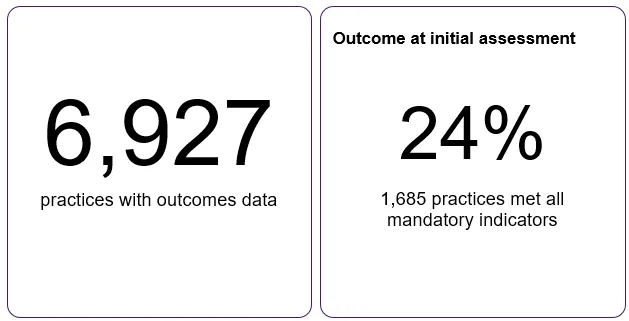
Number of Australian general practices with assessment outcomes data to the RACGP Standards for general practices (5th edition) by state and territory, and practice type.
| Practice type | NSW | VIC | QLD | SA | WA | TAS | NT | ACT | Total |
|---|---|---|---|---|---|---|---|---|---|
| General practice | 2,184 | 1,722 | 1,387 | 428 | 657 | 132 | 56 | 100 | 6,666 |
| Aboriginal Medical Service | 56 | 24 | 62 | 17 | 24 | 6 | 70 | 2 | 261 |
| Total | 2,240 | 1,746 | 1,449 | 445 | 681 | 138 | 126 | 102 | 6,927 |
To view the accreditation status of a general practice or Aboriginal Medical Service, view the Commission's Register of accredited general practices and Aboriginal Medical Services or the Register of registered general practices and Aboriginal Medical Services.
A repeat assessment is required when a general practice has 20% or more mandatory indicators rated ‘not met’ following the initial routine assessment. This ensures the general practice has fully embedded all the changes that were implemented to meet all mandatory indicators when it was awarded accreditation. Full requirements of a repeat assessment are stipulated in Advisory GP23/03: Standardised repeat assessment of general practices.
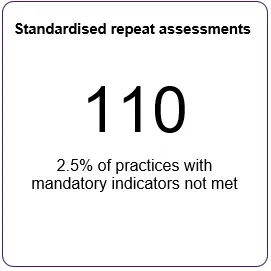
Standardised repeat assessments have been implemented from 1 January 2024.
Indicators where improvements were required before accreditation was awarded
- RACGP Standards for general practices (5th edition)
- Reporting period: April 2023 to August 2026
The assessment outcomes of all 125 indicators of the RACGP Standards for general practices (5th edition) are outlined in the below table. Indicators are ordered from highest to lowest, based on the number of general practices that did not meet them at the initial routine assessment.
Indicators | Description | Not met |
|---|---|---|
| GP3.1A | Qualifications, education and training of healthcare practitioners | 2,065 |
| C3.5B | Work health and safety | 1,554 |
| QI2.1B | Health summaries | 1,532 |
| C8.1B | Education and training of non-clinical staff | 1,182 |
| GP3.1C | Qualifications, education and training of healthcare practitioners | 1,162 |
| QI1.2B | Patient feedback | 1,011 |
| QI1.2C | Patient feedback | 919 |
| C6.4D | Information security | 785 |
| C3.1C | Business operation systems | 783 |
| QI3.1A | Managing clinical risks | 733 |
| GP6.1C | Maintaining vaccine potency | 728 |
| QI1.2A | Patient feedback | 726 |
| GP5.3A | Doctor’s bag | 726 |
| QI2.2E | Safe and quality use of medicines | 719 |
| QI3.1B | Managing clinical risks | 675 |
| GP5.2B | Practice equipment | 661 |
| GP5.2A | Practice equipment | 654 |
| C7.1C | Content of patient health records | 571 |
| C8.1A | Education and training of non-clinical staff | 570 |
| GP6.1B | Maintaining vaccine potency | 563 |
| GP4.1A | Infection prevention and control, including sterilisation | 557 |
| C3.2B | Accountability and responsibility | 551 |
| C1.1A | Information about your practice | 509 |
| C6.4E | Information security | 504 |
| C3.2D | Accountability and responsibility | 482 |
| GP4.1D | Infection prevention and control, including sterilisation | 439 |
| C7.1G | Content of patient health records | 434 |
| GP1.3B | Care outside of normal opening hours | 363 |
| GP2.2B | Follow-up systems | 362 |
| C7.1B | Content of patient health records | 342 |
| C2.1E | Respectful and culturally appropriate care | 341 |
| C6.3A | Confidentiality and privacy of health and other information | 328 |
| C3.2E | Accountability and responsibility | 323 |
| GP2.2E | Follow-up systems | 322 |
| QI1.3B | Improving clinical care | 320 |
| GP2.3B | Engaging with other services | 318 |
| GP6.1D | Maintaining vaccine potency | 317 |
| C3.1A | Business operation systems | 303 |
| GP4.1B | Infection prevention and control, including sterilisation | 301 |
| GP2.2A | Follow-up systems | 300 |
| QI1.1C | Quality improvement activities | 290 |
| C3.3A | Emergency response plan | 276 |
| C3.2C | Accountability and responsibility | 269 |
| QI1.1D | Quality improvement activities | 259 |
| QI2.1A | Health summaries | 256 |
| GP3.1B | Qualifications, education and training of healthcare practitioners | 252 |
| QI2.2D | Safe and quality use of medicines | 210 |
| C2.2A | Presence of a third party during a consultation | 209 |
| C3.1D | Business operation systems | 204 |
| GP6.1A | Maintaining vaccine potency | 201 |
| QI1.1B | Quality improvement activities | 192 |
| C3.5A | Work health and safety | 188 |
| C3.2A | Accountability and responsibility | 186 |
| C7.1E | Content of patient health records | 185 |
| GP4.1C | Infection prevention and control, including sterilisation | 184 |
| GP5.2E | Practice equipment | 176 |
| GP1.2A | Home and other visits | 172 |
| C1.2A | Communications | 156 |
| C6.4F | Information security | 151 |
| GP1.1C | Responsive system for patient care | 139 |
| C6.4B | Information security | 133 |
| GP5.1C | Practice facilities | 128 |
| QI2.2A | Safe and quality use of medicines | 127 |
| C6.4G | Information security | 111 |
| C1.3B | Informed patient decisions | 108 |
| C6.1A | Patient identification | 98 |
| GP1.3A | Care outside of normal opening hours | 95 |
| C6.3D | Confidentiality and privacy of health and other information | 94 |
| QI2.2C | Safe and quality use of medicines | 94 |
| C3.4C | Practice communication and teamwork | 94 |
| C7.1D | Content of patient health records | 94 |
| C6.3B | Confidentiality and privacy of health and other information | 89 |
| QI1.1A | Quality improvement activities | 84 |
| C6.4C | Information security | 82 |
| C6.3C | Confidentiality and privacy of health and other information | 80 |
| C5.3A | Clinical handover | 79 |
| GP4.1E | Infection prevention and control, including sterilisation | 73 |
| GP2.1B | Continuous and comprehensive care | 73 |
| GP2.2C | Follow-up systems | 62 |
| C3.4A | Practice communication and teamwork | 58 |
| GP5.2D | Practice equipment | 56 |
| C2.1B | Respectful and culturally appropriate care | 52 |
| C1.4A | Interpreter and other communication services | 50 |
| GP5.1F | Practice facilities | 50 |
| C1.4B | Interpreter and other communication services | 45 |
| C6.4A | Information security | 43 |
| QI2.2B | Safe and quality use of medicines | 37 |
| C2.3A | Accessibility of services | 37 |
| C1.5A | Costs associated with care initiated by the practice | 36 |
| GP2.1C | Continuous and comprehensive care | 35 |
| C4.1A | Health promotion and preventive care | 35 |
| GP5.1A | Practice facilities | 32 |
| C5.1B | Diagnosis and management of health issues | 27 |
| C5.1A | Diagnosis and management of health issues | 26 |
| GP2.4B | Transfer of care and the patient–practitioner relationship | 26 |
| C3.4B | Practice communication and teamwork | 25 |
| C6.2B | Patient health record systems | 23 |
| GP2.4A | Transfer of care and the patient–practitioner relationship | 23 |
| C1.3A | Informed patient decisions | 23 |
| GP1.1B | Responsive system for patient care | 21 |
| C6.2A | Patient health record systems | 19 |
| C3.6A | Research | 19 |
| C3.6B | Research | 19 |
| C2.1A | Respectful and culturally appropriate care | 18 |
| GP5.1E | Practice facilities | 17 |
| C2.1C | Respectful and culturally appropriate care | 17 |
| C7.1A | Content of patient health records | 17 |
| C3.6C | Research | 15 |
| GP5.2C | Practice equipment | 14 |
| GP1.1A | Responsive system for patient care | 13 |
| C2.1D | Respectful and culturally appropriate care | 6 |
| GP5.1B | Practice facilities | 5 |
| C1.5B | Costs associated with care initiated by the practice | 5 |
| GP5.1D | Practice facilities | 4 |
| GP2.1A | Continuous and comprehensive care | 2 |
| GP2.3A | Engaging with other services | 1 |
| C5.2A | Clinical autonomy for practitioners | 1 |
Lessons learnt
- Mandatory indicators rated as ‘not met’ are largely consistent across general practices in major city and rural or remote locations
- For the three top indicators rated as ‘not met’, the main reason provided by assessors was ‘documentation not available’ from the general practice during the initial assessment
- Most critical issues identified during the assessment of general practices warranting escalation to healthcare complaints organisations have been in relation to:
- GP4.1 - Infection prevention and control, including sterilisation
- GP6.1 - Maintaining vaccine potency
- GP2.2 - Follow-up systems
- QI2.2 - Safe and quality use of medicines