
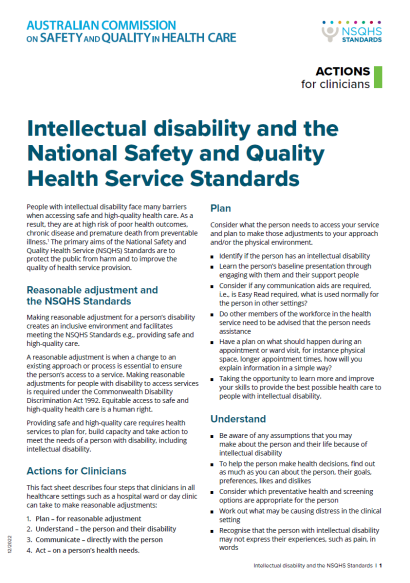
The National Safety and Quality Health Service (NSQHS) Standards support the rights of people with intellectual disability to equitable health care. People with intellectual disability experience significant barriers in accessing safe and quality care evident through a higher mortality rate, increased incidence of preventable illness and more frequent hospital admissions.
In this section, you will find guidance and resources for implementation of the NSQHS Standards, to support healthcare rights and provision of inclusive health care.
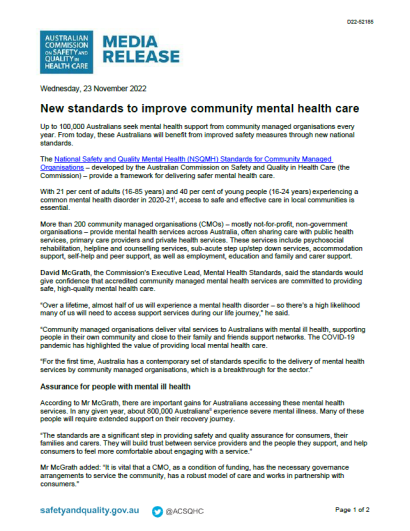
These frequently asked questions provide background on implementation of the National Safety and Quality Mental Health Standards for Community Managed Organisations (NSQMHCMO Standards).
Developing and using shared decision making tools can help clinicians to implement shared decision making in clinical practice.
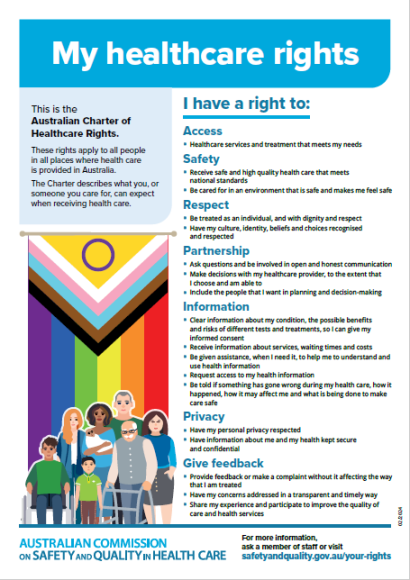
Being actively involved in your health care and working in partnership with your healthcare providers can help ensure that you get the care that is right for you.
Identifying and setting goals of care is an important aspect of shared decision making for consumers, clinicians and health service organisations.
Effective clinical communication with both consumers and colleagues is essential for a collaborative, shared decision making approach to health care.
These case studies highlight the person-centred approaches and strategies used by other Australian and international healthcare organisations, to assist other organisations working to embed person-centred care.
Person-centred care must recognise and respect individual needs, beliefs and culture. Understanding the diversity of consumers seen in your organisation can help you design systems that support staff to better meet their needs.
The principles of person-centred care can help to support patient safety. The communication, culture and systems within healthcare organisations all play a role in fostering patient safety.
Embedding a person-centred approach throughout a healthcare organisation requires the involvement of all staff across various aspects of the patient journey.
Staff wellbeing and teamwork can help to support effective person-centred care. Research shows that patient experiences are better when healthcare staff feel they have a good working environment, low emotional exhaustion, and support from their coworkers and managers.
Evaluation and monitoring are critical aspects of any performance improvement. Evaluation should be conducted to identify areas of need, and ongoing monitoring should measure improvement and assist in the maintenance of standards.
Person-centred care is a way of supporting greater involvement of consumers in health care, which in turn creates better health outcomes. Over the past two decades, person-centred care has become internationally recognised as a dimension of delivering high-quality health care.
Connect with us for the best in person-centred care.
The Network brings together people from Australia and beyond with a shared interest in strengthening the delivery of person-centred care, through peer support and shared learning.
The Commission is hosting a series of free online webinars to highlight the importance of person-centred care for consumers, organisations and healthcare professionals. The webinars will promote successful projects or initiatives that demonstrate practical examples of person-centred care.