
Assessment outcomes data for hospitals
The figures below provide information on the number and percentage of Australian hospitals and day procedure services that have completed assessments to the second edition of the National Safety and Quality Health Service Standards (NSQHS Standards).
The reporting period commenced in January 2019.
The following data includes finalised assessments for all Australian hospitals and day procedure services up to August 2026.
Overview
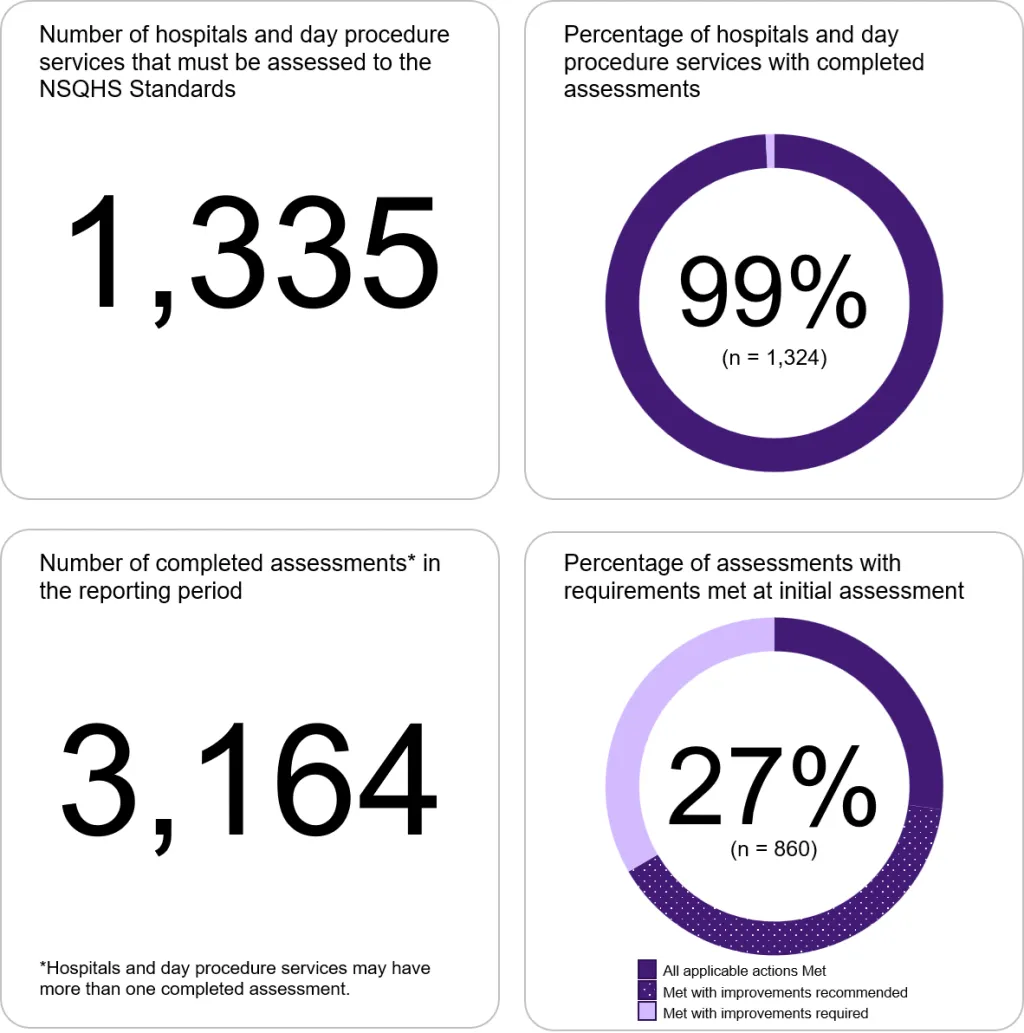
Number of assessments by sector and facility type for each state and territory
| Sector and facility type | NSW | VIC | QLD | SA | WA | TAS | NT | ACT | Other1 | Total |
|---|---|---|---|---|---|---|---|---|---|---|
| Public hospitals | 463 | 359 | 317 | 176 | 207 | 52 | 13 | 14 | 4 | 1,605 |
| Private hospitals | 238 | 163 | 147 | 36 | 57 | 16 | 6 | 15 | - | 678 |
| Day procedure services | 274 | 248 | 148 | 98 | 42 | 28 | 2 | 41 | - | 881 |
| Total | 975 | 770 | 612 | 310 | 306 | 96 | 21 | 70 | 4 | 3,164 |
1Other: Indian Ocean Territories Health Service
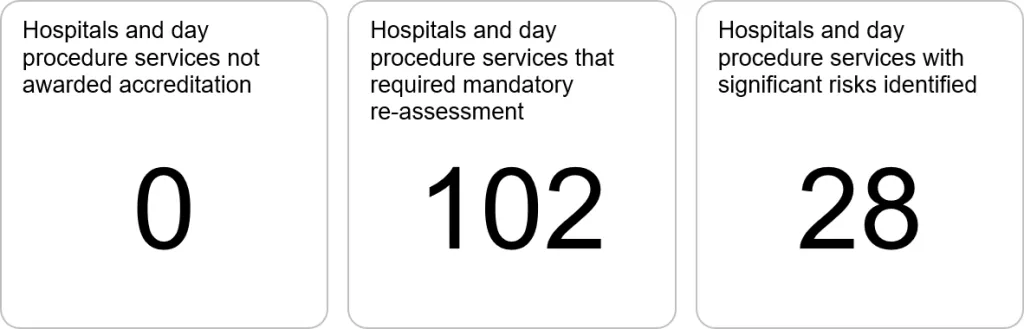
A mandatory re-assessment is required when the outcome of the initial assessment shows a large number of actions in the NSQHS Standards require improvements. Health services must implement improvements to comply with the NSQHS Standards to be awarded accreditation. There is a further assessment to ensure the changes are embedded in the organisation’s daily practice.
Significant risks are notified to the Commission when an assessor identifies a situation that could result in significant harm to patients. These risks must be reported and addressed within 48 hours.
Assessment data by standard
The graph below shows the outcome of the initial assessment by standard. For each standard, the percentage is calculated as the proportion of assessments per rating over total number of assessments.
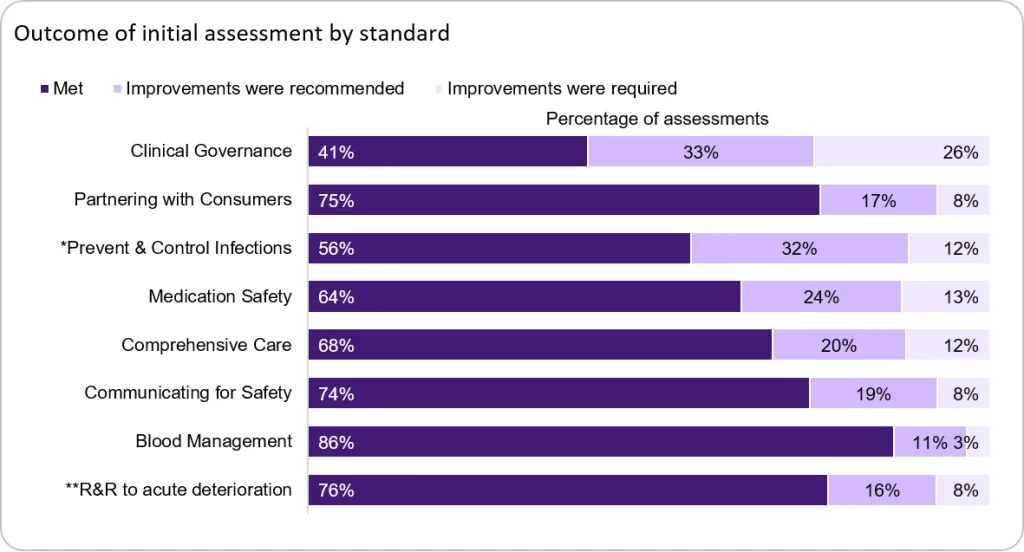
*Preventing and Controlling Infections **Recognising and Responding to Acute Deterioration
What is the rating scale used by assessors?
The NSQHS Standards are made up of 151 actions across the eight Standards. Each action is awarded a rating after assessment. The rating scale is as follows:
| Met | The action was fully met. These actions are represented in dark blue on the bar graphs. |
|---|---|
| Improvements were recommended | The requirements of the action were largely met, with minor improvement recommended. These actions are represented in medium blue on the bar graphs. |
| Improvements required | Part or all of the requirements of the action were not met. Improvements had to be completed before accreditation was awarded. These actions are represented in light blue on the bar graphs. |
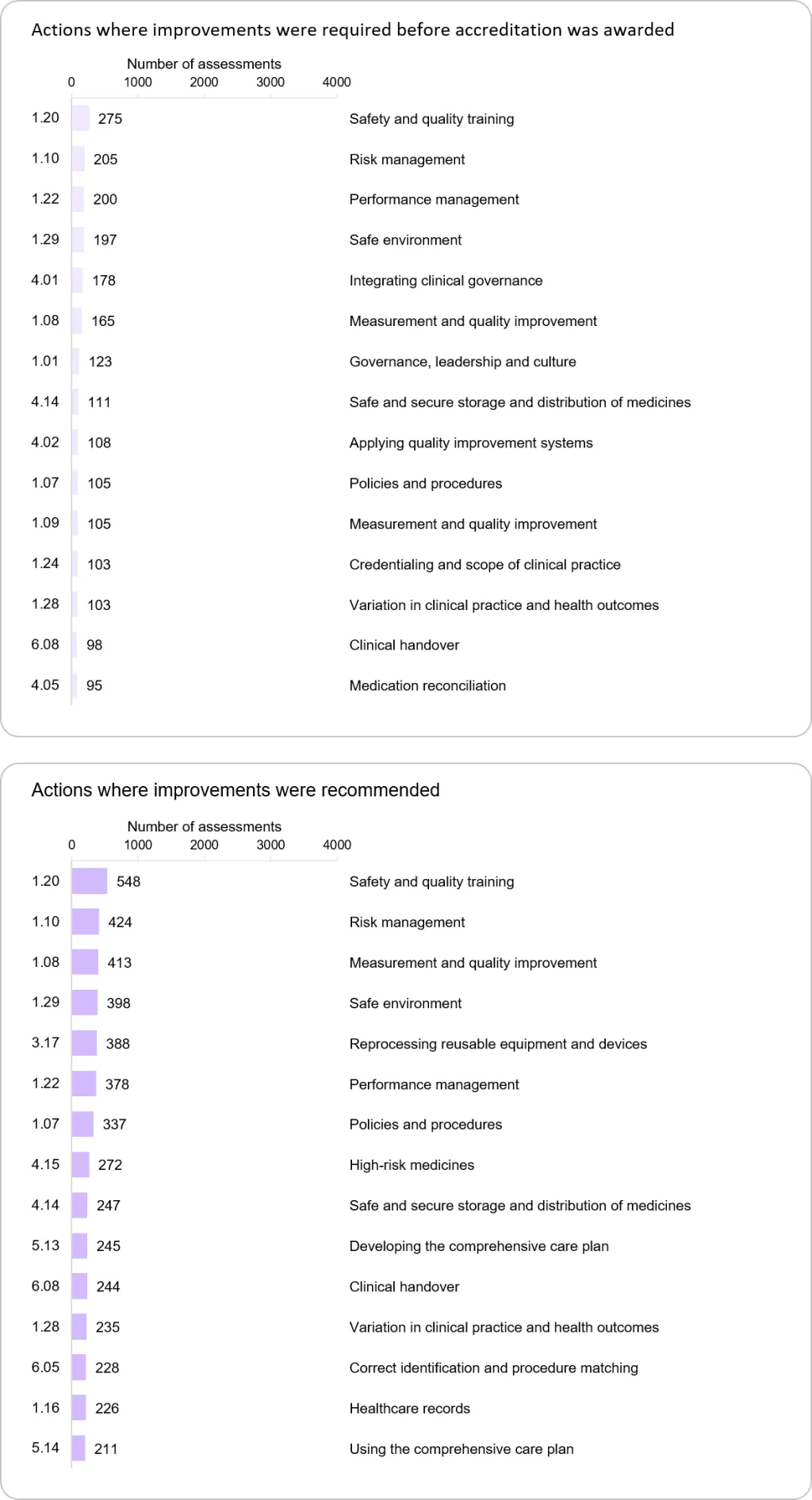
Actions most frequently rated as improvements were required or recommended
Safety in Health Care web tool
You can use our Safety in Health Care web tool to look up a specific hospital and see how well they are meeting the NSQHS Standards and other indicators of safety and quality.