
Safe, appropriate and sustainable use of intravenous fluids
Intravenous (IV) fluids are one of the most common clinical interventions in acute care.
While often essential to patient care, inappropriate initiation, monitoring or continuation can contribute to avoidable patient harm.
We have developed guidance and resources to support safe, appropriate and sustainable use of IV fluids across the patient journey, including pre-procedural fluid management.
These resources can be used by public and private healthcare organisations in the acute sector, as well as health professionals involved in prescribing, administering, monitoring and reviewing IV fluid therapy.
National guidance for IV fluids therapy
Guiding principles for intravenous fluid therapy
The national guidance promotes three guiding principles to support safe IV fluid use throughout the patient journey:
Start appropriate IV fluids only when there is a clear clinical indication.
Stop IV fluids as soon as they are no longer clinically required.
Switch therapies based on clinical response, including modification of IV fluid regimens and timely transition to oral hydration and/or oral medicines as appropriate.
These three guiding principles translate into six practical actions to support safe and appropriate IV fluid use over time.
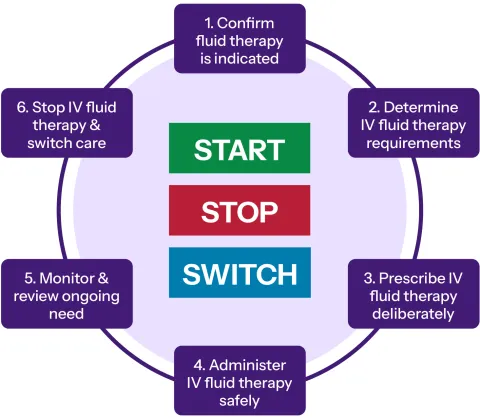
Figure: Diagram explaining the guiding principles for intravenous fluid therapy: Start, Stop Switch. 1. Confirm fluid therapy is indicated. 2. Determine IV fluid therapy requirements. 3. Prescribe IV fluid therapy deliberately. 4. Administer IV fluid therapy safely. 5. Monitor and review ongoing need. 6. Stop IV fluid therapy and switch care.
Avoiding venous air embolism
Venous air embolism (VAE) is a rare but potentially serious complication associated with IV fluid administration.
We have guidance to support health professionals and health service organisations to reduce the risk of VAE through safe administration practices.
Improving pre-procedural fluid management
Unnecessarily prolonged fasting before procedures can contribute to patient discomfort, dehydration and potentially avoidable IV fluid use.
‘Sip Til Send’ is a global initiative, allowing patients to consume small volumes of water (or similar clear liquids) if thirsty, up until they are called to the operating theatre.
‘Sip Til Send’ benefits
Allowing patients to sip clear liquids can significantly reduce fluid fasting times and help improve patient well-being by:
- maintaining hydration
- decreasing light-headedness and anxiety
- decreasing the feelings of thirst
- reducing the incidence of nausea and vomiting
- reducing the subsequent need for IV fluids.
National ‘Sip Til Send’ guidance
Our national guidance on Improving pre-procedural fluid management: Using the practice of ‘Sip Til Send ‘has been informed by a literature review and environmental scan and developed with expert clinical oversight and stakeholder input.
It is accompanied by implementation resources to support local adoption by health service organisations.
Health service organisations can use the guidance to:
- plan and implement 'Sip Til Send' where it is not currently in place
- review and strengthen existing pre procedural oral liquid intake practices.

National 'Sip Til Send' fact sheet
Improving pre-procedural fluid management: Using the practice of ‘Sip Til Send’
Implementation support resources for local adoption
The national ‘Sip Til Send’ guidance has been endorsed by:

Australian and New Zealand College of Anaesthetists


Additional resources
- Safer Care Victoria: Sip Til Send fluid fasting guidance
- Agency for Clinical Innovation, NSW Health: FACT SHEET – Preoperative fasting
- The Royal Children’s Hospital Melbourne: Fasting for general anaesthesia
- The Children's Hospital at Westmead: Fasting guideline for children having general anaesthesia
- Australian and New Zealand College of Anaesthetists
Development of the guidance
We developed these resources with input from the IV Fluids Expert Advisory Group and targeted consultation with clinicians, health service organisations, jurisdictions, professional colleges and peak bodies from across Australia.
The guidance was informed by expertise in:
- anaesthesia and perioperative care
- clinical governance
- critical care
- emergency medicine
- medicines safety
- nursing and midwifery
- paediatrics
- paramedicine
- pharmacy
- public and private healthcare services